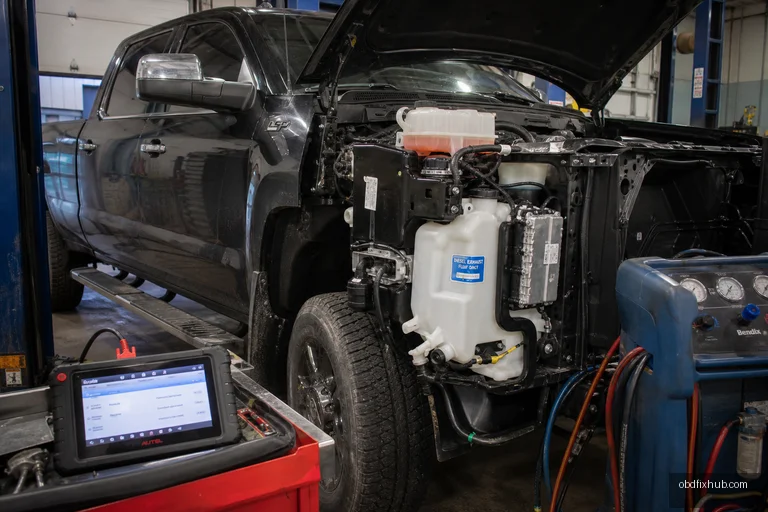
P2059 means the engine control module has detected an open or faulty control circuit for the reductant injection air pump. On diesel vehicles equipped with a selective catalytic reduction (SCR) system, this pump supplies compressed air or assists reductant delivery to the DEF injector. The code is usually caused by a failed pump, blown fuse, poor connector, damaged wiring, or a control-side problem—not automatically by a bad DEF pressure sensor.
This is an informational diagnostic search: the safest repair begins with circuit testing and confirmation of the vehicle manufacturer’s wiring diagram. Replacing the pump immediately can be expensive and may miss a simple power, ground, relay, or harness fault.
What Does P2059 Mean?
P2059 is an OBD-II trouble code defined as Reductant Injection Air Pump Control Circuit/Open. The exact wording can vary slightly by manufacturer, but the underlying issue is the same: the ECM cannot see the expected electrical response from the air pump circuit.
The reductant system uses diesel exhaust fluid, commonly called DEF or AdBlue, to reduce nitrogen oxide emissions in the SCR catalyst. Depending on the vehicle design, an air pump may provide atomizing air for the injector or support pressure control inside the reductant delivery module. If the ECM commands the pump on but detects an open circuit, abnormal current, or no operational feedback, it stores P2059.
This code is not the same as a general engine air-injection fault. It belongs to the aftertreatment and DEF system, so the pump, wiring, pressure sensor, injector, heater, and reductant control module must be considered together.
P2059 Symptoms You May Notice
A vehicle can still drive normally when P2059 first appears, particularly if the system has not yet failed an emissions verification test. However, continued operation may trigger a warning message or a speed limitation strategy.
- Check Engine Light or service emissions warning
- “DEF quality,” “reductant system,” or “exhaust fluid” message
- Reduced engine power or limited vehicle speed
- DEF countdown, including a potential no-start warning
- Hard starting or no start after the countdown expires
- Higher emissions and possible SCR efficiency faults
- A pump that does not run during a commanded test
- Unusual clicking, buzzing, or complete silence from the reductant module
There may be no obvious drivability symptom because the fault concerns emissions equipment rather than fuel or ignition control. A quiet pump alone does not prove failure; the ECM may not be commanding it because another related fault has already disabled the system.
Common Causes of the P2059 Code
1. Failed reductant injection air pump
The pump motor can wear out, seize from contamination, or develop an internal open circuit. DEF crystallization around the delivery system can also increase operating load and shorten pump life. A pump that draws excessive current may blow its fuse, creating both a pump fault and a circuit-open code.
2. Blown fuse or defective relay
Many P2059 diagnoses begin with a fuse or relay inspection. A replacement fuse that fails again is not a repair; it indicates a shorted pump, damaged wiring, or an overloaded circuit. Always use the correct fuse rating and check the service information before bypassing a relay.
3. Damaged wiring or corroded connectors
The harness is often routed near the exhaust, frame, or DEF tank, where heat, road salt, vibration, and moisture can cause trouble. Look for rubbed insulation, green corrosion, loose terminals, pushed-out pins, and DEF crystals inside the connector. A visual inspection should be followed by a voltage-drop test because a wire can look intact while failing under load.
4. Poor ground or power supply
A weak ground may allow the pump to operate intermittently but prevent the ECM from recognizing correct current or speed feedback. Test voltage at the pump connector while the pump is commanded on; checking only battery voltage with the connector unplugged can produce a misleading result.
5. Reductant control module or ECM fault
Module failure is less common than wiring and pump problems. It should be considered only after confirming the power supply, grounds, communication network, control signal, and pump resistance. Software updates may also apply on some models, so manufacturer service bulletins are worth checking before replacing a control module.
How to Diagnose P2059 Correctly
Professional diagnosis is more than clearing the code and seeing whether it returns. The following sequence avoids unnecessary parts replacement:
- Record all stored codes and freeze-frame data. Codes relating to reductant pressure, injector performance, heater circuits, or communication may identify the original failure.
- Check DEF condition and level. Contaminated, diluted, expired, or crystallized DEF can create secondary system faults. Do not add water or aftermarket additives to the tank.
- Inspect the fuse, relay, connectors, and harness. Pay special attention to areas close to the exhaust and reductant tank.
- Verify power and ground under load. Use a multimeter or test light while the pump is commanded on. A voltage-drop test should generally show very low loss across the positive and ground sides; compare with manufacturer specifications.
- Use a scan tool with bi-directional controls. Command the reductant air pump on and listen for operation. Monitor commanded state, current, pressure, and feedback if those data items are available.
- Test the pump itself. Measure resistance only against the manufacturer’s specification. If approved by the service manual, apply fused battery power briefly to confirm whether the motor runs, but do not bypass the control module on systems that require electronic regulation.
- Check reductant pressure and injector operation. An air pump may run correctly while a blocked line, leaking injector, or pressure sensor problem creates a related code.
- Clear the codes and complete the required drive cycle. Some SCR systems need a service regeneration, reductant dosing test, or specific temperature conditions before the repair monitor will run.
A useful workshop clue is the difference between an electrical open and a mechanical restriction. If the pump has correct power and ground but no current draw, suspect an internal open motor. If it draws excessive current and the fuse opens, suspect a seized pump or a restriction. If it runs but pressure is wrong, inspect the air line, injector, pressure sensor, and reductant module rather than condemning the pump immediately.
What Is Reductant Pressure Too High?
“Reductant pressure too high” means the measured DEF or atomizing-air pressure exceeds the range expected by the control module. Depending on the vehicle, this may be caused by a blocked injector, restricted return path, stuck valve, faulty pressure sensor, crystallized DEF, kinked line, or a control problem that keeps the pump running too long.
High pressure is not proof that the pump is healthy. A pump can produce excessive pressure because flow is blocked downstream. Conversely, a pressure sensor that reports an artificially high value can trigger a pressure code even when actual pressure is normal. Confirm the reading with scan data, a mechanical test procedure where specified, and the manufacturer’s pressure limits.
Can a Bad Sensor Cause a P204F Code?
Yes, a bad sensor can contribute to P204F, but it is not the only possible cause. P204F generally indicates reductant system performance, which is a broad system-level fault. A defective DEF pressure sensor, temperature sensor, quality sensor, NOx sensor, or dosing feedback signal can cause the ECM to believe the SCR system is not working correctly.
However, P204F can also result from incorrect DEF, a blocked injector, low reductant pressure, wiring damage, an exhaust leak, poor NOx conversion, or a catalyst problem. Diagnose the supporting codes and live data before replacing a sensor. P2059 and P204F appearing together may mean the air pump fault is preventing correct dosing rather than proving that a sensor has failed.
How Do I Know If My Air Pump Is Bad?
Do not rely on sound alone. A bad reductant air pump typically has no operation during an active test, fails to receive or deliver the correct voltage, shows an abnormal current draw, or cannot reach the specified pressure despite good wiring and a functioning control command.
Listen for a brief buzz or motor sound during a scan-tool test, but remember that some systems operate only under specific temperature and dosing conditions. A pump that runs continuously, blows the fuse, runs loudly, or produces unstable pressure also requires attention. Confirm the diagnosis by testing the pump with the connector, wiring, pressure path, and control module checked.
P2059 Repair Options and Typical Cost Factors
The repair depends on what failed. A corroded terminal or broken wire may be repaired inexpensively, while a complete reductant delivery module or integrated pump can be considerably more costly. On some diesel vehicles, the air pump is serviced separately; on others, it is part of the DEF tank or dosing assembly.
- Repair or replace damaged wiring and terminals
- Replace a failed fuse or relay only after finding the underlying cause
- Replace the reductant air pump or delivery module
- Clean or replace a DEF injector when crystallization is confirmed
- Repair a leaking, kinked, or blocked air or reductant line
- Update or replace a control module only after circuit tests pass
After repair, the vehicle may need a code-clear procedure, reductant system priming, pressure test, and drive cycle. If a DEF countdown remains on the dashboard, clearing P2059 with a generic scanner may not reset the manufacturer’s inducement system; follow the factory service procedure.
Can You Drive With P2059?
Short-distance driving may be possible if the vehicle runs normally, but postponing the repair is risky. Some diesel vehicles gradually reduce speed or prevent restarting once the SCR fault remains active. If the warning says the vehicle will not start, arrange diagnosis before the countdown reaches zero, especially before a long trip.
Frequently Asked Questions
What are the symptoms of a bad air injection pump?
Typical symptoms include an emissions warning, reductant system message, pump noise or silence during an active test, incorrect DEF pressure, reduced power, and a DEF no-start countdown. The engine may otherwise feel normal at first.
Is P2059 always caused by a failed pump?
No. Open wiring, poor grounds, corroded connectors, a failed fuse or relay, control-module problems, and a restricted dosing system can all produce P2059.
Can I clear P2059 without repairing it?
You can erase the code temporarily, but it will usually return when the ECM repeats its reductant system test. Some vehicles will also retain a DEF inducement countdown until the fault is repaired and the required drive cycle is completed.
Should I replace the DEF pressure sensor with the pump?
Not automatically. Test the pump command, circuit voltage, ground, actual pressure, and sensor data first. Replacing both parts without testing can leave the original wiring or restriction problem unresolved.
Bottom line: P2059 points to an electrical or control problem involving the reductant injection air pump. Start with codes, fuses, connectors, power, ground, and a bi-directional pump test; then verify pressure and dosing performance before approving expensive parts. Correct diagnosis protects the SCR system and prevents a minor wiring fault from becoming a no-start event.




