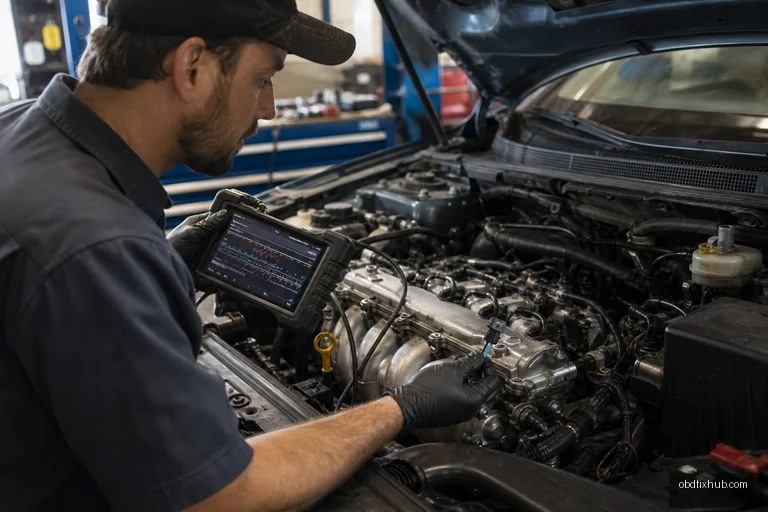
The P2340 code means the engine computer has detected knock or abnormal combustion vibration above its programmed limit on cylinder 5. Do not assume the knock sensor itself has failed: the code can be triggered by genuine detonation, an ignition or fuel problem, damaged wiring, or a sensor that is no longer reading accurately. Short, gentle driving may be possible when the engine runs normally, but heavy acceleration should be avoided until the cause is identified.
What Does P2340 Mean?
P2340 is an OBD-II diagnostic trouble code generally defined as Cylinder 5 Above Knock/Combustion Vibration Threshold. The powertrain control module, or PCM, monitors a piezoelectric knock sensor mounted to the engine block. That sensor listens for high-frequency vibration associated with detonation and abnormal combustion.
When the signal from cylinder 5 repeatedly exceeds the manufacturer’s calibrated threshold, the PCM stores P2340. The exact wording and testing strategy can vary between manufacturers, so the vehicle-specific service manual remains the final authority. On some engines, one sensor monitors several cylinders; on others, separate sensors cover different banks or cylinder groups.
Common Symptoms of a P2340 Code
Some vehicles show only a check engine light, while others develop noticeable drivability problems. The severity depends on whether the PCM is seeing a false vibration signal or protecting the engine from real detonation.
- Illuminated check engine light, sometimes with a flashing light during severe misfire
- Reduced engine power or a failsafe mode
- Pinging, rattling, or metallic knocking under load
- Hesitation during acceleration, especially uphill
- Rough running or intermittent misfire
- Reduced fuel economy
- Hard starting or unstable idle when another fault is present
A short metallic rattle when accelerating from low rpm is especially important. It may be genuine spark knock rather than a defective sensor. Continuing to load an engine that is detonating can damage pistons, ring lands, bearings, or the cylinder head.
What Causes P2340?
1. Genuine detonation or abnormal combustion
The most serious possibility is real knock in cylinder 5. Causes include low-octane fuel, excessive carbon buildup, an overheating engine, incorrect ignition timing, a lean air-fuel mixture, excessive boost, or a combustion chamber problem. A fuel injector that is partially restricted can make one cylinder run lean enough to knock while the remaining cylinders appear normal.
2. Failing knock sensor
Aging, heat-soaked, cracked, or internally damaged knock sensors can produce an implausible signal. Some sensors become less sensitive; others generate noise that the PCM interprets as excessive combustion vibration. A sensor that was overtightened is also suspect because piezoelectric sensors require a specified mounting torque to work correctly.
3. Wiring and connector faults
Oil contamination, corrosion, broken shielding, loose terminals, and wiring routed too close to ignition coils can corrupt the low-voltage knock signal. Harness damage is common after engine repairs, especially when a loom has been trapped against a bracket or exhaust component.
4. Other engine or sensor faults
A P2340 code can be secondary to another problem. A vacuum leak, failing mass-airflow sensor, fuel-pressure issue, injector fault, EGR problem, incorrect engine coolant temperature reading, or a misfire can create abnormal combustion or vibration. Mechanical noise from a loose heat shield, valvetrain, accessory, or exhaust component may also confuse the knock detection system.
How Do You Know If the Knock Sensor Is Going Bad?
A bad knock sensor cannot be confirmed from the trouble code alone. The strongest clues are an implausible sensor signal, visible damage, wiring that passes continuity and insulation checks poorly, or a fault that follows the sensor when components are swapped according to the manufacturer’s procedure.
On many vehicles, the sensor’s resistance specification is not enough to prove its condition. A sensor can measure within a basic resistance range and still produce a weak or noisy output under vibration. A technician may need a scan tool, oscilloscope, wiring diagram, and manufacturer-specific signal tests to separate a sensor fault from real detonation.
How to Diagnose P2340 Correctly
- Record the freeze-frame data. Note engine speed, load, coolant temperature, throttle position, fuel trims, and vehicle speed. P2340 occurring only at high load points toward real combustion stress; a code appearing at idle suggests vibration, wiring, or another engine fault.
- Scan for related codes. Misfire codes, lean codes, fuel-pressure codes, camshaft timing codes, and other knock-sensor codes may identify the primary problem.
- Inspect the engine and harness. Check the sensor connector, shielding, grounds, engine mounts, exhaust shields, and areas disturbed by recent repairs. Look for oil intrusion and wiring pulled tight across the block.
- Check basic engine health. Verify fuel quality, cooling-system operation, ignition components, fuel pressure, injector balance, and air leaks. Compare cylinder 5 with the other cylinders where possible.
- Test the sensor circuit. Follow the wiring diagram rather than applying a generic resistance test. Check reference or signal circuits, ground integrity, continuity under movement, and unwanted voltage or short-to-ground conditions.
- Confirm the repair. Clear the codes and repeat the conditions shown in the freeze frame. A repair is not proven until P2340 stays away during a controlled road test or manufacturer-defined drive cycle.
One practical diagnostic mistake is replacing the sensor before checking ignition and fueling. If cylinder 5 has a weak coil, incorrect plug gap, injector imbalance, or a compression problem, a new knock sensor may only hide the symptom temporarily—or fail to change it at all.
Can You Still Drive With a Bad Knock Sensor?
Sometimes, but only cautiously and for a short distance to a repair facility. If the engine is quiet, the check engine light is steady, coolant temperature is normal, and there is no severe loss of power, gentle driving may be reasonable. Keep engine speed and load low, avoid towing and hard acceleration, and use the correct fuel specified for the vehicle.
Stop driving and arrange recovery if the check engine light flashes, the engine is knocking loudly, the vehicle misfires, overheats, smells strongly of fuel, or enters a severe reduced-power mode. A failed knock sensor can prevent the PCM from responding correctly to detonation, while genuine knock can cause expensive internal engine damage.
Is It Urgent to Replace a Knock Sensor?
It is not always an emergency repair, but it should not be ignored. A knock sensor allows the PCM to reduce ignition advance when combustion becomes unsafe. With an inaccurate signal, the engine may run with too much timing, lose performance because timing is excessively retarded, or continue operating with an unresolved mechanical problem.
Urgency increases when P2340 returns under load, when the vehicle has forced induction, when fuel trims are abnormal, or when there are accompanying misfire and overheating symptoms. A sensor replacement is relatively straightforward on some engines but may require intake-manifold or other component removal on engines where the sensor is buried in the valley.
Repair Options and Typical Cost Factors
The correct fix depends on the confirmed cause. Repairs may include replacing a knock sensor, repairing shielded wiring, cleaning or replacing a connector, correcting fuel pressure, replacing an injector or ignition component, removing carbon deposits, repairing a vacuum leak, or addressing a mechanical engine fault.
- Knock sensor replacement: Parts and labor vary widely by engine access and sensor location.
- Harness repair: Usually less expensive than major engine work, but signal shielding and routing must be restored correctly.
- Fuel or ignition repair: The final cost depends on whether one component or a broader system problem caused the knock.
- Internal engine diagnosis: Compression, leak-down, timing, or borescope testing may be needed when the code persists with good sensor wiring.
Use an OE-quality sensor or a reputable equivalent and follow the specified torque exactly. Over-tightening, using the wrong sensor design, or mounting it on a dirty or damaged surface can create a repeat fault even when the wiring is perfect.
Bottom Line: Fix the Cause, Not Just the Code
P2340 is a warning about excessive combustion vibration on cylinder 5, not automatic proof that the knock sensor is defective. Begin with freeze-frame data, related trouble codes, fuel and ignition checks, and a careful wiring inspection. If the engine is knocking, misfiring, overheating, or flashing the check engine light, stop driving; otherwise, arrange a prompt diagnosis and avoid heavy load until the fault is resolved.
Frequently Asked Questions
What else can throw a knock sensor code?
Low-quality fuel, lean operation, a failing injector, ignition misfire, carbon buildup, overheating, incorrect timing, wiring damage, engine vibration, and loose exhaust or accessory components can all trigger a knock-related code.
Can a bad spark plug cause P2340?
Yes. An incorrect plug gap, wrong heat range, damaged insulator, or poor ignition connection can cause abnormal combustion or misfire-related vibration. Inspect cylinder 5’s plug and coil, but do not assume they are the only possible cause.
Is P2340 always caused by cylinder 5?
Not necessarily. The code identifies the cylinder or cylinder group used by the vehicle’s monitoring strategy. Because one sensor may serve multiple cylinders, a wiring, sensor, or engine-wide issue can set a cylinder-specific code.
Will clearing P2340 fix the problem?
No. Clearing the code only resets the diagnostic memory. If the underlying knock, wiring fault, or sensor problem remains, the code will return—often when the engine reaches the same load and temperature conditions recorded in the freeze-frame data.




