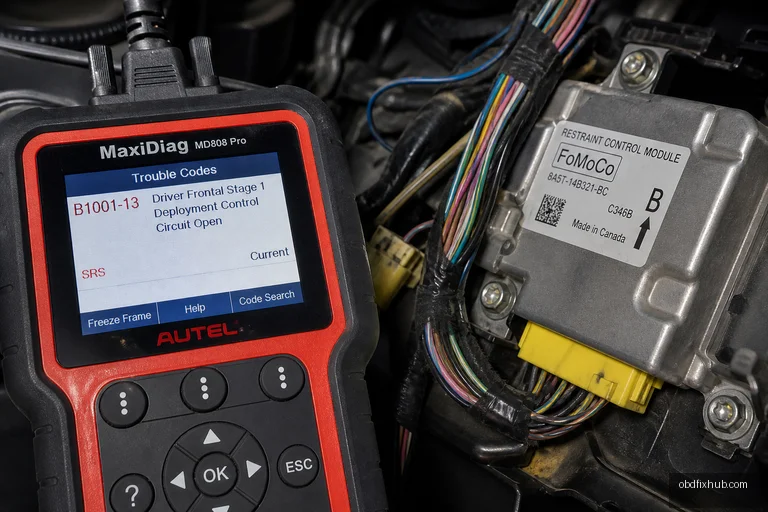
P2512 Event Data Recorder Request Circuit Open means the vehicle has detected an electrical problem in the circuit used to request or communicate with the Event Data Recorder (EDR). In most cases, this is a wiring, connector, power, ground, or module-communication fault—not proof that the recorder itself has failed. Because the EDR may be integrated with the airbag or restraint control system, accurate testing matters more than simply clearing the code.
What Does P2512 Mean?
The EDR stores selected vehicle data around a significant crash event, such as speed, brake application, seat belt status, and airbag deployment information. It is not normally a live video or audio recorder. The exact circuit design varies by manufacturer: some vehicles use a dedicated request wire, while others route the request through a restraint module or vehicle network.
The word “open” indicates that the control module sees an interrupted or electrically incomplete circuit. A broken conductor, loose terminal, corroded connector, missing power supply, poor ground, or an internal module fault can all produce the same diagnostic trouble code. Always confirm the vehicle-specific wiring diagram before testing individual pins.
Common Causes of P2512
- Broken, stretched, or pinched wiring near the EDR, airbag module, dashboard, or center console.
- A connector that is not fully locked after interior, seat, audio, or collision repairs.
- Corrosion, water intrusion, or pushed-back terminals inside a restraint-system connector.
- Low system voltage caused by a weak battery, poor battery connection, or charging problem.
- A blown fuse supplying the restraint control module or related communication circuit.
- Network communication faults between the powertrain, body, and restraint modules.
- An incorrectly installed aftermarket alarm, remote starter, dash camera, or tracking device.
- An internal failure in the restraint control module, EDR assembly, or another module that manages the request.
A useful real-world clue is timing. If P2512 appeared immediately after seat removal, carpet work, a battery replacement, water exposure, or an accident repair, inspect that area before condemning an expensive control module.
Symptoms You May Notice
P2512 may cause few or no drivability symptoms because EDR operation is not normally required to run the engine. The malfunction indicator lamp may be illuminated, and a scan tool may show the code as current, pending, or stored.
- An airbag or SRS warning light may be on, depending on the vehicle’s architecture.
- Other communication or restraint-system codes may appear at the same time.
- A scan tool may be unable to access the airbag or EDR-related module.
- Crash-data retrieval or event-recording functions may be unavailable.
- The vehicle may pass a basic road test while still having a serious diagnostic fault.
Do not assume the vehicle is unsafe to drive solely because P2512 is stored, but do take an SRS warning seriously. If the airbag light is on, the restraint system may not function as designed in a collision.
How to Diagnose P2512 Correctly
- Scan every module. Use a capable diagnostic tool rather than a basic code reader. Record all codes, module names, freeze-frame data, and whether P2512 is current or history.
- Check the battery and charging system. Low voltage can create misleading communication faults. Inspect battery terminals and verify charging voltage according to the manufacturer’s specifications.
- Inspect related fuses. Test both sides of each fuse with a meter or test light; visual inspection alone can miss a poor fuse connection or loss of power under load.
- Follow the wiring diagram. Identify the EDR request circuit, its power source, ground points, connectors, and module pins. Do not guess based on connector color alone.
- Perform a visual and mechanical inspection. Look for chafing, water marks, aftermarket splices, loose locks, bent terminals, and wiring trapped under seat rails or trim panels.
- Test continuity and voltage only as specified. A circuit can show continuity with no load yet fail when current flows. Voltage-drop testing is often more informative than a simple resistance check.
- Check network communication. If multiple modules report lost communication, the root cause may be a CAN-bus power, ground, or termination issue rather than the EDR circuit itself.
Never probe yellow SRS connectors with a test light, incandescent bulb, or ordinary ohmmeter unless the service procedure explicitly permits it. Disconnecting the battery does not automatically make every restraint circuit safe, and waiting times vary by manufacturer. Follow the factory disable procedure.
How to Fix P2512
The repair depends on the failed point. A damaged wire should be repaired with the correct automotive splice method and protected against future chafing. Loose or corroded terminals may require terminal replacement rather than simply spraying cleaner and reconnecting the plug.
If a fuse repeatedly fails, find the short before installing another fuse. If voltage and grounds are correct but the module will not communicate or the code returns immediately, module testing, software configuration, or replacement may be required. Some restraint modules also require initialization, calibration, or crash-data handling after replacement; this is not a normal plug-and-play repair.
After the repair, clear codes with a tool that can access the affected module, cycle the ignition, and rescan all systems. Confirm that the SRS warning lamp performs its normal bulb check and then turns off. A road test alone is not proof that the fault is fixed.
Is P2512 Safe to Ignore?
Ignoring a stored code can leave event data unavailable and may hide a broader restraint or communication problem. If there is an active airbag light, visible crash damage, water intrusion, or several module communication codes, arrange professional diagnosis promptly. Avoid buying an EDR or airbag module based only on this code; wiring faults are usually cheaper and more common.
What Is a Good Website for Fixing Things?
For vehicle-specific repairs, the best source is usually the manufacturer’s official service information because it provides the correct wiring diagrams, connector views, safety procedures, and module programming requirements. iFixit can be helpful for general repair guides and disassembly techniques, while parts-focused websites can help identify components. For P2512 specifically, however, a generic repair website is not a substitute for the factory service manual and a scan tool that can communicate with SRS and body modules.
Frequently Asked Questions
Can a weak battery cause P2512?
Yes. Low voltage or a poor battery connection can interrupt module communication and create an open-circuit or network-related code. Test battery condition and charging voltage before replacing components.
Will clearing P2512 fix the problem?
Clearing the code only removes the stored fault temporarily. If the circuit remains open or communication is still unreliable, P2512 will return, often as a current or pending code.
Does P2512 mean the airbag module must be replaced?
No. Inspect fuses, power, grounds, connectors, wiring, and network communication first. Module replacement should be considered only after those tests meet the manufacturer’s specifications.
Can I test the EDR circuit myself?
Basic visual inspection is reasonable, but restraint-system circuits require special precautions. Do not probe airbag connectors casually; use the factory procedure or have an SRS-qualified technician perform the electrical tests.
Practical Next Step
Record every related code, verify battery voltage, and inspect wiring disturbed by recent repairs before ordering an EDR or airbag module. If P2512 is accompanied by an SRS warning or multiple communication faults, use the manufacturer’s wiring diagram or consult a qualified restraint-system specialist for a safe, module-level diagnosis.




