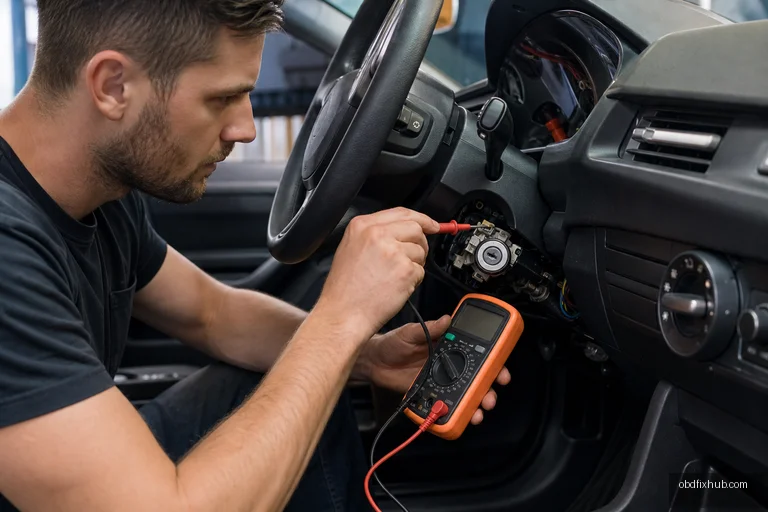
P2530 means the vehicle’s powertrain control module (PCM) is not receiving a reliable “RUN” position signal from the ignition switch circuit. The fault may come from a worn ignition switch, low battery voltage, a blown fuse, damaged wiring, poor connector tension, or a problem in the body or powertrain control module. Although the code may not stop the engine immediately, it can cause stalling, no-start conditions, loss of accessories, or intermittent electrical failures.
What Does P2530 Mean?
The ignition switch does more than control the starter. In the RUN position, it distributes switched battery voltage to systems that must remain active while the engine operates, including the engine computer, ignition system, fuel controls, gauges, and emissions equipment.
When the PCM sets P2530 Ignition Switch Run Position Circuit, it has detected that the expected RUN signal is missing, too low, intermittent, or inconsistent with other ignition signals. On some vehicles, the switch sends power directly; on others, it sends a low-current signal to a body control module, which then commands relays and power feeds.
That difference matters. A vehicle-specific wiring diagram and service information are essential because the same generic code can involve different terminals, fuses, relays, and modules on different makes and models.
Common Symptoms of P2530
The symptoms depend on whether the RUN circuit has failed completely or is dropping out briefly. Intermittent faults are particularly common when the ignition switch has worn internal contacts.
- Engine cranks but does not start
- Engine stalls while driving and may restart after the key is cycled
- Check Engine Light or other warning lights
- Instrument cluster, radio, blower motor, or accessories switching off
- Loss of communication with a scan tool or multiple control modules
- Intermittent no-crank or delayed starting
- Battery discharge after unusual module behavior
- Other ignition-related trouble codes stored at the same time
A useful real-world clue is a cluster that resets as though the battery had been disconnected. If the engine, dashboard, and accessories all lose power together, investigate the ignition feed, main grounds, and battery connections before replacing individual components.
What Causes the P2530 Code?
1. Worn ignition switch contacts
Mechanical ignition switches carry substantial current over many years. The internal contacts can become burned, pitted, or loose. A heavy key ring can accelerate wear by pulling on the lock cylinder and switch actuator, especially on vehicles where the electrical switch is mounted behind the cylinder.
2. Low battery voltage or poor battery connections
Low system voltage can make the RUN signal appear invalid to the PCM. Check battery voltage before condemning the switch: a healthy, fully charged battery is typically around 12.6 volts with the engine off, while a running charging system commonly produces approximately 13.5 to 14.8 volts. Exact specifications vary, so use the manufacturer’s data when available.
3. Blown fuse, defective relay, or overloaded circuit
A fuse labeled IGN, RUN, ECM, PCM, or similar may supply the circuit. Do not simply replace a repeatedly blown fuse with a larger one. A shorted wire, failed relay, aftermarket accessory, or damaged module may be pulling excessive current.
4. Damaged wiring or loose terminals
Wiring near the steering column can be strained, pinched, or damaged during previous repairs. A terminal may look connected but fail under vibration. Corrosion, heat discoloration, and loose female terminals deserve close inspection.
5. Fault in the body control module or PCM
Module failure is possible, but it should be considered only after power, ground, fuses, relay operation, wiring continuity, and signal integrity have been verified. Replacing a PCM because a P2530 code is present is a common and expensive diagnostic mistake.
How to Diagnose P2530 Correctly
- Record all codes and freeze-frame data. A P2530 accompanied by low-voltage, communication, or immobilizer codes may indicate a shared power supply problem rather than a bad switch.
- Test the battery and charging system. Repair weak battery terminals, corroded grounds, or charging faults first. Clear the code and see whether it returns.
- Inspect the ignition-related fuses and relays. Test for power on both sides of each fuse with the key in the required position. A fuse can be intact yet have no supply voltage.
- Identify the RUN signal wire. Use the wiring diagram to find the switch input, RUN output, and module-side signal. Never probe an airbag circuit or unknown connector with a test light.
- Measure voltage under load. A digital multimeter may show normal voltage with no load while a weak connection collapses when the blower motor, headlights, or other loads are switched on.
- Perform a wiggle test. With the vehicle safely stationary and the meter or scan-data display monitored, gently move the ignition harness, switch connector, and steering-column wiring. A sudden voltage or RUN-status change strongly suggests an intermittent connection.
- Compare the key position with scan data. Many vehicles report ignition states such as OFF, ACC, RUN, and START. If the physical key is in RUN but the module reports OFF or ACC, trace the switch and signal circuit.
Back-probing is generally safer than piercing insulation. If a connector is disconnected for resistance testing, switch off the ignition and follow the manufacturer’s instructions; testing resistance through an active control module can damage it.
How to Fix P2530 Without Replacing the Ignition Switch
A switch replacement is not always necessary. If testing identifies an external fault, the repair may be straightforward:
- Clean corrosion from the battery terminals, ground points, and ignition connector using an appropriate electrical-contact cleaner.
- Repair broken or chafed RUN-circuit wiring with properly crimped, sealed automotive splices.
- Restore loose connector tension or replace damaged terminals rather than merely spraying cleaner into the plug.
- Replace a failed ignition relay or correctly sized fuse after finding and repairing the underlying cause.
- Correct a misadjusted ignition lock-cylinder actuator if the electrical switch is not reaching the full RUN position.
- Remove heavy keychains or aftermarket wiring that is stressing the switch or back-feeding the circuit.
There is no dependable permanent “reset” or bypass for a mechanically worn switch. Opening the switch and bending internal contacts may produce a temporary result, but it can create high resistance, heat, and a sudden loss of engine power. Do not jumper the RUN circuit as a permanent repair; the circuit may also control immobilizer, safety, and module wake-up functions.
How Do I Reset My Ignition?
If you mean clearing the P2530 code, connect a compatible OBD-II scanner, record the diagnostic information, repair the cause, and use the scanner’s clear-code function. Disconnecting the battery may erase some codes, but it can also reset radio settings, adaptive values, window functions, and security-related systems. It does not repair a failing ignition circuit.
After clearing the code, cycle the ignition several times, start the vehicle, and monitor the RUN status and system voltage. The code may return only after a road test or after the PCM detects another voltage interruption, so a single successful start is not proof that the repair worked.
What Is the Most Common Cause of Secondary Ignition Failure?
For a general secondary-ignition failure, the most common causes are worn or fouled spark plugs, a weak ignition coil, damaged coil boots, or poor coil power and ground connections. However, those parts do not automatically explain P2530. P2530 concerns the ignition switch RUN-position circuit, which can remove power from the ignition coils and make a secondary-ignition problem appear as a symptom.
If the vehicle has misfire codes alongside P2530, first verify that the coils receive stable RUN voltage. A coil cannot produce a consistent spark if its supply voltage disappears whenever the key, harness, or steering column moves.
Can I Drive With a Bad Ignition Switch?
Driving is not recommended if the engine stalls, the dashboard goes dark, or the RUN signal is intermittent. A failing switch can cut power to the engine management system while the vehicle is moving, potentially causing loss of propulsion and power-assisted features. Even if the engine restarts, the fault may worsen without warning.
If the vehicle only has a stored code with no symptoms, drive only as necessary to reach a repair facility, avoid heavy traffic, and remove unnecessary electrical loads. A vehicle that stalls or repeatedly loses electrical power should be towed rather than driven.
Final Repair Advice
Start with battery voltage, grounds, fuses, and scan-tool data before buying an ignition switch. The most reliable repair is the one supported by a voltage-drop test and the vehicle’s wiring diagram, not the one suggested by the code description alone. Once the fault is repaired, clear the code, verify stable RUN voltage, and complete a road test while watching for another interruption.
Frequently Asked Questions
Does P2530 always mean the ignition switch is bad?
No. The switch is one possibility, but low voltage, a blown fuse, faulty relay, damaged wiring, loose terminals, or a module power problem can produce the same code.
Will disconnecting the battery clear P2530?
It may erase the stored code on some vehicles, but it will not fix the underlying fault. Use a scan tool after repairs and be prepared to restore vehicle memory settings.
Can a bad ignition switch cause a no-start?
Yes. If the RUN output does not power the PCM, fuel system, ignition coils, or immobilizer-related circuits, the engine may crank without starting or may not crank at all.
Is it safe to bypass the ignition switch?
No. A bypass can disable safety and security functions, overheat wiring, or leave the vehicle vulnerable to stalling. Diagnose and repair the original circuit instead.
How much does a P2530 repair cost?
The cost ranges from a simple fuse, terminal, or wiring repair to a switch or module replacement. Diagnosis is important because replacing parts without testing can cost considerably more than repairing the actual fault.




