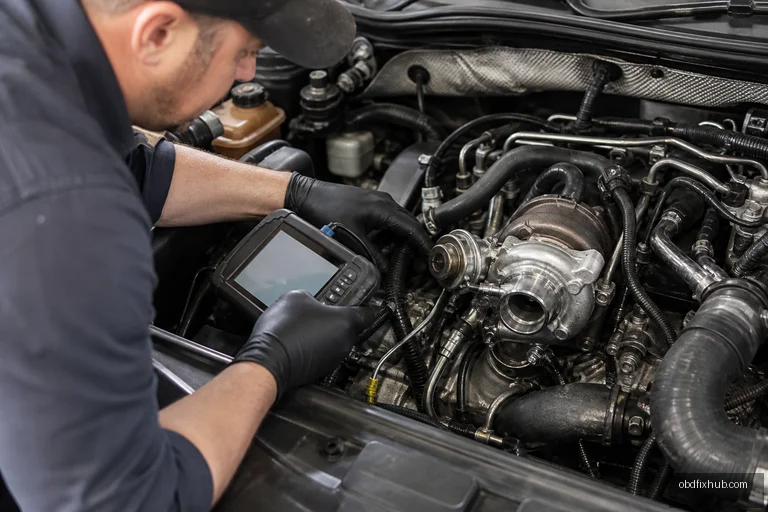
P2562 means the engine control module has detected a problem in the turbocharger boost control position sensor circuit. The fault may come from the sensor, its wiring, the electronic wastegate or variable-geometry turbo actuator, a connector, or a mechanical turbocharger problem. Because several faults can trigger the same code, replacing the turbo immediately is usually a costly mistake.
What Does the P2562 Fault Code Mean?
P2562 is a generic OBD-II diagnostic trouble code defined as Turbocharger Boost Control Position Sensor “A” Circuit. The sensor reports the actual position of the turbocharger control mechanism to the ECU. The ECU compares that feedback with the position it commanded; when the signal is missing, implausible, outside its expected range, or electrically unstable, it stores P2562 and may turn on the check engine light.
The exact component varies by engine. On some vehicles, the position sensor is built into an electronic wastegate actuator. On others, it is integrated into a variable-geometry turbocharger actuator. Manufacturer-specific software may also use slightly different terminology, so the factory wiring diagram and service information matter more than the generic code description.
Common P2562 Symptoms
A vehicle with P2562 may still drive normally at light throttle, which can make the fault easy to ignore. Under load, however, the ECU may limit turbocharger operation to protect the engine and catalyst.
- Check engine light or malfunction indicator lamp
- Reduced engine power or limp-home mode
- Slow acceleration, especially uphill or during overtaking
- Low boost, inconsistent boost, or sudden power surges
- Turbocharger whistling, actuator clicking, or abnormal mechanical noise
- Hard starting or poor throttle response on some applications
- Increased fuel consumption and, on diesel engines, possible excessive smoke
- Additional turbocharger, wastegate, or underboost codes such as P0299
A faulty turbo boost sensor does not always cause a dramatic symptom. A sensor that develops a dead spot near one end of its travel may only fail during maximum boost, so a short city test drive can miss the problem.
Where Is the Turbocharger Boost Control Position Sensor Located?
The turbocharger boost control position sensor is normally located on or inside the turbocharger’s electronic actuator. The actuator is attached to the turbo housing and operates either the wastegate lever or the variable-geometry vane mechanism. Depending on the engine design, you may see a small electrical connector and a short linkage rod mounted directly beside the turbo.
Access is often limited by a heat shield, exhaust manifold, air intake pipe, or the rear of the engine. Do not confuse this component with the intake manifold boost pressure sensor, commonly called the MAP sensor. The MAP sensor measures air pressure; the P2562 position sensor measures actuator or vane position. They perform different jobs and are tested differently.
Before removing anything, identify the vehicle by engine code, not only by model and year. A 1.0-liter turbo engine and a 2.0-liter diesel in the same model range may use completely different actuator designs and connector pinouts.
Most Common Causes of P2562
- Damaged wiring: Turbo wiring is exposed to heat, vibration, oil, and road debris. Brittle insulation or a wire broken inside the insulation is common near the actuator connector.
- Corroded or loose connector: Water intrusion, poor terminal tension, and heat damage can interrupt the position signal or sensor supply voltage.
- Failed actuator position sensor: The sensor may be electrically open, shorted, or inaccurate at part of its operating range.
- Sticking wastegate or variable-geometry vanes: Carbon buildup, rust, or a bent linkage can prevent the actuator from reaching the commanded position.
- Actuator calibration loss: Some electronic actuators require a relearn or initialization procedure after replacement or turbocharger service.
- Turbocharger wear: Excessive shaft play, damaged vanes, or a seized mechanism can create a position error even when the electrical circuit is healthy.
- Low system voltage or software issues: A weak battery, charging problem, or outdated ECU software can produce misleading actuator faults on certain vehicles.
How to Diagnose P2562 Properly
Professional diagnosis starts with the code, but it does not end there. The most useful test is to compare the commanded actuator position with the actual position using a scan tool that supports live data and bidirectional controls.
- Record all codes and freeze-frame data. Note engine speed, load, boost pressure, battery voltage, and temperature when P2562 was set. A companion underboost code changes the diagnostic direction.
- Inspect the actuator and harness. Look for melted insulation, a connector that is not fully locked, oil contamination, and a linkage that is bent or disconnected. Never move an electronic actuator by force.
- Check the power, ground, and signal circuits. Use the vehicle’s wiring diagram and manufacturer voltage specifications. A generic voltage assumption can damage an actuator or lead to a false diagnosis.
- Perform an actuator sweep or output test. The actuator should move smoothly and the live position value should follow the command without dropouts, sudden jumps, or an implausible fixed reading.
- Test mechanical movement. If the electrical signals are correct but the commanded position does not change, inspect the wastegate or vane mechanism for binding. On many turbochargers, this requires removing shielding or the actuator for closer inspection.
- Repair, calibrate, and verify. Clear the code only after the underlying fault is repaired. Run the required actuator learn procedure, then road-test the vehicle while monitoring boost command, actual boost, and actuator position.
One practical diagnostic clue is a position reading that remains fixed at an extreme value even while the scan tool commands movement. That pattern often points to an open circuit, failed sensor, or disconnected linkage. A position value that changes but does not track the command usually suggests binding, incorrect calibration, or turbocharger wear.
How Is P2562 Fixed?
The correct repair depends on the failed part. A damaged pigtail or corroded terminal may require only connector repair, while a failed integrated actuator may require actuator replacement or a complete turbocharger assembly. Some manufacturers sell the actuator separately; others require turbo replacement because the sensor is not serviceable independently.
- Repair or replace heat-damaged wiring and terminals.
- Clean and secure the connector only when the terminals are not physically damaged.
- Replace the boost control actuator when its internal position sensor fails.
- Free a sticking linkage only if the turbocharger manufacturer permits that repair.
- Replace or rebuild the turbocharger when vanes, shaft bearings, or the wastegate mechanism are worn.
- Complete the manufacturer-specific actuator calibration after installation.
Avoid lubricating the actuator or wastegate with random penetrating oil. Some products contaminate the sensor, damage seals, or burn onto hot exhaust components. The repair manual should specify whether cleaning, adjustment, or actuator replacement is allowed.
How Much Does It Cost to Fix P2562?
The cost depends heavily on the vehicle and whether the fault is electrical or mechanical. In the United States, a realistic range is approximately $100–$180 for diagnosis, $150–$500 for wiring or connector repair, and $400–$1,200 for an actuator replacement, including labor on many common vehicles. A complete turbocharger replacement can range from $1,200 to more than $3,000, especially on tightly packaged engines or dealer-serviced vehicles.
These are planning figures, not a fixed quote. A specialist may repair a connector in one visit, while a vehicle with a seized variable-geometry turbo may require extensive labor and calibration. Ask the repair shop whether the estimate includes actuator programming, turbo removal, gaskets, oil lines, and a post-repair boost verification test.
Can You Drive With a P2562 Code?
Short, gentle driving may be possible if the engine has normal oil pressure, no severe turbo noise, no heavy smoke, and only reduced power. Avoid towing, high-speed acceleration, and sustained boost until the fault is diagnosed. Stop driving and arrange recovery if the turbo begins making a siren-like noise, the engine runs away on a diesel, oil consumption rises suddenly, or the check engine light flashes.
Continuing to drive with a sticking actuator can turn a manageable control fault into turbocharger damage. It can also leave the vehicle in an unpredictable power state during merging or overtaking.
Key Takeaway
P2562 identifies a problem with the turbocharger boost control position sensor circuit, not automatic proof that the turbocharger itself has failed. Start with the connector, wiring, power and ground circuits, then compare commanded and actual actuator position with a capable scan tool. Correct diagnosis can save hundreds of dollars by separating a damaged wire or calibration issue from a genuinely worn turbocharger.
Frequently Asked Questions
What does the P2562 fault code mean?
It means the ECU has detected an electrical or plausibility problem in the Turbocharger Boost Control Position Sensor “A” circuit. The sensor provides feedback about wastegate or variable-geometry actuator position.
What are the symptoms of a faulty turbo boost sensor?
Typical symptoms include a check engine light, reduced power, limp mode, inconsistent boost, poor acceleration, and sometimes turbo actuator noise or additional underboost codes.
Where is the turbocharger boost control position sensor located?
It is usually integrated into or mounted on the electronic turbo actuator, directly on the turbocharger housing. Its exact location depends on the engine and whether the turbo uses a wastegate or variable-geometry vanes.
How much does it cost to fix the P2562 code?
Expect roughly $150–$500 for wiring repairs, $400–$1,200 for many actuator replacements, and $1,200–$3,000 or more for a complete turbocharger replacement. Diagnosis and calibration may be charged separately.
Can I clear P2562 without repairing the vehicle?
You can erase the stored code with a scan tool, but it will normally return if the fault remains. Clearing it without testing also removes useful freeze-frame evidence and does not repair the sensor, actuator, or wiring.




