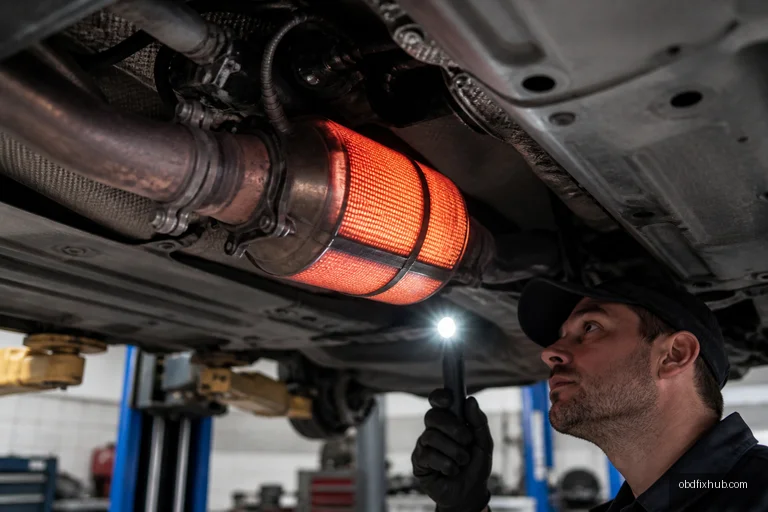
P269F Exhaust Aftertreatment Glow Plug Circuit Open means the engine control module has detected that the electrical circuit powering an exhaust aftertreatment glow plug is not carrying the expected current. In most cases, the fault is caused by a failed glow plug, damaged high-temperature wiring, a poor ground, or a defective control module—not by the engine’s standard intake glow plugs.
This is an informational search intent: the priority is understanding the code and diagnosing it correctly before replacing expensive aftertreatment components. Because the glow plug sits near extreme exhaust heat, visual inspection and voltage-drop testing are often more useful than simply clearing the code and installing a new part.
What Does P269F Mean?
P269F is a generic OBD-II powertrain code associated with the exhaust aftertreatment glow plug circuit. The exact component name and test strategy can vary by manufacturer, but the basic meaning remains the same: the control module commanded the aftertreatment glow plug and detected an open or electrically incomplete circuit.
An aftertreatment glow plug is not normally the same component as one of the glow plugs threaded into a diesel engine’s cylinder head. It is installed in or around the exhaust aftertreatment system, where it may help ignite or oxidize fuel during cold-start emissions control, diesel particulate filter regeneration, or operation of an exhaust fuel burner.
Common Symptoms of P269F
The vehicle may continue to drive normally when this code first appears. However, the aftertreatment system may not be able to reach the temperature required for clean regeneration, particularly during short trips or cold weather.
- Check Engine Light or emissions warning light
- Failed diesel particulate filter regeneration
- Frequent or interrupted regeneration attempts
- Reduced engine power or a limited-performance mode
- Increased fuel consumption
- Higher-than-normal soot loading in the DPF
- Longer cold-start emissions warm-up time
- Additional exhaust temperature, DPF, or regeneration fault codes
A useful field clue is the timing of the warning. If P269F appears after exhaust work, DPF cleaning, or replacement of a turbocharger or downpipe, inspect the wiring and connectors before assuming the glow plug itself failed. Harnesses are easily pulled, pinched, or left too close to the exhaust during those repairs.
Most Likely Causes of the P269F Code
1. Failed exhaust aftertreatment glow plug
The heating element can burn out internally, creating an open circuit. Age, repeated regeneration cycles, contamination, and thermal shock all contribute to failure. A plug may look physically intact while its resistance is infinite, so an electrical test is essential.
2. Melted or broken wiring
Exhaust-side wiring lives in a harsh environment. Heat shields, protective sleeves, and retaining clips can deteriorate, allowing the harness to contact the exhaust pipe or catalytic housing. The conductor may break inside the insulation, which is why gently flexing the harness while monitoring continuity can reveal an intermittent fault.
3. Corroded or loose connector terminals
Moisture, road salt, and repeated heating and cooling can loosen terminal tension or create oxidation inside the connector. A connector can appear clean externally yet have a pushed-back terminal that does not contact the glow plug properly.
4. Poor power or ground supply
Some systems use a dedicated relay, fuse, or aftertreatment glow plug controller. A blown fuse, weak ground strap, corroded power cable, or voltage drop across a connector can make a good glow plug appear defective.
5. Defective glow plug control module
If the glow plug and its wiring pass their tests, the control module may not be supplying voltage or switching the circuit correctly. Module failure is less common than wiring or plug failure, so it should not be the first part replaced.
6. Software or calibration issue
On some vehicles, a manufacturer service bulletin or control-module software update may address false aftertreatment circuit monitoring. This is especially worth checking when the circuit tests correctly and the code returns immediately after clearing.
How to Diagnose P269F Correctly
A professional diagnosis begins with a complete scan, not just the stored P269F code. Record freeze-frame data, coolant temperature, exhaust temperature, battery voltage, and any companion codes before clearing anything. Codes related to the DPF, exhaust temperature sensors, regeneration, or aftertreatment control module may change the diagnostic path.
- Confirm the code and inspect technical information. Use a scan tool that can access the aftertreatment module if the vehicle has one. Verify the manufacturer’s wiring diagram and identify the exact glow plug, fuse, relay, and controller terminals.
- Perform a careful visual inspection. Check the glow plug body, connector lock, terminals, harness routing, heat shielding, and ground points. Look for melted insulation, soot tracks, green corrosion, stretched wiring, or evidence that the harness has touched the exhaust.
- Test the glow plug resistance. Disconnect the plug and measure resistance with a quality digital multimeter. The correct value varies by design, so use the vehicle’s service specification. An infinite reading generally indicates an open heating element; a near-zero reading may indicate an internal short.
- Check circuit continuity under movement. Test from the glow plug connector to the controller or power supply while gently moving the harness. A stable reading is important because a wire can pass a stationary test and fail when the engine or exhaust moves.
- Check power and ground with a load. Do not rely only on an unloaded voltage reading. Use a voltage-drop test or an approved test load to identify resistance in the fuse, relay, connector, positive cable, or ground path.
- Verify controller operation safely. Use the scan tool’s output-control test if supported. Never apply battery power directly unless the manufacturer specifically permits it; some aftertreatment glow plugs are controlled by pulse-width modulation or a dedicated driver.
One practical mistake is measuring resistance through the controller without disconnecting the component. The module’s electronics can distort the reading and may be damaged by an incorrect test. Always isolate the circuit and follow the wiring diagram before probing terminals.
How to Fix P269F
The correct repair depends on the failed test result. If the aftertreatment glow plug is open or out of specification, replace it with the correct application-specific part. Apply only the recommended anti-seize, if any; some manufacturers prohibit compound on the heating element or electrical tip.
If the harness is damaged, repair it with high-temperature automotive wire, sealed splices, and the correct heat protection. Ordinary PVC wire or an unsecured cable tie may fail quickly beside the exhaust. Restore the original routing and make sure the harness cannot contact the DPF, catalytic converter, turbocharger, or sharp brackets.
- Replace a blown fuse only after finding the reason it failed.
- Repair loose or corroded terminals rather than spraying the connector and reconnecting it.
- Clean and tighten designated ground connections, then perform a voltage-drop test.
- Replace the control module only after the glow plug, wiring, power, and ground circuits test correctly.
- After the repair, clear the code and run the manufacturer’s aftertreatment or regeneration verification procedure.
Can You Drive With P269F?
Short-term driving is often possible if the vehicle has no severe power loss, excessive smoke, or additional critical warnings. However, continued operation can prevent successful DPF regeneration and allow soot loading to increase. If the vehicle enters reduced power mode, the DPF warning begins flashing, or exhaust temperatures become abnormal, stop delaying the repair and seek professional diagnosis.
Do not attempt a forced regeneration simply to hide the code. If the glow plug circuit is open, the regeneration process may fail, overheat other components, or create repeated dosing events. Fix the electrical fault first, then confirm that the aftertreatment system can complete a controlled regeneration.
Repair Cost and Difficulty
The cost varies considerably by vehicle design and accessibility. A connector repair or fuse issue may be relatively inexpensive, while an exhaust glow plug seized in a hot, carbon-covered housing can require careful removal. Control-module replacement and programming can cost substantially more than the glow plug itself.
When requesting an estimate, ask whether the price includes diagnostic time, connector inspection, seized-part risk, high-temperature wiring repair, and post-repair regeneration testing. Replacing only the plug without checking why the circuit opened often leads to a repeat P269F code.
Final Takeaway
P269F points to an open electrical circuit in the exhaust aftertreatment glow plug system. Start with a full scan and visual inspection, then test the glow plug, wiring, power supply, grounds, and controller in that order. Correct high-temperature wiring practices and a proper post-repair regeneration check are the difference between a lasting repair and another warning light a few drive cycles later.
Frequently Asked Questions
Is P269F the same as a normal diesel glow plug fault?
No. P269F normally concerns a glow plug used in the exhaust aftertreatment system, not one of the engine’s cylinder-head glow plugs. The exact location depends on the vehicle.
Can a bad fuse cause P269F?
Yes. A blown fuse or failed relay can interrupt power to the aftertreatment glow plug circuit. Find the cause of the fuse failure before installing a replacement, because a shorted harness or glow plug may blow it again.
Will clearing P269F fix the problem?
No. Clearing the code only erases the stored fault. If the circuit remains open, the code will return during the next self-test or regeneration-related operation.
Can P269F prevent DPF regeneration?
It can. If the glow plug is required to create or maintain heat for the vehicle’s regeneration strategy, the control module may cancel regeneration or limit its operation until the circuit is repaired.
Should I replace the aftertreatment glow plug first?
Not automatically. Test the plug and inspect the connector, wiring, fuse, ground, and control output first. Exhaust-side wiring damage is common enough that replacing the plug without testing can waste money.




