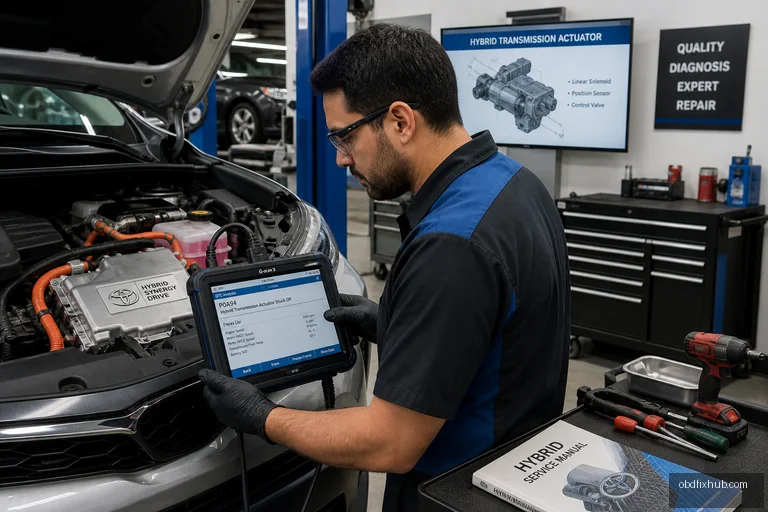
Search intent: Informational. Drivers searching for the P28EF engine disconnect clutch actuator performance code usually want to know whether the vehicle is safe to drive, what caused the fault, and which repair is actually necessary. P28EF indicates that the powertrain control system detected a problem with the operation, position, response, or learned values of the engine disconnect clutch actuator. The exact definition and repair procedure can vary by manufacturer, so the code should be diagnosed with vehicle-specific service information rather than treated as a universal failure of one part.
What Does P28EF Mean?
The engine disconnect clutch is used in certain hybrid, plug-in hybrid, and highly integrated automatic transmission systems to separate the internal-combustion engine from the transmission or hybrid drive unit. When the engine is not needed, the clutch can open; when engine power is requested, it closes in a controlled manner. This allows electric-only driving, smoother engine stop-start operation, and reduced mechanical drag.
The actuator is the electric or electro-hydraulic mechanism that moves this clutch. With P28EF stored, the control module has commanded a movement or position and decided that the actuator did not respond as expected. “Performance” does not necessarily mean the actuator motor is completely dead. Slow movement, excessive current, incorrect position feedback, failed calibration, wiring resistance, or a clutch that is mechanically difficult to move can all trigger the code.
Common Symptoms of P28EF
Symptoms depend on the vehicle design and whether the system has placed the hybrid transmission in a protective mode. Some drivers notice only a warning light, while others experience obvious changes in engine engagement.
- Check Engine, hybrid system, or drivetrain warning message
- Engine failing to start or stop during hybrid operation
- Reduced electric-only driving capability
- Harsh, delayed, or clunking engine engagement
- Transmission stuck in a limited operating mode
- Reduced power or a “drive system fault” message
- Repeated 12-volt battery discharge after failed start attempts
A vehicle may still drive normally immediately after the code appears because the module can temporarily lock the clutch in a fail-safe position. That does not make the fault harmless. Continued operation can produce poor drivability and, in some systems, prevent the engine or hybrid transmission from operating when its assistance is required.
Most Likely Causes of the P28EF Code
1. Low voltage or unstable power supply
Actuator systems are sensitive to voltage. A weak 12-volt battery, corroded ground, loose battery terminal, or charging-system problem can cause an actuator test to fail even when the actuator itself is sound. Before condemning an expensive transmission component, check battery voltage during a cold start and inspect the main grounds and power feeds.
2. Failed disconnect clutch actuator
The actuator motor, internal gears, position sensor, or electronic driver may be defective. Water intrusion and heat-related damage are common concerns because the unit is often mounted close to the transmission. An actuator that draws unusually high current or produces no movement during a bidirectional test is a strong suspect, but the test must be performed using the correct scan tool and manufacturer procedure.
3. Wiring, connector, or communication fault
Look for oil contamination, bent terminals, loose connector locks, damaged insulation, and corrosion at the actuator plug. A circuit can pass a basic continuity test yet fail under load because of hidden resistance. Voltage-drop testing while the actuator is commanded is more useful than relying on an ohmmeter alone.
4. Clutch binding or mechanical damage
If the actuator moves but the clutch does not reach the expected position, the problem may be mechanical. Wear, contamination, incorrect assembly, a damaged release mechanism, or transmission internal damage can restrict clutch travel. In this situation, replacing the actuator alone often results in the same code returning.
5. Lost calibration or software problem
Disconnect clutch systems often require a learn, initialization, or position-calibration routine after actuator replacement, transmission work, battery interruption, or control-module programming. A software update may also be required if the manufacturer has released revised control logic. Clearing P28EF without completing the relearn procedure is a common reason for an immediate comeback.
How to Diagnose P28EF Correctly
- Record every code before clearing anything. Scan the engine, transmission, hybrid, and battery-control modules. A low-voltage or communication code may be the primary fault, while P28EF is only a secondary result.
- Check the freeze-frame data. Note vehicle speed, battery voltage, engine temperature, commanded clutch position, and whether the fault occurred during starting, stopping, or acceleration.
- Test the 12-volt system. Verify the battery, charging voltage, grounds, and relevant fuses against the vehicle manufacturer’s specifications. Do not assume a recently installed battery is fully charged or correctly registered.
- Inspect the actuator circuit. Examine connectors and harness routing near the transmission. Perform voltage-drop and load tests rather than only static resistance checks.
- Use a bidirectional scan tool. Command the engine disconnect clutch through its operating range and compare actual position with commanded position. Listen for grinding, repeated clicking, or a motor that runs without producing movement.
- Confirm calibration requirements. Run the clutch initialization or relearn routine if the service manual specifies one. If the routine aborts, record the exact step and position at which it fails; that detail helps separate an electrical fault from mechanical binding.
- Perform a controlled road test. After repairs, confirm engine start-stop transitions, electric-mode operation, and clutch engagement under different load conditions. Recheck for pending codes, not just active codes.
P28EF Repair: What Usually Fixes It?
The correct repair depends on the failed test. A discharged or defective 12-volt battery may require replacement and system registration. Wiring faults require terminal repair, harness replacement, or restoration of a proper ground. If the actuator fails its electrical and functional tests, replacement followed by calibration is normally required.
When the clutch itself is binding, the repair can be more involved and may require transmission removal or replacement of an internal clutch assembly. Some vehicles also require a software update or a prescribed actuator alignment procedure. Parts should not be ordered solely from the trouble-code description; confirm the actuator part number and the required programming steps using the vehicle identification number.
Can You Drive With P28EF?
Short, cautious driving may be possible if there are no severe symptoms, no red hybrid or transmission warning, and the vehicle selects gears normally. However, avoid towing, hard acceleration, long trips, and repeated attempts to force engine start-stop operation. Stop driving and arrange professional diagnosis if the vehicle loses power, refuses to select Drive or Reverse, makes grinding noises, or displays a high-voltage system warning.
Hybrid systems add a safety concern: orange high-voltage cables and components should not be disconnected or probed without the required training and insulated equipment. A qualified hybrid technician can isolate the high-voltage system before working near the transmission-mounted actuator.
Practical Tips to Avoid a Misdiagnosis
- Do not replace the actuator before checking battery voltage and related communication codes.
- Do not judge the repair by whether the warning light goes out immediately; pending faults may return during the next engine transition.
- Ask for the actuator command-versus-actual-position results, not just a parts recommendation.
- Verify whether calibration, software programming, or transmission fluid-level checks are required after repair.
- Keep the old actuator until the repair is confirmed if the component is being replaced under warranty.
Summary
P28EF engine disconnect clutch actuator performance means the control system detected an unexpected actuator response or clutch position. The root cause may be low voltage, wiring damage, a failed actuator, mechanical binding, or missing calibration. The most reliable fix begins with a complete module scan, power-supply checks, bidirectional actuator testing, and the correct relearn procedure. If your vehicle has hybrid components or cannot engage a gear, use a qualified technician rather than guessing with expensive parts.
Frequently Asked Questions
Is P28EF a serious code?
It can be. The vehicle may continue driving, but the fault can disable hybrid operation, cause harsh engagement, or leave the vehicle in a limited mode. Severity depends on the accompanying symptoms and codes.
Can a weak 12-volt battery cause P28EF?
Yes. Low or unstable voltage can prevent the actuator from completing its movement or calibration. Battery, ground, fuse, and charging-system tests should be completed before replacing the actuator.
Will clearing P28EF fix the problem?
No. Clearing the code only removes the stored warning temporarily. If the actuator still fails its commanded-position test, P28EF will return, often during the next engine start or stop event.
Does P28EF always mean the actuator must be replaced?
No. Wiring faults, mechanical clutch binding, software issues, and lost calibration can create the same code. A bidirectional test and manufacturer-specific diagnostic procedure are needed to identify the actual failure.
Can I diagnose P28EF with a basic OBD2 scanner?
A basic scanner may read the code, but it usually cannot access hybrid or transmission modules, display actuator position, or perform calibration. A manufacturer-capable scan tool is normally required for a dependable diagnosis.




