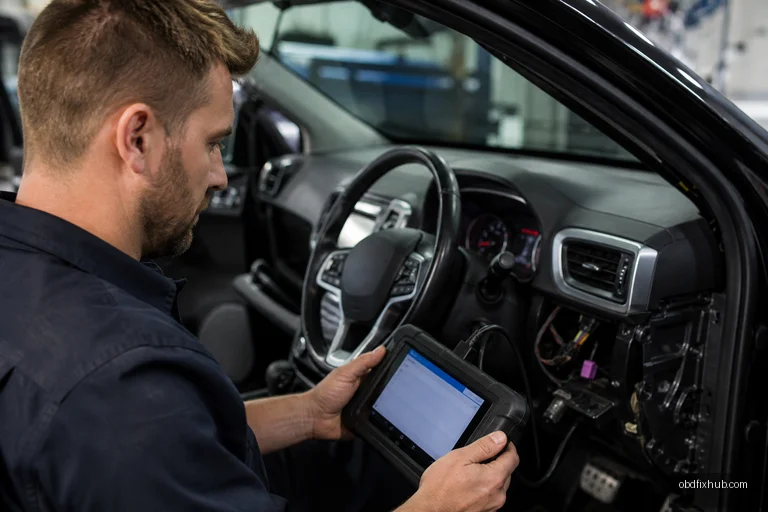
U0156 Lost Communication With Driver Information Center means one or more control modules cannot exchange data with the vehicle’s Driver Information Center, commonly called the DIC. The fault is usually caused by a power or ground problem, an open or shorted CAN bus circuit, connector corrosion, or a failed DIC or instrument-cluster module—not by the code itself. A complete module scan and electrical testing are far more reliable than replacing the display immediately.
What Does U0156 Mean?
Diagnostic trouble code U0156 is a generic network communication code. It is set when another module, such as the body control module, engine control module, or gateway module, stops receiving expected messages from the Driver Information Center over the vehicle communication network.
The exact design varies by manufacturer. In some vehicles, the DIC is a separate display module behind the dashboard. In others, its functions are built into the instrument cluster, infotainment system, or body control system. That distinction matters because the repair may involve a display module on one model and the entire cluster communication circuit on another.
Common Symptoms of U0156
U0156 may appear by itself or alongside several other communication codes. The symptoms depend on whether the DIC has lost only some data or has gone completely offline.
- Blank, frozen, dim, or intermittently rebooting driver-information display
- Missing mileage, fuel-range, trip, warning, or vehicle-status information
- Instrument-cluster warning messages that appear randomly or disappear after cycling the ignition
- Multiple U-codes stored in several modules
- Inoperative steering-wheel display controls or information buttons
- Battery-drain complaints if a module remains awake on the network
- Other body functions behaving unpredictably, depending on the affected CAN circuit
A key diagnostic clue is whether the display is completely dead or simply missing selected information. A dead display suggests power, ground, fuse, or module failure. A working display with missing data may point more strongly toward a network message problem or a fault in another module supplying that data.
Most Common Causes of U0156
1. Low battery voltage or unstable power
Modern modules can log communication codes when system voltage drops during starting. A weak battery, poor battery terminal, damaged ground strap, or charging-system problem may create several seemingly unrelated U-codes at once. Before deeper testing, verify that the battery is fully charged and that charging voltage is stable with the engine running.
2. Blown fuse or lost module power
The DIC or cluster may have separate constant-power and ignition-power feeds. A blown fuse, loose fuse-box terminal, or failed accessory relay can leave the module offline while other dashboard functions still work. Check the fuse with a test light or meter under load; visual inspection alone can miss a poor connection.
3. CAN bus wiring damage
The Controller Area Network, or CAN bus, uses twisted communication wires to allow modules to share information. Wires can be damaged behind the instrument panel, after stereo or remote-start installation, near the steering column, or following water intrusion. A short to ground, short to voltage, open circuit, or crossed CAN-H and CAN-L wires can interrupt communication.
4. Corroded or loose connectors
Dashboard connectors are especially vulnerable after windshield leaks, heater-core repairs, spilled drinks, or condensation. Green corrosion, pushed-back terminals, and partially latched connectors can cause an intermittent U0156 that disappears when the vehicle warms up or the dashboard is moved.
5. Failed DIC, instrument cluster, or gateway module
A module can fail internally because of a power surge, water damage, failed voltage regulator, or age-related circuit-board faults. Module replacement may require programming, configuration, or security relearn procedures. Installing a used unit without checking compatibility can create additional codes and may leave the vehicle immobilized.
How to Diagnose U0156 Correctly
Do not begin by replacing the display. The most efficient diagnosis is to determine whether the module is powered, whether it is visible to the scan tool, and whether the communication network is electrically healthy.
- Record every code. Use a scan tool capable of accessing all modules, not only the engine computer. Note which modules report U0156 and which modules cannot be reached.
- Check battery and charging voltage. Inspect the terminals and grounds. A healthy resting battery is typically near 12.6 volts, while a running charging system commonly measures approximately 13.5 to 14.8 volts, depending on the vehicle.
- Verify DIC or cluster fuses. Test both sides of each related fuse with the ignition in the required position. Confirm constant battery power, switched power, and ground at the module connector using the wiring diagram.
- Inspect connectors and harnesses. Look for water tracks, green deposits, bent pins, aftermarket splices, crushed wires, and harness sections rubbing against metal.
- Test the CAN network. With the battery disconnected and modules asleep, many high-speed CAN systems measure close to 60 ohms between CAN-H and CAN-L because two 120-ohm terminating resistors are in parallel. This is a useful clue, not a universal rule; always follow the manufacturer’s test procedure.
- Check network activity and isolate the fault. A professional scope or manufacturer-level scan tool can reveal missing or distorted CAN signals. If disconnecting a particular module restores network operation, that module or its branch may be shorted.
Never probe a connector randomly with a powered test light. Back-probe the specified terminals, use the service information for that vehicle, and avoid shorting adjacent pins. Some vehicles use multiple networks and gateway modules, so a normal resistance reading on one bus does not prove that every communication path is working.
U0156 Repair: What Usually Fixes It?
The repair depends on the confirmed cause. Common successful repairs include cleaning or replacing corroded terminals, repairing a CAN wire with the correct twisted-pair routing, restoring a missing fuse feed, tightening a ground connection, or replacing a damaged battery cable. After any wiring repair, clear the codes and perform a complete road test while monitoring communication.
If the DIC or cluster itself has failed, compare the module’s power, ground, and network signals with the manufacturer’s specifications before condemning it. A replacement module may need setup with the vehicle identification number, mileage configuration, option coding, or immobilizer-related programming. In many cases, a specialist can repair the original cluster, preserving vehicle configuration and avoiding compatibility issues.
Can You Drive With U0156?
Sometimes the vehicle remains mechanically driveable, but the code should not be ignored. If the DIC is blank, you may not see overheating, low-oil-pressure, charging, airbag, or other critical warnings. Stop driving if the instrument cluster is also failing, several warning lights are illuminated, the engine runs abnormally, or the vehicle has intermittent stalling or starting problems.
If U0156 appeared after a dead battery or jump-start and all displays now work normally, the code may be historical. It should still be scanned for additional active faults, battery voltage should be checked, and the code should be cleared only after confirming that communication returns and remains stable.
How to Prevent the Problem From Returning
- Repair windshield, sunroof, or dashboard leaks promptly.
- Keep battery terminals clean and secure, and test the battery before winter.
- Use proper solderless or sealed wiring methods for accessories; never tap CAN wires casually.
- Confirm that replacement clusters and display modules are compatible and programmable for the vehicle.
- When a communication code returns, scan every module instead of repeatedly clearing the engine code.
Summary: The Right Next Step for U0156
U0156 identifies a communication failure with the Driver Information Center, but it does not identify the failed part. Start with battery voltage, fuses, module power and grounds, then inspect the CAN wiring and connectors before considering module replacement. If several U-codes appear together or the network goes offline intermittently, professional-level scanning and wiring diagrams will usually save more time and money than changing parts by guesswork.
Frequently Asked Questions
Is U0156 caused by a bad battery?
It can be. Low cranking voltage or a weak battery may temporarily take the DIC offline and store U0156. However, a repeated code requires checking charging voltage, grounds, fuses, and network wiring rather than blaming the battery automatically.
Will disconnecting the battery clear U0156?
It may erase some temporary symptoms, but it does not repair the underlying fault. The code can return when the module fails to communicate again, and disconnecting the battery may also erase useful diagnostic data or require relearn procedures.
Can a bad instrument cluster cause U0156?
Yes. On vehicles where the DIC functions are integrated into the cluster, an internal cluster failure can prevent other modules from receiving its messages. Power, ground, and CAN signals must be verified before replacing or rebuilding the cluster.
Does U0156 require dealer programming?
Not always, but many replacement DIC, cluster, and gateway modules require configuration or programming. Check the vehicle’s service information before buying a used module, because an unprogrammed unit may not display correctly or may create additional security and communication codes.




