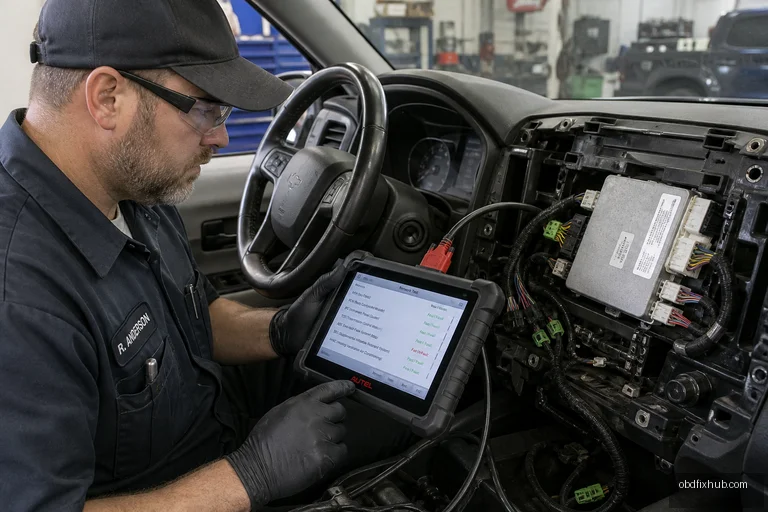
U0214 Lost Communication With Remote Function Actuation Module means one or more control modules on the vehicle network cannot exchange messages with the remote function actuation module. This module commonly manages remote keyless entry, passive entry, alarm functions, trunk or liftgate release, and sometimes part of the push-button start authorization system. The code does not automatically prove that the module itself has failed; power, ground, CAN wiring, a blown fuse, water intrusion, or a low vehicle battery can produce the same fault.
What Does U0214 Mean?
U0214 is a network communication diagnostic trouble code, not a conventional sensor code. The vehicle’s body, security, gateway, and powertrain modules communicate through a CAN bus, and the remote function actuation module is expected to send regular status messages. When those messages disappear for a calibrated period, another module stores U0214.
The exact role and location of the remote function actuation module vary by manufacturer. On some vehicles it is behind the dashboard or near the body control module; on others it may be located in a rear quarter panel, luggage compartment, roof area, or close to the keyless-entry antennas. Always confirm the wiring diagram and module naming for the specific year, make, model, and equipment level.
Common Symptoms of U0214
A stored U0214 may cause only a warning message, while an active communication failure can disable several convenience and security features. Typical symptoms include:
- Remote lock or unlock buttons do not work consistently.
- Passive door-handle entry fails or works only at certain doors.
- The panic alarm, trunk release, or power liftgate does not respond.
- A key-not-detected, no-key, or keyless-start warning appears.
- The vehicle alarm triggers unexpectedly or cannot be armed normally.
- Multiple body-related U-codes appear in several modules.
- The scan tool cannot identify or communicate with the remote function module.
- The battery goes flat because a module remains awake instead of entering sleep mode.
Do not confuse a U0214 communication fault with a dead key-fob battery. A weak fob battery can prevent remote commands from reaching the vehicle, but it normally does not stop a scan tool from communicating with the vehicle’s remote function module. That distinction is useful before replacing expensive parts.
Most Likely Causes of U0214 Lost Communication
1. Low system voltage
A weak 12-volt battery is one of the first checks I make on any vehicle with several communication codes. During cranking, voltage can drop far enough to reset body modules or interrupt CAN communication. A battery that measures 12.6 volts at rest can still fail a proper load or conductance test, so resting voltage alone is not conclusive.
2. Blown fuse or missing module power
The remote function actuation module may have separate battery, ignition, and retained-accessory power feeds. A blown fuse, loose fuse-box terminal, failed relay, or a feed that disappears when the vehicle enters a different power mode can make the module appear defective. Check both sides of each related fuse with a test light or meter; looking at the fuse is not enough.
3. Poor ground connection
A corroded body ground can allow a module to wake up but prevent reliable communication under load. Grounds near the kick panel, A-pillar, rear cargo area, or battery tray are common inspection points, depending on the vehicle. A voltage-drop test while the module is powered is more useful than simply checking continuity with the connector unplugged.
4. CAN bus wiring or connector damage
Open circuits, shorted CAN-high or CAN-low wires, spread terminals, and corrosion inside a connector can interrupt messages. Harnesses are particularly vulnerable where they pass through door pillars, tailgates, trunk hinges, wet carpet, and aftermarket alarm or remote-start installations. A connector can look clean externally while moisture has migrated under the terminal seals.
5. Water intrusion
Water leaks from a windshield, sunroof drain, roof antenna, rear lamp, or tailgate seal can damage the module or its network splice. A damp carpet or a musty odor is valuable evidence. Inspect the module housing, connector cavities, nearby splice packs, and the wiring below the carpet rather than drying only the visible surface.
6. Module software, configuration, or internal failure
Some U0214 faults follow a low-voltage event, software update, module replacement, or failed configuration procedure. If power, ground, CAN wiring, and network termination are correct but the module remains offline, it may require software programming or replacement. A replacement module often needs vehicle-specific configuration, key learning, or security initialization before it will operate.
How to Diagnose U0214 Correctly
The fastest diagnosis is systematic. Replacing the remote function module first is often the most expensive mistake because the underlying problem is frequently a battery, fuse, connector, or network fault.
- Record all codes. Use a full-system scan, not only the engine computer. Note which modules report U0214 and whether the code is current, history, or intermittent.
- Check the 12-volt battery. Test state of charge, cranking performance, and charging voltage. Repair low-voltage problems before interpreting a large group of U-codes.
- Verify module power and ground. Use the manufacturer’s pinout. Test power feeds under load and perform voltage-drop checks on the ground circuit while the module is awake.
- Inspect the physical installation. Look for water, green corrosion, pushed-out terminals, aftermarket splices, crushed harnesses, and loose grounds.
- Test the CAN network. With the vehicle powered down and allowed to sleep, approximately 60 ohms across CAN-high and CAN-low is common on a properly terminated network. Do not measure resistance on a powered circuit, and follow the manufacturer’s test procedure because network designs differ.
- Check communication directly. If the scan tool cannot access the module but other modules communicate, compare the module’s power, ground, and CAN signals with the wiring diagram. An oscilloscope can reveal intermittent distortion that a basic meter misses.
- Program only after the hardware is proven. If the module is defective, install the correct part number and complete configuration, software update, and security/key programming as required.
U0214 Repair Options
The correct repair depends on the failed part of the circuit. A discharged battery may need charging or replacement, while a damaged ground requires cleaning and securing the eyelet to bare metal. Wiring repairs should use sealed automotive splices and correctly sized wire; twisting wires together and covering them with household tape can create a repeat failure.
If corrosion is present in a connector, replacing only the module may not solve the problem. The terminal tension, connector seal, upstream splice, and source of moisture must all be addressed. After repairs, clear the codes, cycle the vehicle through sleep and wake modes, operate every remote function, and perform another full-system scan.
Can You Drive With U0214?
Sometimes the vehicle remains driveable, especially when remote locking is the only affected feature. However, driving should be treated cautiously if the security system, passive start authorization, alarm, or multiple network modules are involved. A progressing CAN fault can create additional warnings or leave the vehicle unable to restart after it is parked.
If the vehicle starts normally, avoid repeatedly disconnecting the battery as a diagnostic strategy. Battery resets can erase useful fault information, trigger security relearn issues, and temporarily hide an intermittent network problem. Save the scan report first and diagnose the circuit while the failure is present.
How Much Does U0214 Repair Cost?
Costs vary widely. A battery, fuse, ground, or minor wiring repair is usually far less expensive than a new remote function actuation module plus programming. Labor can also increase when the module is buried behind interior trim or when water damage affects several connectors and harness splices.
Before authorizing a module, ask the repair shop to show test results for the module’s power, ground, and CAN circuits. A credible diagnosis should identify why communication was lost, not simply report that the module is not responding.
Final Takeaway
U0214 means communication with the remote function actuation module has been interrupted. Start with battery condition, fuses, power, grounds, connector condition, water intrusion, and CAN wiring before condemning the module. If the module is ultimately replaced, make sure configuration and security programming are included in the repair plan.
Frequently Asked Questions
Can a weak key-fob battery cause U0214?
Usually not. A weak key-fob battery can cause failed lock, unlock, or passive-entry commands, but U0214 normally concerns communication between vehicle modules. Test the key fob separately while also checking the vehicle network.
Does U0214 mean the remote function module must be replaced?
No. Low voltage, a blown fuse, poor ground, water damage, CAN wiring faults, and configuration problems are common alternatives. Replacement should follow confirmed power, ground, and network testing.
Why are several U-codes present at the same time?
One failed network power supply, ground, gateway connection, or CAN wire can affect multiple modules simultaneously. Diagnose the code shared by the greatest number of modules and check the battery before treating each U-code as a separate failure.
Will clearing U0214 fix the problem?
Clearing the code only removes the stored record. If the communication fault remains, U0214 will return, and remote-entry or security functions may continue to malfunction. Clear it after repairs and confirm that it stays absent through several ignition and sleep cycles.




