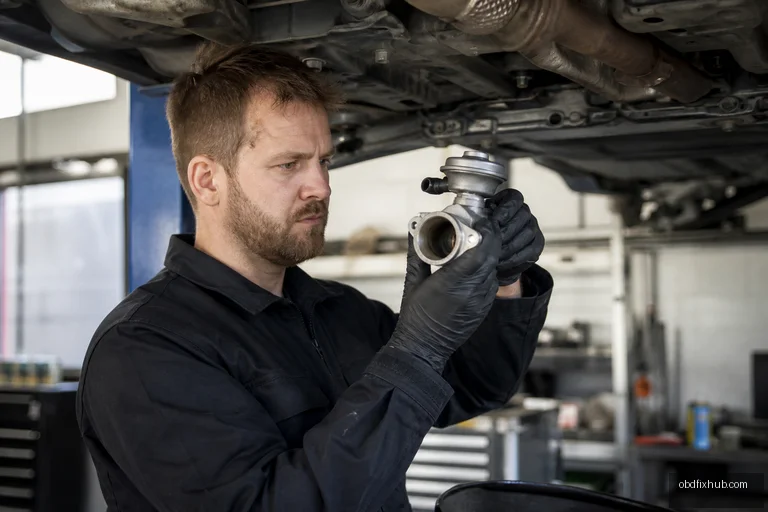
P00E3 means the exhaust heat exchanger exhaust bypass valve A is stuck open. The engine control module has detected that the valve is not following its commanded position, allowing exhaust gas to bypass the heat exchanger when it should be routed through it. This can reduce exhaust heat recovery, affect emissions control, delay engine warm-up, and trigger reduced-performance strategies on some vehicles.
This is an information-seeking fault code, but proper diagnosis matters before replacing expensive exhaust components. A failed valve actuator, carbon buildup, damaged wiring, a position-sensor problem, or a restriction in the heat exchanger can all produce the same P00E3 code.
What Does P00E3 Mean?
The P00E3 diagnostic trouble code refers to an exhaust heat exchanger bypass valve labeled A. The exact design varies by manufacturer, but the valve generally controls whether hot exhaust passes through a heat exchanger or takes a bypass route around it.
Exhaust heat exchangers are used in modern diesel, gasoline, hybrid, and emissions-control systems to manage exhaust temperature. Depending on the vehicle, recovered heat may help warm engine coolant, improve cabin heating, support EGR operation, or bring the emissions system to operating temperature faster.
- Valve commanded closed: Exhaust should flow through the heat exchanger.
- Valve commanded open: Exhaust bypasses the heat exchanger.
- P00E3 detected: The control module believes the valve remains open, or the feedback signal does not match the requested position.
The word “A” identifies one valve in a system that may contain several exhaust control valves. Do not assume it refers to the EGR valve or turbocharger wastegate. Always confirm the component location and test procedure in the vehicle’s service information.
P00E3 Symptoms
Some vehicles store P00E3 without noticeable drivability problems. In other cases, the control module changes thermal-management or emissions strategies, producing symptoms that are more obvious during cold starts and short trips.
- Illuminated check engine light or service engine warning
- Longer engine warm-up time
- Reduced cabin heat, especially during cold weather
- Reduced fuel economy during repeated short journeys
- Delayed diesel particulate filter or emissions-system regeneration
- Reduced engine power or a protection mode
- Higher or unstable exhaust temperatures
- Cooling fan operation after shutdown on some vehicles
- Rattling, clicking, or actuator noise near the exhaust heat exchanger
A useful real-world clue is a vehicle that reaches normal coolant temperature on the highway but takes unusually long to warm up in city traffic. That pattern can point toward a bypass valve that is staying open, although a thermostat or coolant-temperature sensor must also be ruled out.
Common Causes of P00E3
1. Carbon, soot, or corrosion around the valve
Exhaust valves operate in a harsh environment. Soot deposits, condensation, road salt, and thermal cycling can make the flap or shaft bind. A valve may move freely when cold but stick after the exhaust system reaches operating temperature.
2. Failed electric actuator or position sensor
Many bypass valves use an electric motor with an integrated position sensor. A worn gear, stripped reduction mechanism, overheated motor, or inaccurate feedback potentiometer can make the module report that the valve is still open.
3. Wiring, connector, or ground fault
Harnesses close to the exhaust are exposed to heat and vibration. Look for melted insulation, chafing against a bracket, loose terminals, water intrusion, and poor grounds. A connector can appear clean externally while its terminal tension is too weak to carry the actuator current reliably.
4. Restricted or damaged heat exchanger
An internally restricted heat exchanger can create abnormal pressure or temperature readings. In some systems, the actuator reaches the requested position but the control module still detects an implausible result because exhaust flow and temperature do not respond as expected.
5. Software, calibration, or related sensor problem
Manufacturers occasionally release updated engine-control software for false valve-position or thermal-management faults. A faulty exhaust-temperature sensor, differential-pressure sensor, or coolant-temperature sensor can also make a mechanically healthy valve appear to malfunction.
How to Diagnose P00E3 Correctly
Do not begin by replacing the bypass valve. A professional diagnosis compares the requested position, actual position, electrical supply, actuator movement, and the temperature response of the heat exchanger.
- Scan all modules. Record P00E3, freeze-frame data, mileage, coolant temperature, exhaust temperature, battery voltage, and any related codes. Network or temperature-sensor faults may be more important than P00E3 itself.
- Check technical service information. Confirm the valve’s location, normal resistance values, connector pinout, relearn procedure, and whether the vehicle requires a software update.
- Inspect the valve and harness. With the exhaust fully cold, check for seized linkage, broken brackets, damaged wiring, and signs of soot leakage. Never force an electrically driven valve by hand unless the manufacturer specifically permits it.
- Run a bidirectional actuator test. Use a capable scan tool to command the valve open and closed. Listen for motor operation and compare the commanded percentage with the actual position or feedback voltage.
- Test the circuit under load. Verify power, ground, signal wires, and voltage drop while the actuator operates. A static continuity test can pass even when a wire fails under vibration or current demand.
- Check temperature and pressure response. If the valve changes position but exhaust temperatures remain implausible, test the related temperature and pressure sensors and investigate heat-exchanger restriction.
- Clear codes and perform a drive cycle. After repair, complete the required initialization or adaptation. Then test the vehicle under the same conditions shown in the original freeze-frame data.
One diagnostic detail is frequently missed: some valves fail only during a hot-soak restart. If the actuator passes a cold workshop test, repeat the test after the exhaust system has reached operating temperature. Thermal expansion can expose a tight shaft or a failing motor that is invisible during a cold inspection.
P00E3 Repair and Fix Options
The correct repair depends on what the tests reveal. A sticking external linkage may be cleaned or freed if the manufacturer allows that procedure, but replacing the actuator alone will not solve a valve that is mechanically seized inside the heat exchanger.
- Repair damaged wiring, terminals, shielding, or ground connections.
- Replace a defective bypass-valve actuator or integrated position sensor.
- Replace the complete exhaust heat exchanger or valve assembly when the internal flap is seized or the unit is damaged.
- Repair exhaust leaks that are affecting temperature or pressure readings.
- Replace inaccurate exhaust-temperature or differential-pressure sensors.
- Install approved control-module software updates and complete valve adaptation.
Aftermarket parts deserve caution in this area. A valve can fit physically yet have the wrong travel range, connector calibration, or heat shielding. If the actuator feedback does not match the original calibration, P00E3 may return immediately after installation.
Can You Drive With P00E3?
Short, gentle driving may be possible if the engine runs normally and no overheating, severe power loss, or exhaust-temperature warning is present. However, continued driving can interfere with emissions regeneration and may cause additional faults, particularly on diesel vehicles.
Stop driving and arrange immediate inspection if you notice smoke, an exhaust smell in the cabin, severe loss of power, abnormal metallic noise, overheating, or a flashing check engine light. Exhaust components can reach extreme temperatures, so keep combustible materials away from the vehicle and never inspect the valve immediately after driving.
P00E3: Key Takeaways
P00E3 is not simply a generic “bad valve” code. It indicates that exhaust heat management is not responding as expected, and the fault may be mechanical, electrical, sensor-related, or software-related.
- Confirm the exact valve and system layout for the vehicle.
- Inspect heat-damaged wiring before condemning the actuator.
- Use a bidirectional scan-tool test and compare commanded versus actual position.
- Test the system hot as well as cold when symptoms are intermittent.
- Perform adaptation and a verification drive after the repair.
Frequently Asked Questions About P00E3
Is P00E3 the same as an EGR valve fault?
No. P00E3 refers to an exhaust heat exchanger bypass valve. It may influence EGR temperature management, but it is a separate component from the EGR valve unless the manufacturer uses an unusual combined design.
Can a bad thermostat cause P00E3?
A thermostat usually does not directly cause the code, but it can create similar slow-warm-up symptoms. If the valve passes its actuator and position tests, check the thermostat, coolant-temperature sensor, and heat-exchanger temperature response.
Does P00E3 require replacing the whole heat exchanger?
Not always. Some vehicles offer a separate actuator or bypass-valve assembly. If the internal flap or shaft is seized inside the exchanger, however, the complete assembly may be required.
Will clearing P00E3 fix the problem?
Clearing the code only resets the warning temporarily. If the valve remains stuck or its feedback is incorrect, the control module will detect the fault again during a self-test or drive cycle.




