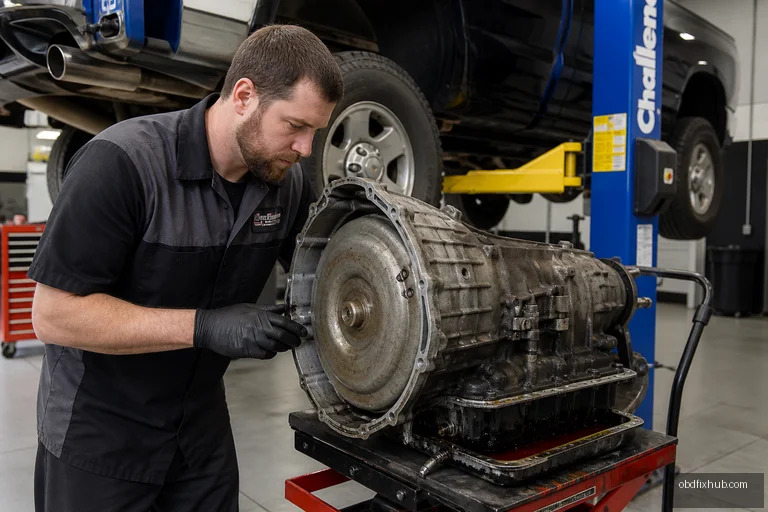
Search intent: Informational. Drivers searching for P0218 usually want to know whether the vehicle is safe to drive, what caused the warning, and how much damage may already have occurred. P0218 Transmission Fluid Over Temperature Condition means the powertrain control module has detected transmission fluid temperature above the manufacturer’s permitted range. In many cases, the vehicle should be stopped and allowed to cool before further driving, because repeated overheating can damage clutches, seals, bearings, and the torque converter.
What Does P0218 Mean?
P0218 is a generic OBD-II trouble code related to excessive automatic transmission fluid temperature. The exact temperature threshold varies by vehicle, transmission design, software calibration, and operating conditions. Some vehicles use a dedicated transmission fluid temperature sensor, while others calculate temperature from sensor data inside the transmission valve body or control module.
The code does not automatically prove that the transmission is permanently damaged. It confirms that the control system saw an overheating condition, or received temperature information that looked dangerously high. A proper diagnosis must determine whether the heat was real, caused by a cooling problem, or reported incorrectly by a faulty sensor or wiring circuit.
Common Symptoms of P0218
P0218 may appear with obvious drivability problems, although some vehicles only illuminate the check engine light or transmission warning lamp. The transmission may also enter a protective “limp mode” to reduce further damage.
- Check engine light or transmission temperature warning
- Harsh, delayed, or slipping gear changes
- Transmission stuck in one gear or failsafe mode
- Reduced engine power or limited vehicle speed
- Burning odor from overheated transmission fluid
- Dark, discolored, or foamy fluid
- Fluid leaking from cooler lines, seals, or the transmission pan
- Transmission whining, shuddering, or unusual noise
A burning smell is especially important. Fresh automatic transmission fluid normally has a mild petroleum odor and a clean red, amber, or manufacturer-specific color. Fluid that smells burnt and looks very dark may indicate that clutch material has overheated, although fluid color alone is not enough to determine transmission failure.
Most Likely Causes of P0218
1. Low transmission fluid
Low fluid is one of the most common and most overlooked causes. When the fluid level drops, the pump can draw air, hydraulic pressure becomes unstable, and internal components receive less lubrication. A leak may come from an axle seal, transmission pan gasket, cooler hose, electrical connector seal, or front pump seal.
Do not simply add fluid without finding the leak. Overfilling can also cause aeration and abnormal pressure, so the level must be checked using the exact procedure specified for that vehicle. Many newer transmissions require a level check at a specific fluid temperature with the vehicle perfectly level; some have no traditional dipstick.
2. Restricted or failed transmission cooler
Automatic transmissions release heat through a cooler integrated into the radiator, an external cooler, or both. A blocked cooler line, damaged hose, clogged heat exchanger, or failed electric cooling fan can prevent heat from leaving the fluid. A cooler that is contaminated with clutch debris may flow poorly even when the outside of the hose looks normal.
3. Heavy towing, steep grades, or extreme heat
Towing a trailer, carrying a heavy load, driving slowly up a long grade, or operating in very hot weather can push transmission temperature beyond its normal range. Repeated stop-and-go driving may be harder on the transmission than steady highway driving because the torque converter slips more and produces additional heat.
A useful real-world clue is the timing of the code. If P0218 appears after towing or mountain driving and disappears after cooling, the cooling system still needs inspection; the event should not be dismissed as “normal.” A healthy transmission cooling system should be able to manage the vehicle’s rated load.
4. Faulty temperature sensor or wiring
A failed transmission fluid temperature sensor can report an implausibly high temperature even when the fluid is not hot. Corroded terminals, damaged wiring near the transmission, poor grounds, and fluid intrusion into an electrical connector can create the same result.
Compare the scan tool’s temperature reading with the vehicle’s cold-soak temperature before starting it. After sitting overnight, transmission temperature should generally be close to engine coolant temperature and ambient conditions. A reading that shows extreme heat on a cold vehicle is a strong diagnostic clue, not evidence that the transmission actually overheated.
5. Internal transmission problems
Worn clutches, a failing torque converter, slipping bands in older designs, restricted valve-body passages, or a weak pump can generate excessive heat. Slipping is particularly damaging: the transmission loses engine power as heat instead of transferring it efficiently to the wheels. In this situation, replacing the fluid alone may temporarily improve symptoms but will not repair the worn internal parts.
How to Diagnose P0218 Correctly
- Stop and cool the vehicle safely. If the warning is severe, the vehicle is slipping, or smoke and a strong burning odor are present, arrange a tow rather than continuing to drive.
- Scan all control modules. Record P0218, related transmission codes, freeze-frame data, vehicle speed, engine load, and reported fluid temperature.
- Inspect for leaks. Check the transmission pan, cooler lines, radiator area, axle seals, and electrical connector. A small leak can become serious once the fluid is hot.
- Verify the fluid level and condition. Follow the manufacturer’s temperature and gear-selection procedure. Never guess based on fluid level when the transmission is cold unless the service information specifically allows it.
- Check cooler flow and airflow. Inspect the radiator, auxiliary transmission cooler, fan operation, and cooler lines for kinks or restrictions.
- Test the temperature signal. Compare live scan data with an infrared thermometer at the cooler lines, remembering that an infrared reading is a comparison tool rather than a direct substitute for the internal sensor.
- Evaluate transmission operation. Look for delayed engagement, flare between shifts, slipping under load, abnormal pressure, and excessive clutch debris in the pan.
One practical diagnostic mistake is replacing the transmission temperature sensor before checking the fluid level and cooler circuit. If the scan data rises logically under load and the cooler outlet remains unusually hot, the sensor may be working correctly while the transmission is genuinely overheating.
How Is P0218 Fixed?
The repair depends on the confirmed cause. A low-fluid condition requires leak repair and fluid replacement with the correct specification. A restricted cooler may require flushing, line replacement, radiator replacement, or installation of an auxiliary cooler designed for the vehicle and its load.
- Repair leaking seals, hoses, pan gaskets, or cooler connections.
- Replace a failed transmission fluid temperature sensor or damaged wiring.
- Restore proper radiator and cooling-fan operation.
- Use only the manufacturer-approved transmission fluid.
- Service or replace a contaminated filter where applicable.
- Repair valve-body, pump, torque-converter, or clutch damage when testing confirms an internal fault.
Be cautious with an aggressive power flush on a badly overheated, high-mileage transmission. A service may be appropriate, but the technician should inspect the fluid and pan first and follow the manufacturer’s service procedure. If the transmission is already slipping, a fluid exchange cannot rebuild worn clutches.
Can You Drive With P0218?
Only drive far enough to reach a safe location if the vehicle still shifts normally, the temperature warning has cleared, and there is no leak, slipping, smoke, or burning odor. Do not tow, climb steep grades, or continue normal use while the code is active. If the transmission is in limp mode or will not engage a gear, towing is the safer choice.
After repairs, the code should be cleared only after the cause has been corrected. The vehicle should then be road-tested under similar conditions while monitoring live transmission temperature and shift quality. A code that returns immediately after cooling usually points toward a sensor, wiring, or control problem; one that returns under load demands renewed attention to fluid flow and internal transmission performance.
Key Takeaway
P0218 is a warning that transmission heat has exceeded a safe limit or has been reported incorrectly. Check the fluid level, leaks, cooler operation, temperature data, and transmission behavior before replacing parts. Acting quickly can turn a relatively manageable cooling or sensor repair into a much more expensive transmission rebuild.
Frequently Asked Questions
Is P0218 a serious code?
Yes. It can result from a minor sensor fault, but it may also indicate real overheating that damages internal transmission components. Treat it as urgent until testing proves otherwise.
Can low transmission fluid cause P0218?
Yes. Low fluid can cause pump cavitation, poor lubrication, clutch slipping, and increased heat. Find and repair the leak before correcting the fluid level.
How long can I drive with the transmission over temperature warning?
Do not continue driving normally with the warning active. Move to a safe place, let the vehicle cool, and have the cause diagnosed. Towing is recommended if shifting is harsh, delayed, or slipping.
Will changing the transmission fluid fix P0218?
Only if degraded or incorrect fluid caused the overheating and no mechanical damage is present. Fluid replacement will not fix a blocked cooler, faulty sensor, leak, worn clutches, or a failing pump.
Does P0218 always mean the transmission needs replacement?
No. A temperature sensor, wiring fault, low fluid level, cooling fan, or restricted cooler can trigger the code without requiring a replacement transmission. Diagnosis must come before any major repair decision.




