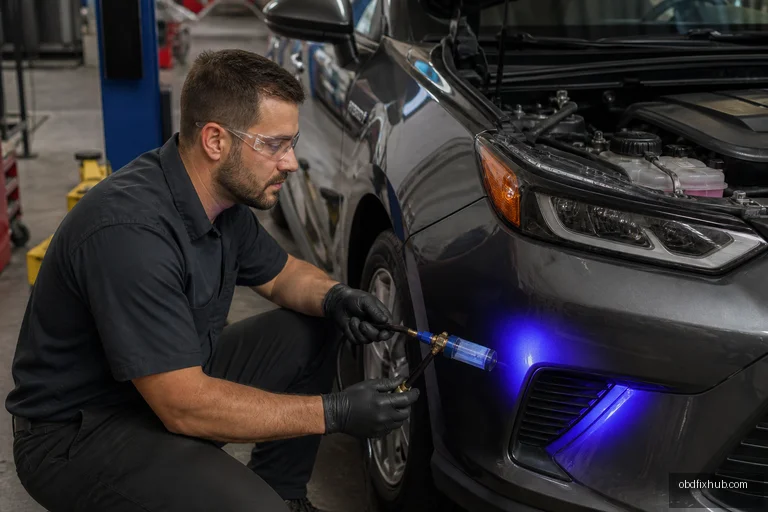
P0534 A/C Refrigerant Charge Loss means the vehicle’s control module has detected that A/C refrigerant pressure is lower than expected, usually because refrigerant has leaked from the system. The correct fix is not simply adding refrigerant: the leak must be located and repaired, the system evacuated, and the exact refrigerant charge restored. Driving with the code may leave the air conditioner inoperative and can damage the compressor.
What Does the P0534 Code Mean?
P0534 is an OBD-II diagnostic trouble code for A/C refrigerant charge loss. The engine or body control module monitors A/C pressure through a pressure sensor or pressure switch. When the reported pressure stays below the calibrated safety threshold, the module may disable the compressor and store P0534.
This code describes a pressure or charge problem, not a specific failed component. A genuine leak is common, but an inaccurate pressure sensor, wiring fault, incorrect previous recharge, or unusually low ambient temperature can produce a similar result. That distinction matters because replacing the pressure sensor without checking the refrigerant circuit often wastes money.
Common Causes of P0534 A/C Refrigerant Charge Loss
- A refrigerant leak from an O-ring, hose, service port, condenser, evaporator, or compressor seal
- Damage to the condenser from road debris or corrosion between the condenser and radiator
- A leaking evaporator core, sometimes identified by refrigerant or dye inside the passenger compartment
- A faulty A/C pressure sensor or pressure-switch circuit
- Loose, damaged, or corroded wiring at the pressure sensor
- An improperly performed previous recharge or the wrong refrigerant type
- System pressure that is too low because of cold weather or an undercharged system
On older vehicles, a pressure switch may open when charge is low to protect the compressor. Many newer vehicles use a three-wire pressure transducer that sends a variable voltage to the control module. The diagnostic strategy is different, but the practical rule is the same: verify actual system pressure before condemning the electrical component.
P0534 Symptoms You May Notice
The most obvious symptom is an A/C system that blows warm air, but the code can appear before cooling completely disappears. The compressor may fail to engage, cycle rapidly, or operate only intermittently. Some vehicles also turn on the check engine light or store an additional body or hybrid-system warning.
- Warm air from the vents despite the A/C button being illuminated
- No compressor clutch engagement on belt-driven systems
- Rapid compressor cycling or unusual compressor noise
- Weak cooling that becomes worse during idle or hot weather
- Check Engine Light or an A/C warning message
- Other manufacturer-specific codes related to pressure, compressor operation, or hybrid power management
Do not use compressor engagement alone as proof of a healthy system. Some vehicles deliberately prevent compressor operation when pressure is unsafe. On electric vehicles and hybrids, the electric compressor may be controlled through high-voltage electronics and can be silent even when operating normally.
How to Diagnose P0534 Correctly
A professional diagnosis starts with the vehicle’s refrigerant specification and service history. R-134a and R-1234yf are not interchangeable, and hybrid vehicles may require compressor oil with specific electrical insulation properties. A shop should confirm the refrigerant label under the hood before connecting recovery equipment.
- Read all stored codes and live data. Check for pressure-sensor, compressor, hybrid, and communication codes that may explain why P0534 was set.
- Inspect the visible system. Look for oily residue around fittings, the condenser, compressor, service ports, and hose connections. Refrigerant oil often leaves a dirt-attracting mark near a leak.
- Measure static and operating pressure. Pressure readings must be interpreted with ambient temperature and compressor command. A single gauge reading is not enough to identify every fault.
- Perform a leak test. Nitrogen pressure testing, an approved electronic detector, and ultraviolet dye can be used. Dye is helpful, but it may not reveal a very small evaporator leak immediately.
- Test the pressure sensor circuit. Verify its reference voltage, ground, signal voltage, connector condition, and scan-tool reading. Compare the reported pressure with a calibrated gauge.
- Repair, evacuate, and recharge by weight. The system should be evacuated with proper equipment and charged to the manufacturer’s specified mass, not by guessing from gauge color zones.
A useful workshop clue is a system that holds vacuum but still loses charge later. Vacuum testing alone can miss leaks that open under positive pressure, so a proper nitrogen pressure test is often more reliable when the leak is small.
How to Fix Low Refrigerant Charge
Low refrigerant is fixed by repairing the source of the loss, not by repeatedly topping up the system. A temporary recharge may restore cooling for a few days, but it can allow the leak to grow and may send liquid refrigerant into a compressor that is not adequately lubricated.
The normal repair process is to recover any remaining refrigerant, replace the leaking component or seal, pressure-test the system, evacuate moisture and air with a vacuum pump, and recharge it using the specified refrigerant quantity. If the compressor has been damaged or contaminated, additional flushing or component replacement may be necessary.
Avoid DIY refrigerant cans that contain sealant. Sealant can damage recovery machines, clog expansion devices, and make a future repair more expensive. Refrigerant handling also requires the right equipment and, in many regions, certified service personnel.
What Does P0534 Mean on a Chevy Volt?
On a Chevy Volt, P0534 generally indicates that the climate-control system has detected insufficient A/C refrigerant pressure or an implausible pressure signal. The Volt uses an electrically driven A/C compressor rather than relying on a conventional engine-driven belt, so the A/C system can operate while the gasoline engine is off.
That electric compressor is also used for important thermal management functions. Depending on model year and operating conditions, the system may help cool the passenger cabin and high-voltage battery. A refrigerant problem can therefore produce more than warm air; it may trigger additional hybrid-related codes such as P1E00 when the vehicle reports a separate powertrain or control-module fault.
Do not allow an unqualified shop to add ordinary compressor oil or use generic recharge equipment on a Volt. The electric compressor requires the correct oil specification and safe high-voltage service procedures. A Volt with P0534 should be diagnosed using the factory service information and a scan tool capable of reading its hybrid and climate-control modules.
What Happens If the A/C High-Pressure Switch Is Bad?
A faulty high-pressure switch or pressure sensor can prevent the compressor from turning on, cause repeated compressor cycling, or create an incorrect pressure reading. If the switch falsely reports excessive pressure, the control module may shut the compressor down to protect the system. If it falsely reports low pressure, the result can look exactly like a refrigerant leak.
However, a high-pressure switch is not automatically the cause of P0534. Before replacing it, compare the scan-tool pressure value with actual manifold or service-equipment pressure and test the wiring. A damaged connector or a missing five-volt reference can imitate a failed sensor.
How Much Does It Cost to Fix P0534 or P0533?
Repair cost depends on whether the vehicle needs a simple electrical repair, a seal, a condenser, an evaporator, or a compressor. Typical independent-shop ranges in the United States are:
- Diagnosis and leak test: approximately $100–$250
- Recharge after a confirmed minor repair: approximately $150–$300
- O-ring, service port, or hose repair: approximately $200–$600
- Pressure sensor or switch replacement: approximately $200–$500
- Condenser replacement: approximately $500–$1,200
- Evaporator replacement: approximately $1,000–$2,500 or more
- Compressor replacement: approximately $900–$2,500, with hybrid and EV systems often costing more
The question is often written as “How much does it cost to fix P0533?” P0533 is a different code: it generally refers to an A/C refrigerant pressure sensor circuit reporting a high signal. Its repair may cost less than a refrigerant leak repair if the problem is only a connector or sensor, but the pressure must still be verified before parts are ordered.
Can P0534 Be Cleared Permanently?
Clearing the code or disconnecting the battery does not repair the underlying fault. Once the leak or sensor problem is corrected, the code can be cleared with a scan tool, but some vehicles will only mark the monitor complete after several drive cycles and specific A/C operating conditions.
If P0534 returns immediately after clearing, check live pressure data and wiring before adding more refrigerant. A returning code is useful evidence: it usually means the charge is still low, the pressure signal is implausible, or the system has not been recharged to the exact factory specification.
Key Takeaway
P0534 A/C Refrigerant Charge Loss usually means the A/C system is undercharged because of a leak, but it can also result from a bad pressure sensor or circuit fault. The reliable repair is a measured diagnosis, leak repair, evacuation, and recharge by weight. On a Chevy Volt, use technicians familiar with high-voltage electric compressors and the correct compressor oil. If the code is accompanied by warm air or hybrid-system warnings, have the system tested rather than repeatedly topping it off.
Frequently Asked Questions
How do I fix low refrigerant charge?
Find and repair the leak, recover the remaining refrigerant, evacuate the system, and recharge it by the manufacturer’s specified weight. Simply adding refrigerant is only a temporary measure and may hide a serious leak.
Can I drive with the P0534 code?
Short-term driving is usually possible, but the A/C may be disabled. Avoid operating the system if the compressor makes unusual noises, and seek prompt diagnosis because low charge can reduce lubrication and cause compressor damage.
Is P0534 caused by a bad high-pressure switch?
It can be, but a low refrigerant charge is more common. Actual system pressure, sensor data, reference voltage, ground, and wiring should be tested before replacing the switch.
Why does my Chevy Volt show P0534 and P1E00 together?
P0534 may cause the climate-control module to report a refrigerant or compressor problem, while P1E00 is often a general hybrid or powertrain fault associated with another module. Scan all modules and diagnose the underlying Volt-specific fault rather than treating P1E00 as the root cause by itself.




