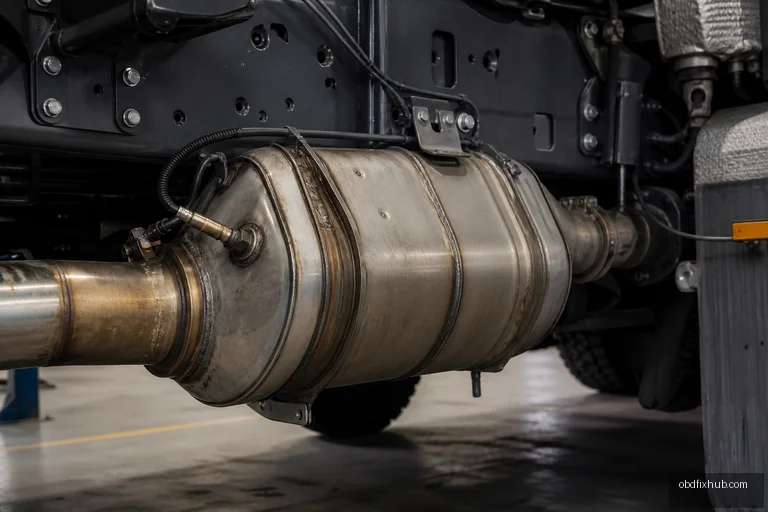
Search intent: Informational. The P05EB code means the engine computer has detected that the SCR catalyst inlet temperature is too low during a cold-start emissions monitor. In practice, the cause may be a faulty temperature sensor, exhaust leak, poor heat management, wiring problem, or an engine that is not reaching operating temperature. The code does not automatically mean the SCR catalyst itself must be replaced.
What Does P05EB Mean?
P05EB Cold Start SCR NOx Catalyst Inlet Temperature Too Low is an OBD-II diagnostic trouble code used on diesel vehicles equipped with selective catalytic reduction, commonly called SCR. During a cold start, the powertrain control module expects the exhaust system to heat the SCR catalyst quickly enough for NOx conversion to begin.
If the measured temperature at the SCR catalyst inlet remains below the expected threshold, or rises too slowly compared with engine load and exhaust flow, the module stores P05EB. The exact enabling conditions vary by manufacturer, so the factory service information is more reliable than a generic code description alone.
Why SCR Catalyst Inlet Temperature Matters
SCR systems inject diesel exhaust fluid, or DEF, into the exhaust stream. The DEF must decompose into ammonia before the SCR catalyst can use it to convert nitrogen oxides into nitrogen and water. If the catalyst is too cold, DEF conversion and NOx reduction become ineffective.
The cold-start monitor is not simply checking whether the engine is cold. It is comparing several signals, including coolant temperature, exhaust temperature, engine load, exhaust flow, ambient conditions, and sometimes the time taken to reach a calculated catalyst temperature. This is why an apparently normal truck or car can still set P05EB after a short trip or a sensor fault.
Common Causes of P05EB
- Defective SCR inlet temperature sensor: The sensor may report a temperature that is lower than the actual exhaust temperature or respond too slowly.
- Damaged wiring or connectors: Heat, vibration, road salt, and DEF crystallization can damage the sensor harness near the exhaust.
- Exhaust leaks before the SCR catalyst: A leak can draw in outside air and cool the exhaust, while also causing the sensor readings and exhaust flow model to disagree.
- Engine running too cool: A stuck-open thermostat, faulty coolant temperature sensor, or excessive idle time can prevent the exhaust from reaching the required temperature.
- Restricted or damaged exhaust components: Problems with the diesel oxidation catalyst, diesel particulate filter, or exhaust mixer can alter heat transfer and flow.
- Incorrect DEF dosing or poor DEF quality: Incorrect reductant delivery can create deposits and affect SCR operation, although DEF quality alone is not always the direct cause of P05EB.
- Calibration or software issues: A control-module update may be required if the manufacturer has revised the cold-start strategy or temperature plausibility limits.
- Very cold operating conditions: Extreme ambient temperatures, light loads, short journeys, and prolonged idling can expose a marginal system that works normally in warmer conditions.
P05EB Symptoms You May Notice
Many vehicles store P05EB before the driver notices a performance change. The most common symptom is an illuminated check engine light. On commercial diesels, the vehicle may also display an emissions-system warning, DEF warning, countdown message, or reduced-power warning if the fault remains active.
- Check engine or malfunction indicator lamp illuminated
- SCR, DEF, or emissions warning message
- Longer cold-start emissions warm-up period
- Reduced fuel economy in some driving conditions
- Failed emissions inspection
- Progressive derate or speed limitation on some heavy-duty vehicles
- Additional temperature, DPF, NOx, or reductant-system codes
Do not assume that a lack of drivability symptoms means the fault is harmless. SCR faults can start as a monitoring issue and later develop into a derate or no-start countdown, depending on the vehicle manufacturer.
How to Diagnose P05EB Correctly
A reliable diagnosis begins with the conditions under which the code was set. Record the freeze-frame data before clearing anything. Pay attention to coolant temperature, ambient temperature, engine speed, calculated exhaust temperature, vehicle speed, and whether the engine was idling or driving under load.
- Scan all modules, not just the engine ECU. Look for related codes involving exhaust gas temperature sensors, NOx sensors, DEF quality, DPF regeneration, glow plugs, coolant temperature, or communication faults.
- Inspect the exhaust and sensor harness. Look for soot marks that indicate a leak, loose sensor fittings, melted insulation, corroded terminals, and white DEF crystallization around the injector or exhaust pipe.
- Compare live temperature data. With the engine cold, the SCR inlet temperature should normally be reasonably close to ambient temperature and other exhaust temperature sensors. A reading that is implausibly low, fixed, or jumping sharply points toward a sensor or circuit problem.
- Test the sensor circuit. Use the manufacturer’s resistance and voltage specifications. A generic resistance value found online may be wrong because some vehicles use thermistors while others use temperature sensors integrated into a different assembly.
- Check warm-up performance on a road test. A controlled drive under moderate load is more useful than extended idling. Observe whether the inlet temperature rises smoothly and whether the catalyst reaches the manufacturer’s target within the specified time.
- Verify engine temperature and heat production. If coolant temperature remains low, inspect the thermostat, coolant temperature sensor, glow-plug system, injection operation, and any exhaust heat-management strategy.
- Check for software updates and service campaigns. Some cold-start faults are affected by revised ECU calibration, especially on vehicles that operate in severe cold or spend much of their time idling.
A useful workshop tip is to compare the temperature sensor data with an infrared thermometer only as a plausibility check. An infrared reading on a shiny exhaust surface can be inaccurate, so it should not replace a proper sensor-circuit test or scan-tool analysis.
How to Fix P05EB
The correct repair depends on the failed test. Replace the SCR inlet temperature sensor when its output is out of specification or does not agree with actual temperature. Repair wiring with heat-resistant, properly routed conductors; ordinary electrical tape near the exhaust will not survive for long.
Repair any exhaust leak upstream of the SCR catalyst before replacing expensive emissions components. If the engine never reaches normal coolant temperature, address the thermostat or coolant-temperature fault first. When deposits are present, inspect the DEF injector, exhaust mixer, and dosing pattern according to the manufacturer’s procedure rather than repeatedly forcing regeneration.
After the repair, clear the codes and complete the specified drive cycle. Some systems require a cold soak followed by a particular speed, load, and temperature range before the monitor will run. A code that returns immediately usually indicates an electrical or plausibility fault; one that returns only after a long drive may require deeper analysis of heat management, dosing, or catalyst performance.
What Does NOx Catalyst Efficiency Below Threshold Bank 1 Mean?
NOx catalyst efficiency below threshold, Bank 1 means the control module believes the SCR system is not reducing enough nitrogen oxide on the side of the engine designated as Bank 1. On an inline engine, there is normally only one bank, so Bank 1 represents the complete cylinder group. On a V-engine, it is the side containing cylinder number one.
The calculation usually compares NOx sensor readings upstream and downstream of the SCR catalyst while considering exhaust temperature, DEF dosing, exhaust flow, and operating conditions. A low-efficiency result can be caused by an aged SCR catalyst, incorrect DEF injection, a faulty NOx sensor, an exhaust leak, poor temperature control, or misleading temperature data. It should not be diagnosed by replacing the catalyst before those inputs are verified.
What Does the P20EE 00 Fault Code Mean?
P20EE-00 generally means SCR NOx Catalyst Efficiency Below Threshold, Bank 1. The “00” suffix is commonly a failure-type or status subcode used by scan tools and manufacturer-specific systems; the core fault is P20EE.
P20EE is related to P05EB but is not the same fault. P05EB concerns insufficient SCR inlet temperature during cold start, while P20EE concerns calculated NOx conversion efficiency. A vehicle can set both codes because a catalyst that stays too cold cannot reduce NOx effectively. Diagnose temperature, NOx sensors, DEF dosing, exhaust leaks, and catalyst condition together instead of treating P20EE as proof that the SCR catalyst has failed.
Can You Drive With P05EB?
Short-term driving is often possible when the vehicle runs normally and no derate message is present, but ignoring the code is risky on diesel vehicles with emissions countdown strategies. Avoid unnecessary idling and repeated short trips, and arrange a diagnosis promptly. If a DEF countdown, severe power reduction, or flashing warning appears, follow the vehicle manufacturer’s instructions and seek professional service before the countdown reaches zero.
Final Takeaway
P05EB points to an SCR system that is not reaching the expected inlet temperature during cold-start operation. The most efficient repair path is to verify freeze-frame data, inspect the exhaust and wiring, compare live sensor values, confirm engine warm-up, and test DEF dosing before condemning the catalyst. If P20EE is also present, treat it as a connected NOx-efficiency problem and diagnose the complete SCR system as one system.
Action step: Scan for companion codes and save the freeze-frame data before clearing P05EB. That information often reveals whether the problem is a temperature sensor, a cold-running engine, an exhaust leak, or a genuine SCR performance issue.
Frequently Asked Questions
Is P05EB caused by a bad SCR catalyst?
Not necessarily. A failed temperature sensor, wiring fault, exhaust leak, thermostat problem, or software issue can set P05EB. Test the temperature signal and exhaust system before replacing the catalyst.
Can low-quality DEF cause P05EB?
Contaminated or incorrect DEF can damage dosing performance and cause related SCR faults, but P05EB specifically concerns cold-start inlet temperature. Check DEF quality and the injector when companion reductant or NOx codes are present.
Will clearing P05EB fix the problem?
Clearing the code only removes the stored fault temporarily. If the monitor detects the same temperature problem again, P05EB will return, and some vehicles may eventually enter an emissions-related derate.
What is the difference between P05EB and P20EE?
P05EB indicates that SCR inlet temperature is too low during a cold-start test. P20EE-00 indicates that calculated SCR NOx conversion efficiency is below the expected threshold. One can contribute to the other, but they require separate diagnostic checks.
Where is the SCR inlet temperature sensor located?
It is usually installed in the exhaust close to, and upstream of, the SCR catalyst. Exact placement varies by vehicle, and some systems combine temperature sensing with another exhaust sensor or use a dedicated sensor harness.




