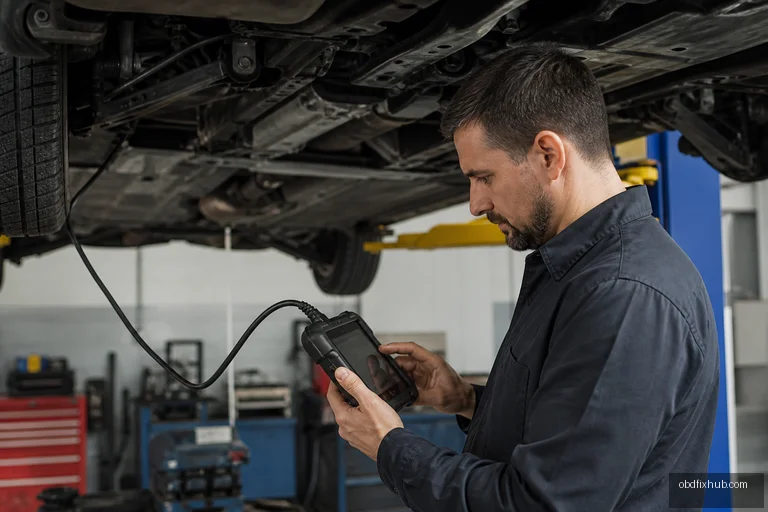
P0949 Automatic Shift Manual Adaptive Learning Not Complete means the transmission control module started, but did not successfully finish, an automatic shift or manual shift adaptive-learning routine. It does not automatically prove that the gearbox is worn out. In many vehicles, the real cause is low voltage, incorrect transmission temperature, a calibration problem, or a hydraulic or sensor fault that prevents the learning sequence from completing.
This is an informational search query: drivers usually want to understand the code before deciding whether they need a software reset, a transmission service, or professional repair. The safest approach is to diagnose the reason the procedure stopped rather than simply clearing P0949 and continuing to drive.
What Does P0949 Mean?
P0949 is generally described as Auto Shift Manual Adaptive Learning Not Complete. The transmission controller uses adaptive learning to adjust clutch pressure, solenoid commands, shift timing, and engagement feel as it observes the vehicle operating.
When the control module cannot complete the required learning routine, it stores P0949. The code may appear after a battery replacement, transmission repair, control-module programming, hydraulic-valve-body work, or an interrupted relearn procedure. On some vehicles, the code is manufacturer-specific, so the exact definition and test procedure must be confirmed with the service information for that vehicle.
Common Symptoms of P0949
The symptoms depend on whether the code was caused by an interrupted learning event or by a genuine transmission-control problem. A vehicle that drives normally after a battery disconnect may need only a correct relearn. Harsh shifting or loss of drive points to a more serious issue.
- Delayed engagement when selecting Drive or Reverse
- Firm, harsh, or inconsistent upshifts and downshifts
- Hesitation, flare, or a noticeable bump during a gear change
- Transmission warning light or check-engine light
- Manual-shift mode that will not respond correctly
- Fail-safe operation, limited gears, or transmission limp mode
- Gear hunting, especially when the transmission is cold or under light throttle
One useful clue is timing. If P0949 appears immediately after a low battery event or transmission-control-module replacement and the vehicle has no abnormal shifting, a missed initialization is more likely. If the code returns after a proper relearn and the transmission slips or bangs into gear, mechanical and hydraulic testing becomes much more important.
Why P0949 Happens
Low or unstable battery voltage
Adaptive learning can be interrupted if voltage drops while the scan tool is commanding the routine. This is common when a technician performs programming with a weak battery or without a regulated power supply. Check battery state of charge, charging voltage, grounds, and voltage drop before condemning the transmission.
Incorrect transmission temperature
Most relearn routines require a specific fluid-temperature range. Fluid that is too cold can produce slow, misleading clutch-fill results; fluid that is overheated can also invalidate the test. A scan tool should be used to monitor the transmission-fluid-temperature sensor rather than relying only on dashboard temperature readings.
Interrupted or incomplete relearn procedure
Stopping the vehicle, switching off the ignition, applying the wrong throttle input, or driving in traffic during a structured procedure can prevent completion. Some systems require a stationary initialization followed by a carefully controlled road test with specific accelerations and coast-down events.
Transmission fluid or hydraulic problems
Incorrect fluid level, contaminated fluid, the wrong fluid specification, restricted passages, a worn valve body, or a leaking clutch circuit can make the commanded shift impossible to learn. Adaptive values may reach their limit because the controller is compensating for a pressure or clutch-application problem.
Solenoid, sensor, wiring, or software faults
Input and output speed sensors, pressure sensors, shift solenoids, connectors, and wiring all affect adaptive learning. A software update may also be required if the manufacturer released revised transmission calibration. P0949 should therefore be read alongside every other stored transmission code, not diagnosed in isolation.
How to Diagnose P0949 Correctly
- Scan all modules. Use a capable scan tool that can access the transmission control module. Record current, pending, and history codes, plus freeze-frame data.
- Check the battery and charging system. Confirm stable voltage during the test. Inspect grounds and power feeds before performing any reset or programming.
- Verify fluid level and specification. Follow the manufacturer’s temperature-based checking procedure. A generic dipstick check can be wrong on transmissions that require a specific fluid temperature.
- Inspect wiring and connectors. Look for fluid intrusion, loose terminals, damaged harness sections, and poor grounds near the transmission.
- Check software and service bulletins. Manufacturer bulletins may specify a calibration update, a revised adaptive strategy, or a particular drive cycle.
- Perform the approved adaptive-learning routine. Use a bidirectional scan tool, maintain the required temperature, and follow the exact throttle and driving instructions.
- Evaluate the result. If P0949 returns, monitor pressure commands, shift time, turbine and output speeds, and clutch slip. Repeated failure requires deeper hydraulic or mechanical diagnosis.
How to Fix P0949
The repair depends on the finding. A successful fix may be as simple as charging the battery and completing the factory relearn. Other cases require correcting the fluid level, replacing damaged wiring, updating the transmission software, repairing a solenoid circuit, servicing the valve body, or rebuilding a worn clutch assembly.
Do not confuse “resetting adaptive values” with repairing the cause. Clearing the code may temporarily remove the warning, but it also deletes learned pressure and timing corrections. If the underlying problem remains, the transmission can shift worse while it tries to relearn.
After a reset, many vehicles need a controlled drive cycle. The transmission may feel slightly different for the first several miles because it is rebuilding its shift tables. Avoid aggressive acceleration, towing, or repeated manual-mode testing until the relearn is complete, unless the manufacturer’s procedure says otherwise.
What Does P0949 Mean on a Smart Car?
On a Smart car, P0949 may relate to the automated manual transmission and its clutch or gear-actuator learning process. Smart Fortwo models use transmission systems that can be described as automated manual rather than a conventional torque-converter automatic, so clutch engagement and gear-position calibration are especially important.
However, Smart model year, market, transmission version, and scan-tool software matter. Some generic scanners display a broad SAE-style description that does not perfectly match the manufacturer’s wording. Confirm the code in the Smart/Mercedes diagnostic system and check clutch actuator position, teach-in status, battery voltage, and any companion actuator or gear-position codes.
A weak battery is a particularly practical first check on a Smart, because low voltage can interrupt actuator initialization. If the clutch actuator is misadjusted, the clutch is worn, or the gearbox cannot reliably select a gear, a simple reset will not provide a lasting repair.
How Do I Turn Off Adaptive Learning on a 10R80 Transmission?
You generally cannot and should not permanently turn off adaptive learning on a Ford 10R80. Adaptive shift control is part of the transmission’s normal strategy; it adjusts line pressure and shift timing to account for clutch characteristics, wear, temperature, and driving conditions.
What technicians can do is clear the learned values or reset the transmission adaptive tables with a suitable Ford scan tool, then carry out the specified relearn procedure. This is useful after a transmission replacement, valve-body repair, solenoid work, software update, or certain diagnostic repairs. It is not a method for hiding slipping, harsh shifts, or a failing clutch.
On a 10R80, use a regulated battery support unit during programming or reset procedures. Afterward, follow the Ford drive cycle rather than immediately judging the transmission on one short trip. If harshness remains after the adaptation period, check fluid condition, calibration, solenoid performance, pressure control, and clutch slip data.
How Ford Transmission Adaptive Learning Works
Ford transmission adaptive learning uses feedback from speed sensors, pressure information, engine torque data, and shift timing. The control module compares the expected gear change with the actual clutch response, then adjusts commands so future shifts occur with the intended smoothness and consistency.
The system can compensate for normal variation, but it has limits. It cannot permanently correct a leaking clutch circuit, severely worn friction material, a failing solenoid, or an inaccurate speed sensor. When the required correction becomes excessive or the learning event cannot be completed, a code such as P0949 may be stored.
For example, a 10R80 that has just received a valve-body repair may need time to relearn clutch pressure. If the battery voltage collapses halfway through the routine, the module can store P0949 even though the hydraulic repair is sound. If the same code returns after stable voltage, correct temperature, and a completed drive cycle, the next step is data-based testing rather than another reset.
Can You Drive With P0949?
Short, gentle driving may be possible when the vehicle shifts normally and P0949 is the only code. Avoid towing, steep climbs, hard acceleration, and long trips until the cause is known. Stop driving and arrange professional diagnosis if the transmission slips, refuses to engage, bangs into gear, smells burnt, or enters limp mode.
Final Advice
P0949 is best viewed as a failed transmission-learning event, not as a complete diagnosis. Start with voltage, temperature, fluid, wiring, software, and the correct factory relearn procedure. If the code returns, use live transmission data to determine whether the problem is electronic, hydraulic, or mechanical—and avoid repeatedly clearing the code without testing.
Frequently Asked Questions
Is P0949 a serious transmission code?
It can be minor when caused by a low battery or interrupted relearn, but it can also indicate a transmission that cannot achieve the required clutch pressure or shift timing. Symptoms and companion codes determine the level of risk.
Will disconnecting the battery fix P0949?
Disconnecting the battery may erase learned values on some vehicles, but it does not complete the manufacturer’s adaptive procedure. It can also create new initialization issues, so a scan-tool reset and proper drive cycle are preferred.
How long does transmission adaptive learning take?
The stationary initialization may take only a few minutes, while the road-learning portion can require several miles and multiple shifts. The exact time depends on the vehicle and the conditions specified by its manufacturer.
Should I replace the transmission because of P0949?
No. Diagnose voltage, fluid, sensors, solenoids, software, pressure, and clutch slip first. A complete transmission replacement should be considered only after testing proves that internal wear or damage is the cause.
Can a generic OBD scanner diagnose P0949?
A basic scanner may read the code, but it often cannot perform adaptive resets, display transmission data, or run actuator tests. A manufacturer-level or professional bidirectional scan tool is normally required for an accurate diagnosis.




