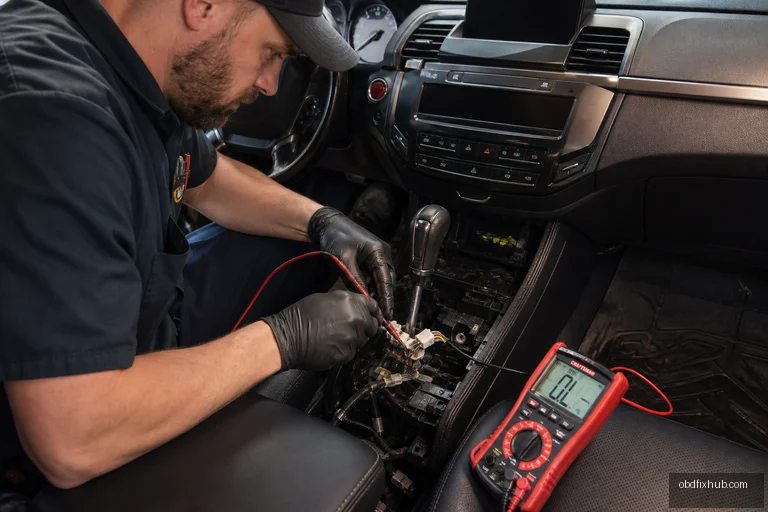
P0950 Automatic Shift Manual Control Circuit means the transmission control module has detected a problem in the electrical circuit used to request manual gear changes. In practical terms, the vehicle may not respond correctly to the “+” and “−” shift commands, even though the transmission itself may still operate in normal automatic mode. The fault can be caused by a failed shift switch, damaged wiring, a poor connector, a range-selector problem, or—less commonly—a control module fault.
This is an informational diagnostic code, not a verdict that the transmission needs to be replaced. A proper circuit test is important because many P0950 repairs involve a switch, wiring repair, or connector service rather than an internal gearbox rebuild.
What Does the P0950 Code Mean?
Automatic transmissions equipped with a manual or sport-shift function use a switch circuit to tell the transmission control module (TCM) that the driver wants to shift up or down. Depending on the vehicle, this request may come from a console-mounted shifter, steering-wheel paddles, a separate manual gate, or switches integrated into the gear selector.
When the TCM sees a voltage, resistance, or signal pattern that does not match the expected values, it stores P0950. The exact wording can vary between manufacturers, and some brands may use related codes for the upshift switch, downshift switch, or manual mode performance. Always compare the generic code with the manufacturer-specific description in the service information for that vehicle.
Common Symptoms of P0950
The symptoms depend on whether the fault is intermittent, a short circuit, an open circuit, or a switch that is permanently stuck. A vehicle with this code may drive almost normally, which is why the problem is sometimes ignored until it becomes more frequent.
- Manual or sport mode will not activate.
- The “+” or “−” command does not change gears.
- The transmission remains in automatic mode.
- The check engine light or transmission warning light comes on.
- The instrument cluster shows an incorrect shift-mode indication.
- The transmission enters a fail-safe or limp-home strategy.
- Harsh, delayed, or fixed-gear shifting occurs when related faults are present.
A useful clue is whether the normal automatic shifting remains smooth. If the car shifts normally but manual commands are completely dead, the selector switch or its wiring deserves early attention. If the transmission is slipping, flaring, or refusing several gears, P0950 may be only one part of a broader electrical or transmission-control problem.
Most Common Causes of P0950
1. Failed manual shift switch
The small contacts inside a shift-up or shift-down switch can wear, oxidize, or stick. Liquid spilled around a center console is a frequent real-world cause. On paddle-shift systems, a broken internal contact or damaged switch connector can produce the same fault.
2. Damaged wiring or poor connections
Wires routed through the shifter assembly can be pulled, pinched, or broken where the harness repeatedly flexes. Corrosion may also develop inside a connector even when the outside looks clean. A terminal pushed backward in the connector can create an intermittent P0950 that disappears when the shifter is moved.
3. Faulty transmission range selector or shift assembly
On some vehicles, the manual-shift contacts are built into the complete selector assembly. A misadjusted range selector, worn detent mechanism, or contaminated internal contact track can prevent the TCM from recognizing manual mode.
4. Low voltage or module communication problems
Weak battery voltage, poor grounds, or charging-system problems can create misleading transmission codes. Check system voltage before condemning a component. A TCM that loses its reference voltage or ground may report a circuit fault even though the switch itself is functional.
5. TCM or software fault
A transmission control module failure is possible, but it should be considered only after the switch circuit, power supply, grounds, wiring, and related codes have been tested. Some vehicles also require a software update or calibration after a control-module repair.
How to Diagnose P0950 Correctly
Replacing the shifter immediately is an expensive guess. The following workflow is more reliable and can often identify an intermittent fault before parts are removed.
- Record all diagnostic trouble codes. Use a scan tool that can communicate with the transmission module, not only a basic engine-code reader. Save freeze-frame data, transmission temperature, battery voltage, and the status of related codes.
- Confirm the complaint. With the vehicle safely parked, select the appropriate manual or sport mode and observe the scan tool’s live data. The upshift and downshift parameters should change when the corresponding command is operated.
- Inspect the shifter and connector. Look for spilled liquid, loose trim, bent terminals, green corrosion, pulled wires, and signs that the selector has been disturbed during previous repairs.
- Check power, ground, and reference voltage. Use a wiring diagram and a digital multimeter. Do not assume that a visible ground is electrically sound; perform a voltage-drop test under load.
- Test the switch circuit. The correct resistance or voltage depends on the vehicle. Some systems use separate switches, while others use a resistor ladder with different voltage values for each command. Use the manufacturer’s specifications rather than a universal resistance rule.
- Perform a wiggle test. Monitor live data while gently moving the harness, selector, and connector. If the manual-shift status changes without touching the switch, the wiring or terminal fit is suspect.
- Clear the code and verify the repair. Road-test the vehicle through automatic and manual modes. Confirm that the code does not return and that the live-data command agrees with the gear request.
Never probe an airbag circuit or an unknown connector with a test light. When working around a console-mounted selector, follow the manufacturer’s safety procedure and disconnect the battery only when the service information calls for it. Disconnecting the battery can erase useful adaptive data and may not repair the underlying fault.
How to Fix P0950
The correct repair depends on the test result. Common fixes include replacing the manual shift switch, repairing a broken wire, tightening or replacing a terminal, cleaning corrosion with the approved electrical-contact procedure, or replacing the complete shift-selector assembly.
If the fault is caused by low system voltage, repair the battery, alternator, or ground connection first and then clear the code. A TCM replacement should be the last step, and it may require programming, immobilizer synchronization, or transmission adaptation with factory-level equipment.
After the repair, inspect the harness routing so it cannot rub against the console, steering column, or selector mechanism. If liquid caused the original failure, clean and dry the affected area; otherwise the replacement switch may fail again.
Can You Drive With a P0950 Code?
Short-distance driving may be possible if the vehicle shifts normally, no transmission warning is flashing, and manual mode is the only feature that has stopped working. However, continued use is not risk-free. If the transmission enters limp mode, stays in one gear, shifts harshly, or shows slipping, have it diagnosed promptly and avoid towing or heavy loads.
Do not treat a flashing warning light, severe shift shock, burning odor, or loss of drive as a minor P0950 issue. Those symptoms may indicate additional transmission faults that require immediate attention.
P0950 Repair Cost: What Affects the Price?
Cost varies widely because the code can involve a simple switch or a difficult harness fault. A diagnostic fee may be the largest part of the repair when the problem is intermittent. A console switch is usually less expensive than a complete selector assembly, while module programming and wiring repairs can add labor time.
- Lower-cost repair: connector cleaning, terminal repair, or a straightforward wire repair.
- Moderate repair: replacement of a shift switch or paddle assembly.
- Higher-cost repair: complete selector replacement, extensive harness repair, or TCM programming.
Ask the repair shop for the stored codes, test results, and the failed circuit component. A diagnosis that simply says “replace the transmission” without showing electrical test results is not enough to justify that repair.
Frequently Asked Questions
Is P0950 a serious transmission code?
It can be serious if the vehicle enters fail-safe mode or develops harsh shifting, but many cases affect only manual-shift operation. The severity depends on the symptoms and any additional codes stored in the TCM.
Can a bad battery cause P0950?
Yes. Low battery voltage, unstable charging voltage, or poor grounds can disrupt the shift-control circuit and trigger misleading codes. Battery and charging-system tests should be part of the diagnosis.
Will clearing P0950 fix the problem?
Clearing the code may turn the warning light off temporarily, but it will not repair a failed switch, damaged wire, or poor connection. If the fault remains, the code will return after the TCM runs its circuit checks.
Does P0950 mean I need a new transmission?
No. P0950 identifies a manual-shift control circuit problem, not automatic transmission damage by itself. Test the switch, wiring, connectors, power, and grounds before considering internal transmission work.
Final Takeaway
P0950 points to a problem in the electrical path between the manual shift control and the transmission controller. Start with a complete scan, live-data confirmation, and a careful inspection of the selector wiring before replacing expensive components. If automatic shifting is also abnormal, treat the code as part of a wider transmission diagnosis and arrange professional testing promptly.




