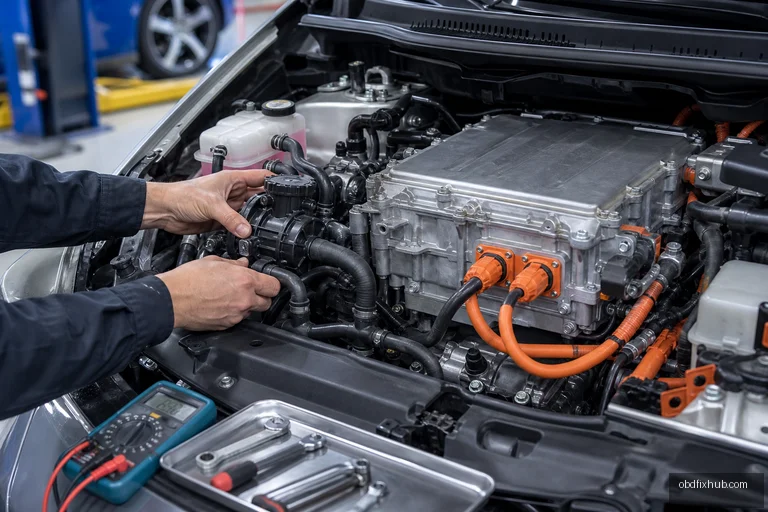
P0A05 means the vehicle has detected an open or interrupted control circuit for the motor electronics coolant pump. In practical terms, the pump may not be receiving power, ground, or a valid control signal, or the pump itself may have an internal electrical failure. Because this pump protects power electronics such as an inverter, converter, or motor controller, the fault should be diagnosed promptly—especially on a hybrid or electric vehicle.
What Does P0A05 Mean?
P0A05 is an OBD-II powertrain fault code associated with the motor electronics coolant pump control circuit. The exact wording and diagnostic strategy can vary by manufacturer, but “open” generally indicates that the control module sees an electrical path that is missing, interrupted, or outside its expected range.
This is not necessarily proof that the coolant pump has failed. A blown fuse, corroded connector, damaged wiring, poor ground, failed relay, or a control-module driver can create exactly the same code. On some vehicles, P0A05 may also appear with manufacturer-specific hybrid or EV codes that identify the affected pump or cooling loop more precisely.
Why the Motor Electronics Coolant Pump Matters
Hybrid and electric vehicles use liquid cooling to control the temperature of high-current electronics. The electric coolant pump circulates coolant through components such as the inverter, motor-generator, DC-DC converter, or battery-related power electronics, depending on the vehicle design.
When circulation stops, heat can build rapidly during acceleration, regenerative braking, charging, or high-load driving. The vehicle may reduce power as a protective measure. In severe cases, continued operation can damage expensive electronic assemblies, so clearing P0A05 without finding the cause is a poor repair strategy.
Common P0A05 Symptoms
The symptoms depend on whether the system has detected a complete open circuit or an intermittent fault. A vehicle with an intermittent connector problem may drive normally at first, while one with a dead pump can enter a reduced-power mode almost immediately.
- Check Engine, hybrid system, EV system, or service warning light
- Reduced engine or electric motor power
- “Stop vehicle” or “Check hybrid system” message
- Cooling fan running more often than usual
- Electric coolant pump silent when it should be operating
- Overheating of the inverter or motor electronics
- Limited regenerative braking or charging capability
- Multiple related communication, temperature, or power electronics codes
Do not rely on the absence of a coolant temperature warning. The pump can lose electrical control before the coolant becomes hot enough to trigger a visible temperature alarm.
Most Likely Causes of P0A05
- Failed electric coolant pump: The motor may be open internally, seized, or unable to respond to the command signal.
- Blown fuse or failed relay: A shorted pump or wiring fault can open the supply fuse. Installing a larger fuse can cause serious harness damage.
- Damaged wiring: Harnesses near the radiator, inverter, or underbody can suffer from rubbing, heat, water intrusion, or previous repair work.
- Corroded or loose connector: Coolant, road salt, and moisture can create high resistance or an intermittent open circuit at the pump connector.
- Bad ground: A loose ground eyelet or corroded ground point can make a good pump appear defective.
- Faulty relay or control module: The pump may have power and a good ground but no usable command from the vehicle’s control system.
- Air in the cooling circuit: Air usually causes poor circulation rather than a true electrical open, but it can produce misleading symptoms after pump replacement or coolant service.
How to Diagnose P0A05 Correctly
Use a scan tool that can access hybrid or EV control modules, not only the generic engine computer. Record every code and freeze-frame detail before clearing anything. Battery voltage, coolant temperature, vehicle speed, and the operating condition when the code set can reveal whether the fault is constant or intermittent.
1. Check the vehicle-specific service information
Locate the correct pump, fuse, relay, connector pinout, and circuit description for the exact year, model, and powertrain. Some vehicles use a simple switched pump; others use a pulse-width-modulated control wire or network-controlled pump. Testing the wrong terminal can lead to a false diagnosis.
2. Inspect the fuse, relay, and harness
With the vehicle safely powered down, inspect the pump fuse and relay according to the manufacturer’s procedure. Look for green corrosion, pushed-back terminals, melted plastic, rodent damage, and areas where the harness has rubbed against a bracket. A visual check of the connector is not enough; gently tug each wire and inspect for terminal tension.
3. Test power and ground under load
A multimeter may show battery voltage with no load while the circuit collapses when the pump is connected. Check voltage at the pump connector with the system commanded on, then perform a voltage-drop test on both the power and ground sides. A ground reading that looks acceptable with an ohmmeter can still fail under pump current.
4. Command the pump with a capable scan tool
Many professional scan tools provide an actuator test for the coolant pump. Listen for a smooth electric motor sound and verify coolant movement through the reservoir or service procedure specified by the manufacturer. Do not open high-voltage covers or probe orange high-voltage cables; the pump circuit is usually low voltage, but it may be physically close to dangerous components.
5. Confirm the control signal
If power and ground are correct but the pump does not run, test the control circuit using the wiring diagram and the required scope or meter procedure. A missing command can result from a broken control wire, a communication issue, an enabling condition that has not been met, or a failed controller output. Never replace the inverter or hybrid control module before proving the wiring and pump circuit.
P0A05 Repair: What Usually Fixes It?
The repair depends on the failed part, but common solutions include replacing the electric coolant pump, repairing a corroded connector, restoring a damaged ground, replacing a fuse or relay after correcting the underlying short, or repairing the harness.
After installing a pump, the cooling system often needs a specific bleeding procedure. Some vehicles require a scan-tool bleed routine, while others use a dedicated bleed screw or a prescribed ignition-and-pump sequence. Air trapped near the inverter can prevent proper circulation even when the new pump runs normally.
Use the correct coolant type and avoid mixing incompatible formulas. On hybrid systems, coolant contamination or incorrect conductivity can create additional problems. Follow the manufacturer’s service procedure rather than treating the circuit like a conventional engine radiator loop.
Can You Drive With P0A05?
Short-distance driving may be possible if the warning is intermittent and the vehicle shows no reduced-power, overheating, or hybrid-system message. However, the risk is difficult to judge from the code alone. Stop driving and arrange professional diagnosis if power is limited, the cooling fan runs continuously, the vehicle warns you to stop, or the pump does not operate during its commanded test.
High-voltage systems can remain dangerous after the vehicle is switched off. DIY inspection should be limited to clearly identified low-voltage fuses, connectors, and wiring, following the service manual. Isolation testing and work around orange cables should be left to a technician trained in hybrid and EV safety.
How Much Does a P0A05 Repair Cost?
Cost varies widely because the code may require anything from a connector repair to a control module. A fuse or wiring repair is usually relatively inexpensive, while a genuine electric coolant pump, coolant service, and labor can cost considerably more. Diagnosis is especially valuable here: replacing a pump without checking the fuse and control circuit can leave the original fault untouched.
Practical Tips That Prevent Misdiagnosis
- Do not condemn the pump solely because it is quiet; first verify whether the vehicle is commanding it on.
- Compare measured voltage at the pump with voltage at the battery to identify supply-side voltage drop.
- Inspect connector terminals for looseness, not just visible corrosion.
- Check for related codes before clearing P0A05; they may identify a shared power or ground fault.
- Bleed the cooling system after repair and confirm actual coolant flow, not merely pump noise.
- Use the exact wiring diagram for the vehicle because pump control methods differ significantly between models.
Summary
P0A05 indicates an open or interrupted motor electronics coolant pump control circuit. The pump may be defective, but the real cause is often a fuse, relay, connector, ground, damaged harness, or missing control signal. Scan all modules, test the circuit under load, verify the pump command, repair the underlying fault, and complete the correct coolant bleeding procedure before returning the vehicle to service.
Frequently Asked Questions
Is P0A05 always caused by a bad coolant pump?
No. A blown fuse, corroded connector, damaged wire, poor ground, failed relay, or control-module problem can all set P0A05. The pump should be tested rather than replaced automatically.
Can low coolant cause P0A05?
Low coolant can cause overheating and poor circulation, but it does not normally create an electrical open by itself. It may appear alongside P0A05 after a leak or pump failure, so check both the electrical circuit and coolant level.
Will clearing P0A05 fix the problem?
Clearing the code only removes the stored fault temporarily. If the circuit remains open, the code and warning will return, and the vehicle may reduce power to protect its electronics.
Can I test the pump with direct battery power?
Only if the manufacturer specifically permits that procedure and identifies the correct terminals. Some pumps use electronic control and can be damaged by direct power. A scan-tool actuator test is generally safer and more informative.
Is it safe to work on a hybrid vehicle with P0A05?
Basic low-voltage fuse and connector inspection may be possible with the correct service information, but orange high-voltage wiring and inverter components require trained procedures. If the vehicle displays a high-voltage or hybrid-system warning, use a qualified technician.
Next step: Save the complete scan report, identify the exact pump and circuit from the vehicle’s service information, and test power, ground, wiring, and command signal before buying parts.




