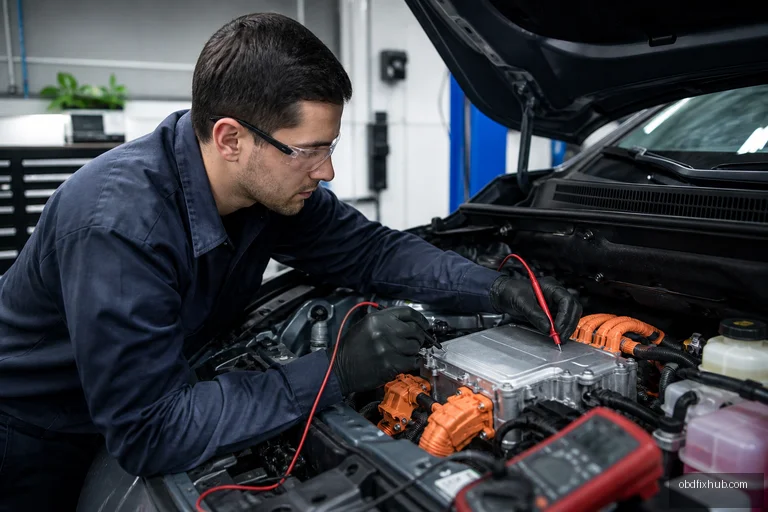
P0A08 indicates a problem with the DC/DC converter status circuit in a hybrid or electric vehicle. The converter supplies low-voltage power to the 12-volt system, and the vehicle control module is not receiving the expected status signal. The fault may come from a weak 12-volt battery, wiring or connector damage, a control fuse, an interlock issue, or a failed converter—not necessarily the converter itself.
What Does P0A08 DC/DC Converter Status Circuit Mean?
Hybrid and electric vehicles use a high-voltage battery pack to power the traction motor. Because the lights, control modules, infotainment system, pumps, and other accessories still operate on a low-voltage network, the vehicle uses a DC/DC converter to reduce high-voltage battery energy to approximately 12–14 volts.
The converter normally sends a status, enable, or feedback signal to a hybrid control module, power management ECU, or vehicle control module. When that module sees a missing, implausible, or inconsistent signal, it stores P0A08. The exact signal voltage, duty cycle, and test conditions vary by manufacturer, so the factory service information matters more than a generic voltage chart.
Common Causes of P0A08
- Low or failing 12-volt battery: A weak auxiliary battery can create unstable module communication and false converter-related codes.
- Blown fuse or fusible link: The converter may lose its low-voltage supply, ignition feed, or control circuit power.
- Damaged wiring: Open circuits, shorted wires, corrosion, rodent damage, or chafing near the converter can interrupt the status signal.
- Loose or contaminated connectors: Moisture, oxidized terminals, backed-out pins, and poor connector locking are frequent real-world causes.
- High-voltage interlock or service-plug problem: An improperly seated interlock can prevent the converter from operating.
- DC/DC converter internal failure: Power transistors, control electronics, temperature sensors, or internal protection circuits may fail.
- Communication or control-module fault: CAN bus problems or a software issue can make a correctly operating converter appear defective.
- Thermal shutdown or cooling problem: A blocked cooling path, failed pump, or low coolant level can cause the converter to switch off.
P0A08 Symptoms You May Notice
The symptoms depend on whether the converter has stopped producing low-voltage power or has only lost its feedback signal. A vehicle can sometimes drive normally for a short period while the 12-volt battery gradually discharges, making this code more serious than it first appears.
- Hybrid system warning, check-engine light, or “Check Hybrid System” message
- 12-volt battery warning or repeated low-battery complaints
- Intermittent no-start or a vehicle that powers off after the battery is depleted
- Flickering lights, unstable accessories, or infotainment resets
- Reduced-power mode or the vehicle refusing to enter READY mode
- Multiple communication, undervoltage, or battery-management fault codes
- Unusual converter, inverter, or cooling-fan operation
How to Diagnose P0A08 Correctly
Do not begin by replacing the DC/DC converter. On many vehicles, the converter is expensive and difficult to access, while a poor 12-volt battery connection or corroded connector is comparatively easy to fix.
1. Check the complete code set and freeze-frame data
Use a scan tool that can access hybrid and EV modules, not only generic engine codes. Record all current, pending, and history codes, along with freeze-frame data. Codes for low 12-volt voltage, high-voltage interlock, insulation faults, cooling systems, or CAN communication may identify the root cause more quickly than P0A08 itself.
2. Test the 12-volt battery under load
Measure the battery after the vehicle has been parked and perform a proper conductance or load test. A battery can show acceptable open-circuit voltage yet collapse when the vehicle wakes up. Check the battery terminals, body ground, and converter ground for looseness, heat damage, and excessive voltage drop.
3. Verify fuses and power supplies
Test both sides of every relevant fuse with the circuit energized. A fuse that looks intact may have power on only one side, and some converter feeds use fusible links or dedicated high-current protection. Follow the manufacturer’s wiring diagram to identify the converter’s battery, ignition, ground, and control-module supplies.
4. Inspect the status circuit and connectors
Look for green corrosion, water tracks, bent terminals, pushed-back pins, harness tension, and damage where the loom passes near brackets or the underbody. If the status wire is a low-current signal, a resistance check alone may not find a fault that appears only when the harness is moving or loaded. Use the specified wiring test procedure, including voltage-drop and wiggle tests where permitted.
5. Confirm converter operation safely
With the vehicle in the correct operating state, verify whether the low-voltage system is being maintained at the manufacturer’s specified charging voltage. Do not assume one universal number applies to every hybrid or EV. Some systems regulate voltage differently, and certain vehicles require a scan-tool command or READY mode before the converter operates.
High-voltage warning: Orange cables, inverter terminals, and converter connections can contain lethal voltage even when the vehicle is switched off. Only trained technicians with the correct insulated tools, personal protective equipment, and manufacturer shutdown procedure should test or disconnect high-voltage components. Never back-probe an orange cable with ordinary test equipment.
How to Fix P0A08
The repair should match the failed part of the circuit rather than the code description alone. Typical fixes include:
- Replace and register or initialize a weak 12-volt battery when required by the vehicle.
- Repair damaged wiring, terminals, grounds, or corroded connectors.
- Replace the correct fuse or fusible link only after finding why it failed.
- Correct a high-voltage interlock, service-plug, cooling, or thermal-management problem.
- Update or reprogram the applicable control module if a manufacturer bulletin identifies a software issue.
- Replace the DC/DC converter only after its power, ground, control signal, and operating conditions have been proven correct.
After the repair, clear the codes and complete the manufacturer’s prescribed drive cycle. Confirm that the vehicle reaches READY mode, the 12-volt charging system remains stable under electrical load, and no related hybrid, battery, or communication codes return.
Why Replacing the 12-Volt Battery May Not Solve It
A new auxiliary battery can temporarily hide P0A08 because it provides enough reserve capacity to keep the vehicle operating. If the converter is not charging, however, the new battery will eventually discharge as well. Check charging performance after installation instead of treating the battery replacement as proof that the original diagnosis was correct.
Can You Drive With P0A08?
Driving may be possible if the vehicle still enters READY mode and the 12-volt system voltage remains within specification, but it is not a code to ignore. If the converter stops working, the vehicle may lose electrical power, fail to restart, or shut down after the auxiliary battery is depleted. Stop driving and arrange professional diagnosis if warning messages multiply, READY mode is unavailable, lights become unstable, or the vehicle enters reduced power.
Key Takeaway
P0A08 is a status-circuit fault involving the hybrid or EV DC/DC converter, but it does not automatically condemn the converter. Start with the 12-volt battery, grounds, fuses, interlocks, wiring, connector condition, and related codes. Because the circuit is connected to high-voltage equipment, use manufacturer-specific service information and qualified EV safety procedures before testing or replacing components.
Action step: Have the vehicle scanned with a hybrid-capable diagnostic tool and request a documented test of converter power, ground, status signal, and low-voltage charging output before authorizing an expensive converter replacement.
Frequently Asked Questions About P0A08
Is P0A08 caused by a bad 12-volt battery?
It can be, especially when the battery is weak or its terminals and grounds are poor. However, the battery is only one possibility; wiring, fuses, interlocks, control modules, and the converter itself must also be tested.
Does P0A08 mean the DC/DC converter must be replaced?
No. The code identifies a problem with the converter status circuit, not a confirmed internal converter failure. Power supply, ground, feedback wiring, software, and related hybrid faults should be ruled out first.
Can a generic OBD2 scanner diagnose P0A08?
A basic scanner may display the code, but it often cannot read hybrid control modules, converter data, or manufacturer-specific subcodes. A hybrid-capable scan tool is strongly recommended for accurate diagnosis.
Is P0A08 safe to clear and continue driving?
Clearing the code does not repair the fault. If it returns or the 12-volt charging system is unstable, continued driving can leave the vehicle unable to restart or operate safely.




