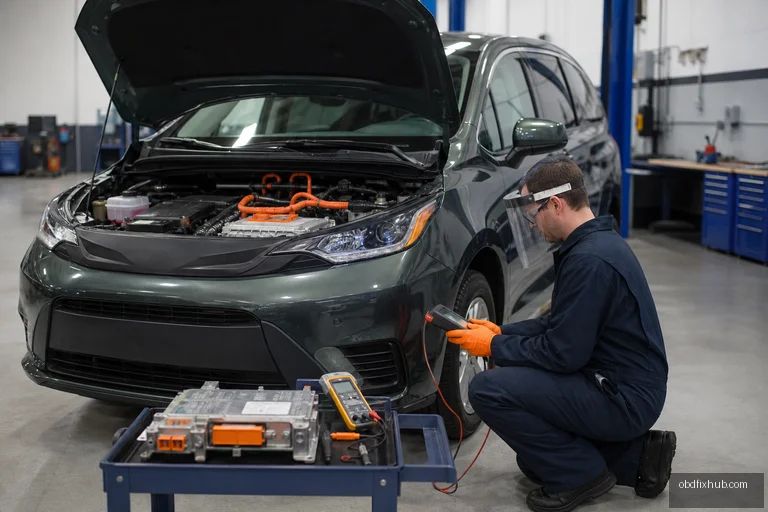
P0A0A indicates a problem in the high-voltage system interlock circuit, the low-voltage safety loop that confirms hybrid battery covers, service disconnects, inverter connections, and other high-voltage components are properly secured. On a Chrysler Pacifica Hybrid, the fault may prevent READY mode, disable electric propulsion, or trigger a hybrid-system warning. Because this circuit is part of a high-energy safety system, diagnosis should be performed by a trained hybrid technician using the factory service information and appropriate personal protective equipment.
What Does the High-Voltage System Interlock Circuit High Error Mean?
The phrase “high-voltage system interlock circuit high” describes the electrical condition reported by the monitoring module; it does not necessarily mean that the vehicle has excessive traction-battery voltage. The interlock is normally a monitored low-voltage circuit. When every connector and cover is installed, the loop has the expected electrical state. If the control module sees an unexpected voltage, an open circuit, or a signal outside its calibrated range, it stores an interlock DTC such as P0A0A.
The exact wording and suffix matter. A scan tool may display P0A0A, P0A0A-00, or a manufacturer-specific variation. The PCM, hybrid control processor, battery controller, or another module may be the device that records the code, so a complete vehicle scan is more useful than reading only generic powertrain codes.
What Is a High-Voltage Interlock Circuit?
A high-voltage interlock circuit, often called HVIL, is a low-voltage safety loop routed through the vehicle’s high-voltage components. It is designed to open if a service plug is removed, a battery cover is not latched, or a high-voltage connector is not fully seated. The vehicle then knows that the high-voltage system may not be safe to energize.
In practical terms, the circuit acts like a chain of switches. The battery pack, inverter, onboard charger, electric air-conditioning compressor, and other assemblies can each contain an interlock contact or jumper. One loose connector can break the entire loop, even when the traction battery itself is healthy.
- Closed loop: the control module sees the expected signal and permits normal system checks.
- Open or abnormal loop: the module disables high-voltage operation and stores a diagnostic trouble code.
- Intermittent loop: the vehicle may work normally until vibration, temperature change, or movement causes the connection to open again.
What Does P0A0A Mean on a Pacifica Hybrid?
On a Chrysler Pacifica Hybrid, P0A0A generally means the hybrid control system cannot validate the high-voltage interlock signal. The vehicle may remain inoperative, show a hybrid or electric-powertrain warning, or start the gasoline engine without entering the expected READY condition. The code does not identify one guaranteed failed part; it identifies a safety circuit that must be traced.
Pacifica Hybrid diagnosis is especially sensitive to connector position and service-disconnect installation. A previous repair, collision inspection, battery service, water intrusion, or improperly refitted high-voltage component can leave an interlock connector partially engaged. A connector can appear connected while its secondary lock is not fully seated, which is why visual inspection alone is not always conclusive.
Common Causes of P0A0A
- A loose, incompletely seated, or damaged high-voltage connector
- A service disconnect or interlock plug that is not fully locked
- A battery-cover switch, connector, or terminal that is open
- Broken wiring, pulled terminals, corrosion, or water intrusion
- Damage caused by rodents, underbody impact, or collision repairs
- A failed interlock switch or internal component monitor
- Low 12-volt battery voltage causing misleading hybrid-system faults
- A blown fuse, poor ground, control-module issue, or software-related fault
Low 12-volt voltage deserves attention before replacing expensive hybrid parts. During startup, a weak auxiliary battery can make several modules reset or lose communication. If P0A0A appears with multiple network, undervoltage, or communication codes, test the 12-volt battery and charging system first—but do not assume that low voltage explains the code without checking the interlock data.
Symptoms You May Notice
Typical symptoms depend on when the fault occurred and whether it is continuous or intermittent. Common complaints include:
- “Hybrid System,” “Service Hybrid System,” or “Electric Vehicle System” warnings
- No READY indication or a refusal to start normally
- Loss of electric drive or limited propulsion power
- Gasoline-engine-only operation
- Charging that will not begin or stops unexpectedly
- Several warning lights and a stored or pending P0A0A code
A vehicle that still drives is not necessarily safe to ignore. The interlock is intended to prevent high-voltage operation when a protective condition has not been verified. Continuing to use the vehicle may also turn an intermittent connector problem into heat damage or a no-start condition.
How to Diagnose P0A0A Safely
Professional diagnosis starts with the entire fault picture, not with random parts replacement. A suitable scan tool should retrieve codes from the PCM, hybrid control modules, battery controller, and charging system, along with freeze-frame information and interlock-status data where available.
- Confirm the code and symptoms. Record all current, pending, and history codes before clearing anything.
- Check the 12-volt system. Verify battery condition, terminal security, grounds, and charging voltage.
- Review recent work. Ask whether the battery, inverter, charger, underbody panels, or collision-damaged areas were recently serviced.
- Inspect accessible interlock wiring. Look for pinched harnesses, damaged insulation, corrosion, missing locks, and connectors that are not fully seated.
- Use the factory wiring diagram. Identify which modules and switches are part of the specific vehicle’s interlock loop.
- Test the low-voltage signal as specified. Do not substitute a generic continuity test for the manufacturer’s procedure.
- Clear and verify. After the repair, perform the required ignition cycle, charging test, and road or system verification procedure.
Never probe orange high-voltage cables or traction-battery terminals with ordinary test equipment. The interlock may be a low-voltage circuit, but it is physically associated with lethal-energy components. A technician must follow the vehicle-specific disable procedure and use rated insulated tools, gloves, and test equipment.
How Is P0A0A Repaired?
The repair depends on the failed section. A loose connector may require correct reseating and replacement of a damaged lock. Corroded terminals may require a proper pigtail or connector repair rather than cleaning alone. A damaged harness must be repaired with the manufacturer-approved method, keeping the wiring protected from vibration, water, and high-voltage component heat.
If the interlock switch or monitored high-voltage assembly has failed, the affected component may need replacement. Do not bypass the circuit with a jumper. Bypassing the interlock removes a safety function and can allow the system to energize when a cover or connector is not secure.
How Long Should You Wait After Removing the Service Plug?
For many hybrid vehicles, the service procedure specifies waiting at least five minutes after removing the service disconnect so capacitors can discharge. Some models or procedures require longer. On a Pacifica Hybrid, follow the exact Chrysler service-manual instruction for the vehicle’s model year and repair operation; a timer alone is never proof that the system is safe.
After the specified wait, a qualified technician must verify the absence of high voltage at the designated test points using properly rated equipment. The safe rule is: remove the service plug, secure it against reinstallation, wait the manufacturer-specified time, and confirm zero voltage before touching high-voltage components. Do not rely on dashboard warnings, silence, or the fact that the gasoline engine is off.
Can You Clear P0A0A Yourself?
A basic OBD scanner may erase the code, but clearing it does not repair the interlock. If the fault is still present, P0A0A will return when the hybrid controller performs its next safety check. More importantly, a generic scanner may not show the interlock status, manufacturer-specific subcode, or related battery and isolation faults needed for an accurate diagnosis.
If the code appeared immediately after routine service and the vehicle is safely powered down, the first practical step is to return to the shop that performed the work. If there is visible damage, a burning smell, liquid near high-voltage components, crash damage, or repeated no-start behavior, arrange professional hybrid service rather than attempting to reconnect components yourself.
Key Takeaway
P0A0A is a safety-monitoring fault, not a simple “bad battery” code. The most efficient repair is a complete scan, a 12-volt health check, a wiring and connector inspection, and a vehicle-specific HVIL test. On a Pacifica Hybrid, never bypass the interlock and never treat the required discharge wait as a substitute for a verified zero-voltage measurement.
Frequently Asked Questions
What does “high-voltage system interlock circuit high” mean?
It means the monitoring module sees an abnormal high-side electrical state on the interlock signal. It does not automatically mean the traction battery voltage is too high. An open connector, wiring fault, switch problem, or control-module issue can produce the message.
Is P0A0A on a Pacifica Hybrid safe to drive?
It is not advisable to treat the vehicle as normal when P0A0A is active. The hybrid system may disable propulsion or unexpectedly enter a limited operating mode. Have the fault diagnosed by a technician trained on high-voltage vehicles.
Will replacing the hybrid battery fix P0A0A?
Not necessarily. P0A0A often results from a connector, service disconnect, interlock switch, harness, or low-voltage supply problem. Battery replacement without testing the interlock circuit can be an expensive and ineffective repair.
How long should I wait after removing the hybrid service plug?
Use the exact manufacturer procedure. Many systems specify at least five minutes, but the technician must still verify zero voltage with correctly rated test equipment before servicing high-voltage components.




