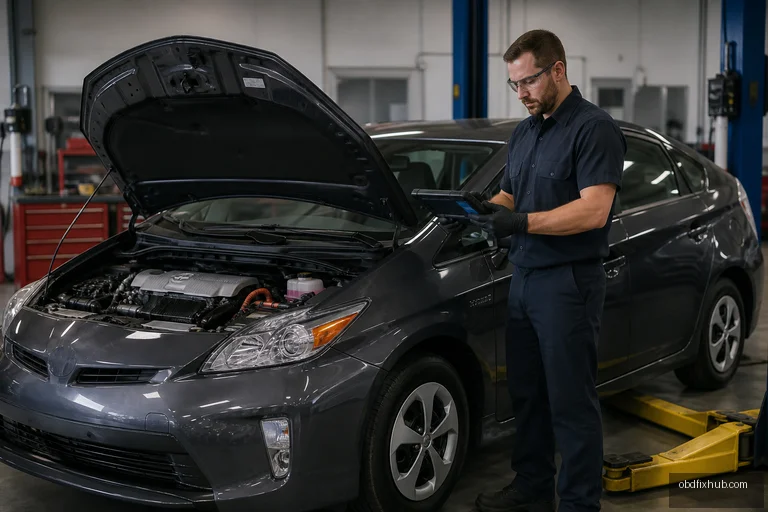
P0A0F Hybrid Engine Failed to Start means the vehicle’s hybrid control system commanded the gasoline engine to run, but the engine did not start or did not reach the expected operating speed. The code does not identify one failed part by itself. A weak 12-volt battery, low fuel pressure, ignition failure, engine position sensor, immobilizer problem, hybrid battery issue, or another stored trouble code may be responsible.
This is primarily an information and diagnosis issue, not a part-shopping code. Do not replace the hybrid battery or inverter simply because P0A0F appears on a scan tool. The correct repair starts with the related codes, freeze-frame data, battery voltage, and confirmation of what happens when the vehicle enters READY mode.
What Does P0A0F Mean on a Hybrid?
P0A0F is a generic OBD-II powertrain code describing an unsuccessful engine-start event. In a conventional vehicle, the driver turns the key or presses the start button and the starter motor cranks the engine. A hybrid uses the high-voltage motor-generator to spin the engine, so the starting process is controlled by the hybrid ECU, engine ECU, inverter, and battery management system.
The gasoline engine may be requested to start during acceleration, battery charging, cold-start emissions control, or high electrical demand. If the engine ECU does not see a valid crankshaft signal, combustion, engine speed, or successful handoff from the electric motor, the hybrid system can record P0A0F.
Common Symptoms of P0A0F
The exact symptoms vary by model and by the underlying fault. Some vehicles still move under electric power for a short distance, while others refuse to enter READY mode. Typical signs include:
- “Check Hybrid System,” “Hybrid System Malfunction,” or “Check Engine” warning messages
- The vehicle does not enter READY mode or shuts down shortly after starting
- The gasoline engine cranks but never fires
- Repeated start attempts, rough starting, or an engine that starts and immediately stalls
- Reduced power, limp mode, or limited electric-only driving
- Low fuel economy, unusual engine noise, or a strong fuel smell
- Additional codes such as P3190, P3191, P3000, P0A80, or ignition and sensor codes
P0A0F Hybrid Engine Failed to Start: Main Causes
1. Weak or discharged 12-volt battery
The 12-volt battery powers control modules, relays, fuel-pump commands, and communication networks. A hybrid can have a fully charged high-voltage battery and still fail to start because the small 12-volt battery cannot initialize the system correctly.
A battery that measures approximately 12.6 volts after resting may be healthy, but voltage alone is not enough. During vehicle initialization, a failing battery can drop sharply and cause multiple misleading communication or engine-start codes. Load-test the battery and inspect the ground connections before diagnosing expensive hybrid components.
2. Fuel delivery or poor-quality fuel
The gasoline engine still needs correct fuel pressure and injector operation. A failed fuel pump, blocked filter, damaged wiring, stuck injector, empty tank, or contaminated fuel can cause the hybrid motor-generator to crank the engine without combustion.
Do not rely only on the fuel gauge. A faulty fuel-level sender can display fuel when the tank is nearly empty. If the engine cranks normally but never fires, verify fuel pressure with the manufacturer’s specified test procedure and check whether the injectors receive a proper command.
3. Ignition, air, or engine timing problems
Worn spark plugs, failed ignition coils, a dirty throttle body, a restricted air intake, or an engine timing problem can prevent successful combustion. A severe misfire may cause P0A0F after the engine attempts to start but cannot maintain operation.
Timing-chain failure deserves special attention if the engine suddenly became unusually quiet while cranking, produces abnormal mechanical noise, or has a very low compression reading. A compression test, camshaft-to-crankshaft correlation check, and inspection of related codes can separate a fuel problem from a mechanical failure.
4. Crankshaft or camshaft position sensor failure
The engine ECU needs accurate crankshaft and camshaft signals to control fuel injection and ignition. If a sensor, connector, reluctor wheel, or wiring circuit fails, the hybrid motor may spin the engine but the ECU may not recognize engine speed or position.
Use scan-tool live data while the engine is being started. An engine-speed reading that remains at zero is an important clue, although it does not automatically prove the crankshaft sensor is defective. Verify power, ground, signal waveform, and wiring continuity before replacing it.
5. Immobilizer or key-recognition fault
An immobilizer problem can allow the vehicle electronics to wake up while preventing fuel injection or engine operation. A discharged key-fob battery, damaged transponder, replacement ECU, communication fault, or unregistered key may be involved.
Look for security or immobilizer codes in every relevant module, not just the engine ECU. Try the manufacturer-approved spare key only as a quick check; do not bypass the immobilizer system.
6. Hybrid battery, inverter, or high-voltage system issue
The high-voltage battery and inverter control the motor-generator that starts the gasoline engine. Low state of charge, excessive battery temperature, cell imbalance, inverter failure, a service-plug problem, or an open high-voltage interlock can interrupt the start sequence.
These faults often create additional hybrid codes. P0A80 may indicate battery deterioration, while P3000 can point to battery-control or manufacturer-specific information. The exact meaning depends on the vehicle manufacturer, so read all modules with a hybrid-capable scan tool rather than relying on a basic code reader.
How to Diagnose P0A0F Correctly
- Record every code. Scan the engine, hybrid control, battery control, ABS, and body modules. Save freeze-frame data before clearing anything.
- Confirm the complaint. Check whether the vehicle enters READY mode, whether the gasoline engine is actually being rotated, and whether it starts and stalls.
- Test the 12-volt system. Measure resting voltage, perform a load or conductance test, inspect terminals, and verify the main grounds.
- Check basic engine requirements. Confirm fuel level, fuel pressure, spark, injector operation, intake airflow, and engine compression where appropriate.
- Review live data. Monitor engine RPM, crank and cam synchronization, coolant temperature, fuel pressure data, immobilizer status, and hybrid battery state of charge.
- Inspect connectors and interlocks. Look for corrosion, rodent damage, loose engine harness connectors, and signs of water intrusion.
- Test high-voltage components only with proper training. Follow the manufacturer’s shutdown procedure and use rated personal protective equipment.
A Toyota or Lexus hybrid, for example, may store P0A0F alongside P3190 or P3191 when the engine does not produce expected power. In that situation, checking the air induction system, throttle operation, fuel pressure, and engine speed data is usually more productive than immediately condemning the traction battery.
Can You Drive With P0A0F?
Driving is not recommended if the vehicle will not enter READY mode, shows a red hybrid warning, loses power, stalls, smells strongly of fuel, or has abnormal mechanical noise. A hybrid that continues moving may be using limited battery power while the gasoline engine remains unavailable; it can stop when the battery state of charge becomes too low.
If the warning appeared once and the vehicle operates normally, move it only a short distance to a safe location or repair facility after checking the 12-volt battery and confirming there are no severe symptoms. Do not repeatedly attempt to start the car, because repeated cranking can discharge the auxiliary battery and load the high-voltage system.
P0A0F Repair Options and Cost Factors
The repair depends entirely on the confirmed cause. A 12-volt battery, corroded ground, blown fuse, damaged connector, or failed spark plug is relatively straightforward. Fuel-pump replacement, sensor diagnosis, immobilizer programming, inverter repair, or high-voltage battery replacement requires more specialized equipment and can cost substantially more.
- Replace or recharge the 12-volt battery only after testing the charging system and battery condition.
- Repair fuel, ignition, air-intake, or engine timing faults found during testing.
- Program or pair keys and control modules when an immobilizer problem is confirmed.
- Have high-voltage battery or inverter faults diagnosed by a qualified hybrid technician.
Ask the repair shop for the complete code report, test results, and the reason a component was condemned. A trustworthy diagnosis should identify why the engine failed to start, not simply list P0A0F as the “bad part.”
Safety Advice for Hybrid Owners
Never open an inverter, disconnect high-voltage cables, remove a battery cover, or probe orange wiring unless you are trained and equipped for hybrid service. High-voltage systems can remain dangerous even when the vehicle is switched off. Keep clear of a damaged or flooded hybrid and arrange professional recovery if there is smoke, collision damage, fluid leakage, or exposed orange cable.
Key Takeaway
P0A0F is a failed-start result, not a complete diagnosis. Begin with the 12-volt battery, scan all modules, examine companion codes, and verify fuel, spark, engine speed, and immobilizer data before considering high-voltage repairs. If the vehicle will not enter READY mode or shows a serious hybrid warning, have it transported to a technician experienced with hybrid systems.
Frequently Asked Questions
Is P0A0F caused by a bad hybrid battery?
Not necessarily. A weak hybrid battery can contribute to the code, but a 12-volt battery, fuel-system fault, ignition problem, crank sensor, immobilizer, or engine mechanical issue is often responsible. Companion codes and live data are needed to identify the cause.
Can a weak 12-volt battery trigger P0A0F?
Yes. Low 12-volt voltage can prevent control modules, relays, fuel systems, and communication networks from working correctly. Test the battery under load rather than judging it from a single voltage reading.
Will clearing P0A0F fix the hybrid system?
No. Clearing the code only erases the stored fault temporarily. If the starting failure remains, P0A0F and related codes will return, and repeated clearing can remove useful freeze-frame information.
Can I drive my hybrid if P0A0F is stored?
Only if the vehicle enters READY mode, operates normally, and has no severe warning or loss-of-power symptoms—and even then, drive only to a safe repair location. Do not drive if the hybrid system refuses READY mode, the engine stalls, or a red warning appears.




