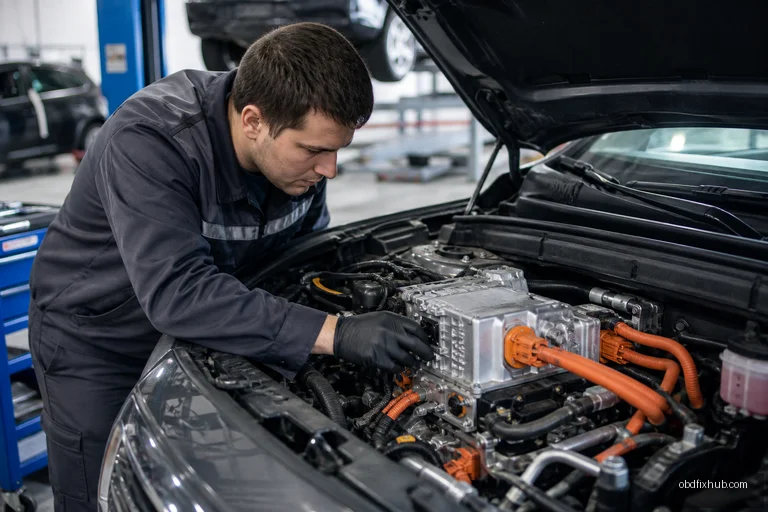
P0A17 means the vehicle has detected a problem in the electric motor torque sensor circuit. On a hybrid or electric vehicle, this usually concerns the drive motor or transaxle torque-sensing system—not automatically the steering torque sensor. The fault may be caused by damaged wiring, a poor connector, a sensor failure, an inverter or control-module issue, or incorrect sensor calibration. Do not replace the motor first: a circuit and live-data check can often identify the real cause.
What Does P0A17 Mean?
P0A17 is an OBD-II powertrain code commonly described as Motor Torque Sensor Circuit. The exact component and diagnostic procedure vary by manufacturer, so the factory service information for the specific vehicle is essential. In some hybrid systems, the torque sensor is integrated into the electric motor, transaxle, or motor-generator assembly.
The sensor reports how much torque the electric motor is producing or attempting to produce. The hybrid control system compares that information with inverter commands, motor speed, accelerator position, battery current, and vehicle speed. If those values do not agree, or if the sensor signal is electrically abnormal, the control module can store P0A17 and restrict electric propulsion.
P0A17 Symptoms You May Notice
A vehicle with this code may still start and drive, but the control system may switch to a protective strategy. Symptoms depend on whether the fault is intermittent, an open circuit, a short circuit, or a complete sensor failure.
- Check Engine, hybrid system, EV system, or powertrain warning light
- Reduced electric-motor power or limited acceleration
- Engine running more often than normal because hybrid assist is restricted
- Harsh engagement, hesitation, or an unusual transition between motor and engine power
- Failure to enter EV mode or a “proceed to a safe place” message
- Stored companion codes involving the inverter, motor position, CAN communication, or high-voltage system
- In severe cases, a no-drive condition or a vehicle that will not enter READY mode
An intermittent wiring fault may be more noticeable after rain, vibration, or a long drive. A permanently implausible sensor signal is more likely to produce immediate reduced-power operation.
Common Causes of the P0A17 Motor Torque Sensor Circuit Code
1. Damaged wiring or connectors
High-voltage drivetrain components experience heat, vibration, and movement. Chafed harness insulation, corrosion inside a sealed connector, a backed-out terminal, or water intrusion can interrupt the low-voltage sensor circuit. A connector can look clean externally while its terminal tension is too weak to maintain a reliable connection.
2. Failed motor torque sensor
The sensor may fail internally because of heat, moisture, wear, or an internal electronic fault. Depending on the design, it may use Hall-effect elements, resolver-style feedback, or another position-and-torque measurement method. Some manufacturers do not sell the sensor separately because it is built into the electric motor or transaxle.
3. Power, ground, or reference-voltage problem
A sensor cannot produce a valid signal if its supply or ground is unstable. A shared 5-volt reference, ground splice, fuse, or control-module power feed can create several apparently unrelated codes. This is why replacing the sensor based only on the code description is risky.
4. Inverter, hybrid control module, or CAN communication fault
The torque signal may be valid at the sensor but corrupted before it reaches the control module. A damaged CAN network, poor module ground, inverter fault, or software issue can set P0A17 alongside communication or motor-control codes.
5. Mechanical or calibration problem
After motor, transaxle, inverter, or control-module work, the system may require initialization or torque-sensor calibration. A misaligned component, incorrect replacement part, or failed calibration routine can produce an implausible reading even when the wiring is intact.
How to Diagnose P0A17 Correctly
Proper diagnosis requires more than clearing the code and taking a test drive. Hybrid and EV systems can contain lethal high voltage, so only technicians trained for the vehicle’s high-voltage architecture should disconnect orange cables or open inverter and battery components.
- Record every code and freeze-frame detail. Note vehicle speed, motor speed, battery state of charge, temperatures, and whether the code is current or history. Companion codes often reveal whether the problem is electrical, mechanical, or communication-related.
- Confirm the code with a capable scan tool. A basic generic scanner may display P0A17 but cannot access hybrid live data, manufacturer-specific subcodes, or calibration functions.
- Inspect the harness before testing components. Follow the torque-sensor wiring from the motor or transaxle to the inverter and control module. Look for rubbed insulation, oil contamination, coolant residue, rodent damage, and connectors that are not fully locked.
- Check supply voltage and ground under load. Do not rely on a continuity test alone. A wire can show continuity with no load yet fail when the circuit carries current or vibrates. Voltage-drop testing and terminal-tension checks are often more revealing.
- Compare live data with commanded torque. A healthy system should show a stable, plausible torque value that changes smoothly with operating conditions. A fixed maximum, sudden spike, implausible negative value, or signal dropout points toward a sensor, wiring, or module problem.
- Use an oscilloscope when the fault is intermittent. Scope testing can reveal dropouts, electrical noise, missing pulses, or mismatched sensor channels that a scan tool may not capture.
- Perform required calibration or initialization. Only after the electrical and mechanical checks pass should the specified relearn procedure be carried out. If calibration repeatedly fails, the component or its mechanical alignment may be incorrect.
Never probe orange high-voltage cables with ordinary test equipment. Follow the manufacturer’s shut-down, isolation, wait-time, and verification procedure before working near the traction system.
How Is P0A17 Fixed?
The repair depends on the failed part rather than the code alone. Typical solutions include repairing a damaged signal wire, replacing corroded terminals, securing a loose connector, restoring a sensor ground, repairing a CAN circuit, updating or replacing a control module, or replacing the integrated motor or transaxle assembly.
- Harness repair: clean, solder or crimp using the manufacturer-approved method, seal, and secure the harness away from heat and moving parts.
- Connector repair: replace terminals or the connector body when terminal tension, corrosion, or water damage is present.
- Sensor replacement: possible on some models, but integrated sensors may require a motor-generator or transaxle assembly.
- Software and calibration: complete the required programming, zero-point learning, or torque-sensor initialization after installation.
Repair cost ranges widely. A loose connector or accessible harness repair may be relatively inexpensive, while an integrated sensor requiring a motor or transaxle replacement can become a major repair. Ask the shop for the test results that justify the estimate, not just a parts list.
What Happens If a Steering Torque Sensor Goes Out?
A steering torque sensor is a different component from the drive-motor torque sensor associated with P0A17. In an electric power steering system, the steering torque sensor measures how much force the driver applies to the steering wheel and in which direction. The EPS control unit uses that input to calculate how much motor assistance to provide.
If the steering torque sensor fails, the system may turn on an EPS or steering warning light, disable power assistance, provide reduced assistance, or enter a fail-safe mode. Steering usually remains mechanically possible, but the wheel can become very heavy—especially while parking, making tight turns, or moving at low speed. Some vehicles may provide uneven or unexpected assistance, so the car should not be driven normally until the fault is diagnosed.
Do not assume that replacing an EPS torque sensor will fix P0A17. A steering-related code normally has a manufacturer-specific EPS or chassis designation, whereas P0A17 generally points to the propulsion motor torque circuit. Always verify the exact module that stored the code.
What Is the Function of a Torque Sensor in Electric Power Steering?
The EPS torque sensor sits around the steering shaft or torsion bar and detects the driver’s steering effort. When you turn the wheel, the torsion bar twists slightly; the sensor converts that movement into an electrical signal. The EPS controller then commands the steering motor to add assistance in the correct direction.
This feedback allows assistance to vary with driving conditions. More help is provided at low speed for parking, while assistance is reduced at higher speed to preserve steering feel and stability. The controller also checks torque-sensor plausibility against steering angle, motor position, and vehicle speed. If the signal is missing or contradictory, it limits or removes assistance as a safety measure.
Can You Keep Driving With P0A17?
There is no universal yes-or-no answer. If the vehicle has reduced power, a hybrid-system warning, abnormal acceleration, or a message instructing you to stop, pull over safely and arrange professional diagnosis. Even if the vehicle drives normally, continued operation can leave you without expected electric propulsion and may allow a small wiring fault to damage other components.
For a suspected steering torque-sensor failure, avoid unnecessary driving because heavy or inconsistent steering assistance increases the risk during parking, emergency maneuvers, and congested traffic. A qualified hybrid or EV technician should inspect the vehicle with the correct service information and safety equipment.
Key Takeaway
P0A17 identifies a motor torque sensor circuit problem, but it does not by itself identify the failed part. Start with a complete scan, wiring and connector inspection, power-and-ground testing, and live-data comparison. Separately, remember that a steering torque sensor belongs to the EPS system and can cause heavy or inconsistent steering when it fails. Diagnose the module that stored the code before authorizing an expensive motor, transaxle, or steering-column replacement.
Frequently Asked Questions
Is P0A17 related to the steering torque sensor?
Usually not. P0A17 generally refers to the electric propulsion motor torque-sensor circuit. A steering torque sensor is part of the EPS system and normally produces a different, manufacturer-specific fault code.
Can a weak 12-volt battery cause P0A17?
It can contribute to misleading hybrid and sensor faults if system voltage drops during startup. Test the 12-volt battery, charging voltage, and relevant grounds, but do not assume the battery is the only cause without checking the stored and current codes.
Will clearing P0A17 fix the problem?
No. Clearing the code only removes the stored fault temporarily. If the circuit remains abnormal, the code and warning will return, often as soon as the vehicle performs its next torque-sensor self-test.
How much does a P0A17 repair cost?
The range is broad. A loose connector or harness repair may be modest, while an integrated motor, inverter, or transaxle repair can be expensive. The correct estimate depends on the vehicle, the failed component, labor access, and whether calibration or programming is required.
Can I diagnose P0A17 with a cheap OBD scanner?
A basic scanner may read the generic code, but it often cannot show hybrid live data, manufacturer subcodes, or calibration procedures. A professional scan tool and the vehicle’s service documentation are normally required for reliable diagnosis.




