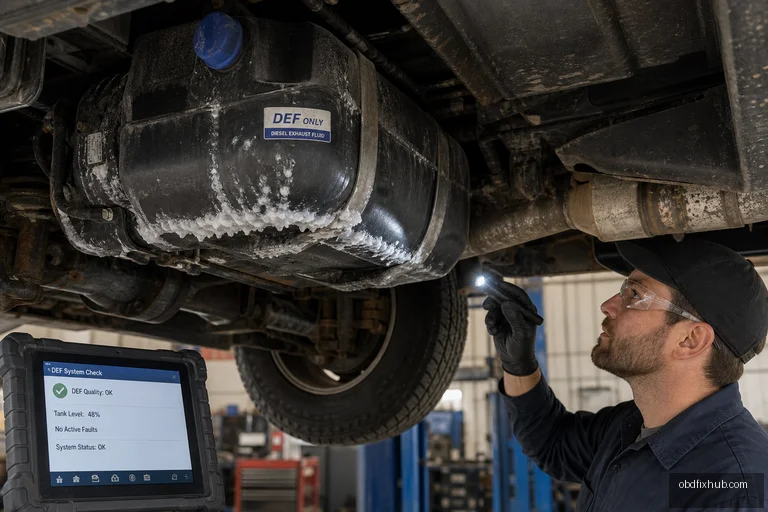
P202D Diesel Exhaust Fluid Reductant Leakage means the vehicle has detected that DEF pressure or delivery is not behaving as expected, often because fluid is escaping from the tank, pump, line, injector, or a related connection. A damaged DEF hose is a common cause, but a weak pump, faulty pressure sensor, crystallized injector, wiring problem, or contaminated fluid can produce the same code. Do not replace the entire DEF tank until the system has been pressure-tested and inspected.
What Does the P202D Fault Code Mean?
P202D is an OBD-II diagnostic trouble code associated with a reductant leakage condition. In diesel emissions systems, reductant is the technical term for Diesel Exhaust Fluid, commonly called DEF or AdBlue. The fluid is injected into the exhaust to help the selective catalytic reduction system reduce nitrogen oxide emissions.
The engine control module monitors the reductant pump, pressure sensor, dosing injector, and delivery lines. If commanded pressure drops too quickly, fails to build, or does not match the expected value, the module may interpret the condition as a leak and store P202D. The exact test logic varies by manufacturer, so the vehicle-specific service manual remains the final authority.
Common Causes of P202D Diesel Exhaust Fluid Reductant Leakage
- Cracked DEF supply line: Plastic lines can split after repeated exposure to freezing temperatures, road debris, heat, or vibration.
- Loose or damaged connector: A poor seal at the tank, pump, injector, or line coupling can allow DEF to escape or air to enter the circuit.
- DEF pump failure: A worn pump may run but fail to create stable pressure, which can look like a leak to the control module.
- Crystallized DEF deposits: Dried DEF leaves white, chalky crystals around fittings and the dosing injector. These deposits can restrict flow or prevent a seal from closing correctly.
- Leaking reductant injector: An injector that does not close properly may drip into the exhaust or lose pressure after the pump shuts off.
- Faulty pressure sensor: An inaccurate sensor can report low pressure even when the fluid circuit is intact.
- Damaged DEF tank or pump module: Impact damage, corrosion, or internal module failure can cause an external or internal leak.
- Incorrect or contaminated fluid: Diesel fuel, water, dirt, or old fluid can damage components and interfere with accurate pressure control.
Symptoms You May Notice
P202D does not always produce an obvious puddle. DEF can evaporate from a warm exhaust area and leave only white residue, while a small leak may occur only when the pump is operating. Common symptoms include a check engine light, a DEF warning, an emissions-system message, or a countdown indicating limited starting or reduced vehicle speed.
- White crystals around the DEF tank, pump, lines, or exhaust injector
- A sweet or ammonia-like odor near the rear of the vehicle
- Low DEF level despite recent filling
- Reduced engine power or an emissions-related warning
- A pump that runs for an unusually long time during key-on testing
- Hard starting or a no-start condition after the warning countdown reaches zero
Some vehicles will continue to drive normally at first. That does not mean the problem is harmless; the system may be allowing time for diagnosis before applying stricter emissions protections.
What Does Reductant Pressure Too Low Mean?
Reductant pressure too low means the DEF pump cannot build or maintain the pressure required for accurate dosing. A genuine leak is one possibility, but low pressure can also result from a restricted filter, a weak pump, a leaking injector, frozen fluid, a blocked line, or a defective pressure sensor.
A useful diagnostic distinction is whether pressure falls immediately or only after several minutes. An immediate drop often points to a disconnected line, open injector, or major leak. Pressure that slowly declines may indicate a small seep, a check-valve problem, or a pump that cannot maintain pressure when warm.
How to Diagnose P202D Correctly
Professional technicians normally begin with a complete scan rather than clearing the code. Record all stored and pending codes, freeze-frame data, DEF temperature, tank level, commanded pump pressure, and measured pressure. Additional codes for the pump, sensor, injector, or heater can reveal which part of the system failed first.
- Inspect the system cold and dry. Look at the tank seam, pump module, line connections, underbody tubing, and exhaust dosing injector. White crystalline residue is an important clue.
- Check for line damage. Follow the complete DEF line from the tank to the injector. Pay special attention to clips, bends, areas close to the exhaust, and locations exposed to road spray.
- Test electrical power and ground. A voltage drop or poor ground can make a healthy pump appear weak. Inspect terminals for moisture and DEF corrosion.
- Run the manufacturer-specific reductant pressure test. The scan tool should command the pump while pressure is compared with the specified range. Do not guess based on pump noise alone.
- Check pressure decay. After the pump stops, observe whether pressure holds. A rapid loss points toward a leak, injector that is not sealing, or an internal pump check-valve fault.
- Verify fluid quality and concentration. DEF should meet ISO 22241 specifications. If contamination is suspected, test the fluid or drain and refill it according to the manufacturer procedure.
Never force compressed air through a DEF line unless the service information specifically allows it. Excessive pressure can damage the injector, pump, or seals and turn a small repair into a complete module replacement.
How to Tell If DEF Fluid Is Bad
Fresh DEF is a clear, colorless liquid with a mild ammonia-like odor. It should not contain dirt, oil, diesel fuel, rust particles, or visible sediment. A cloudy appearance, strong petroleum smell, unusual discoloration, or separation suggests contamination.
Age and storage conditions also matter. DEF can freeze without being permanently ruined, but repeated overheating or prolonged storage can reduce quality. Keep unopened containers away from direct sunlight and excessive heat, and do not pour questionable fluid into an expensive SCR system simply because the tank is low.
- Check the container seal and expiration or production information.
- Do not use fluid that has been stored in a dirty or previously contaminated container.
- Use a DEF refractometer or an approved concentration tester when fluid quality is in doubt.
- Never add water, fuel, additives, or antifreeze to the DEF tank.
How Is P202D Repaired?
The repair depends on where pressure is being lost. A damaged line or connector may be replaced, followed by a leak test and a commanded dosing-system test. DEF crystals can sometimes be dissolved with warm water on external components, but heavily blocked injectors, damaged seals, and contaminated modules normally require replacement rather than aggressive cleaning.
If the pump module is faulty, the vehicle may require a tank-mounted pump assembly. Some models sell the pump separately; others integrate the pump, heater, level sensor, and pressure sensor into one DEF tank module. This is why a confirmed diagnosis matters before ordering parts.
After repair, the technician should clear the code, perform the required reductant-system prime or reset procedure, and complete a road test. Simply clearing P202D without restoring pressure can leave the warning active or trigger a starting countdown later.
How Much Does It Cost to Fix DEF in a Diesel Tank?
Repair cost varies widely by vehicle and by the failed component. A basic diagnosis may cost approximately $100 to $200. Replacing a connector, short line, or injector can often total $150 to $600, while a DEF pump or tank module may range from $800 to more than $2,500 including labor, depending on the truck and parts availability.
Contaminated DEF can increase the bill because the tank and lines may need draining, flushing, and component replacement. Dealer pricing for large diesel pickups and commercial vehicles is often higher than an independent diesel specialist. Ask for a written estimate that identifies the pressure-test results and the exact failed part, not just a recommendation to replace the entire tank.
Can You Drive With P202D?
Short, necessary driving may be possible if the vehicle has no severe power loss or active fluid leak, but postponing the repair is risky. A continuing DEF fault can lead to a speed limitation or a no-start countdown. If DEF is visibly leaking onto hot exhaust components, stop driving and arrange a repair because the leak can worsen and damage nearby wiring or heat shields.
Final Takeaway
P202D points to a reductant pressure or leakage problem, not automatically a failed DEF tank. Start with a visual inspection for white crystals, verify fluid quality, test pump pressure and pressure decay, and inspect the wiring before replacing expensive parts. If the warning is accompanied by a countdown, schedule a qualified diesel or emissions-system diagnosis promptly.
Frequently Asked Questions
What does P202D mean on a diesel truck?
It means the vehicle detected a reductant, or DEF, leakage condition based on pressure behavior. A cracked line, weak pump, leaking injector, sensor fault, or contaminated fluid can all be responsible.
Can low DEF pressure be caused by a bad pump?
Yes. A pump may run and still fail to reach or hold the specified pressure. The correct test is a scan-tool pressure and pressure-decay test, not simply listening for the pump.
Will DEF crystals cause P202D?
They can. Crystallized DEF may restrict the injector, damage a seal, or interfere with a line connection. Clean external residue carefully and inspect the component for permanent damage.
Is it safe to add new DEF to old DEF?
Only if the existing fluid is clean, uncontaminated, and stored within acceptable conditions. If it smells like fuel, looks cloudy, contains debris, or its history is unknown, have the system checked before adding more.
Does clearing P202D fix the problem?
No. Clearing the code only removes the stored warning temporarily. If the pressure fault remains, the code and DEF countdown will usually return after the system performs another self-test.




