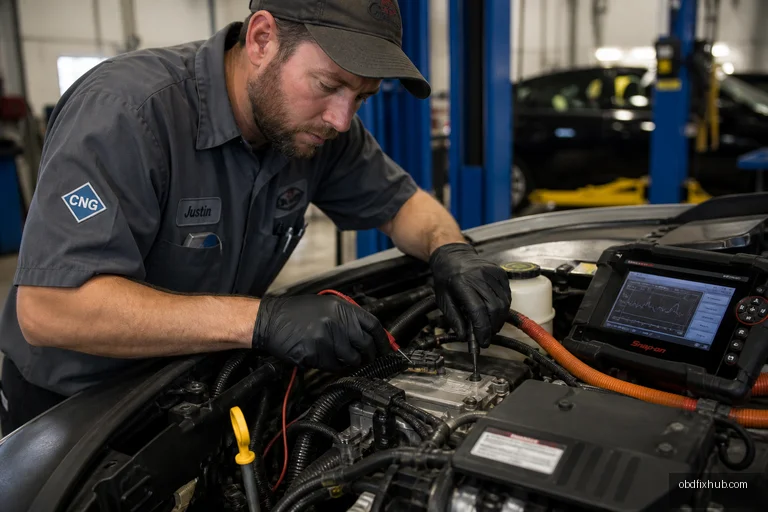
Search intent: Informational. The P25BE Alternative Fuel Disable Control Circuit code usually means the engine computer has detected an open, interrupted, or electrically invalid circuit used to disable an alternative-fuel system. It is most common on vehicles equipped with LPG, CNG, ethanol, hydrogen, or factory bi-fuel systems. The correct repair is not to replace the fuel pump immediately; the circuit, wiring, connectors, control module, and manufacturer-specific diagnostic procedure must be tested first.
What Does P25BE Mean?
P25BE is an OBD-II powertrain diagnostic trouble code associated with the alternative fuel disable control circuit. In practical terms, the powertrain control module (PCM) cannot confirm that the circuit controlling alternative-fuel shutdown is working as expected. Some manufacturers describe the fault as “Alternative Fuel Disable Control Circuit/Open,” while the exact wording and circuit design can vary by make and model.
This circuit is a safety and control pathway. Depending on the vehicle, it may allow the PCM, alternative-fuel control module, or a fuel-system interface module to shut off gas or secondary-fuel delivery during a crash, key-off event, severe engine fault, or transition back to gasoline. A P25BE does not automatically prove that the fuel pump, injector, or pressure sensor is defective.
P25BE Symptoms You May Notice
Some vehicles store P25BE without a noticeable drivability problem, particularly when the alternative-fuel system is not currently in use. Others will prevent fuel switching as a protective measure. Common symptoms include:
- Illuminated check engine light or malfunction indicator lamp
- Inability to switch from gasoline to LPG, CNG, or another alternative fuel
- Engine starting and running only on gasoline
- Hard starting, stalling, hesitation, or reduced power
- Alternative-fuel warning light, flashing fuel-type indicator, or system shutdown message
- Fail-safe operation after a low-voltage event, collision signal, or wiring repair
A useful real-world clue is whether the fault appeared immediately after battery replacement, bodywork, an engine conversion, water intrusion, or work near the fuel tank. Those events often disturb the circuit without damaging the fuel hardware itself.
Most Common Causes of P25BE
- Open or damaged wiring: A broken conductor, stretched harness, chafed insulation, or poorly repaired splice can interrupt the disable command.
- Corroded connectors: Moisture near the alternative-fuel module, tank, underbody harness, or firewall can create high resistance or an intermittent open.
- Blown fuse or failed relay: A power supply fuse may feed the control module or an enable/disable relay.
- Missing ground: A loose ground strap or corroded ground eyelet can make a healthy module appear electrically disconnected.
- Failed alternative-fuel control module: Internal driver failure is possible, but it should be considered after the wiring and power supplies test correctly.
- Incorrect conversion wiring: Aftermarket LPG or CNG installations may use nonstandard splices, relays, or emulators that are vulnerable to vibration and heat.
- Low system voltage: A weak battery or charging problem can set communication and control-circuit codes during cranking.
- Software or configuration issue: Some vehicles require module programming, relearning, or a specific reset after replacement.
How to Diagnose the P25BE Alternative Fuel Disable Control Circuit
Begin with the complete vehicle scan, not just a generic code reader. Record all stored, pending, and history codes, along with freeze-frame data. Codes involving low voltage, lost communication, crash input, or the alternative-fuel module can be more important than P25BE itself.
1. Verify the vehicle and fuel system
Confirm whether the vehicle is factory-built for an alternative fuel or has an aftermarket conversion. Obtain the wiring diagram for the exact year, engine, and fuel configuration. Pin locations and circuit logic are not universal; applying a test voltage to the wrong LPG or CNG circuit can damage a control module or create a fuel-safety risk.
2. Inspect the harness before using a meter
Follow the circuit from the PCM or fuel-system module to the disable relay, connector, and related safety inputs. Look for green corrosion, pushed-back terminals, broken locking tabs, crushed conduit, aftermarket crimp connectors, and harness sections rubbing against brackets. Pay special attention to areas exposed to road salt, water spray, and engine heat.
3. Check power, ground, and fuses under load
A fuse can look intact but fail to deliver reliable power through a damaged fuse-box terminal. Use a wiring diagram and test for battery voltage at the module power terminal with the circuit connected. Perform a voltage-drop test on the ground side while the system is operating or being commanded; a ground that shows excessive voltage drop is not a good ground, even if continuity is present.
4. Test circuit continuity correctly
Disconnect the relevant modules before checking resistance. Verify continuity from end to end, then check for shorts to ground and shorts to battery voltage. Do not rely on a quick continuity beep alone: a wire can pass a low-current meter test yet fail when the circuit carries current or vibrates. A load test or oscilloscope may reveal an intermittent break that a stationary resistance test misses.
5. Command the circuit with a capable scan tool
If supported, use bi-directional controls to command the alternative-fuel disable relay or output. Compare the commanded state with the actual voltage at the specified pin. If the PCM commands the circuit but the output is absent, the fault may be in the driver, relay, power feed, or wiring. If the output is correct but the module reports an open circuit, inspect the return signal, module ground, and connector terminals.
How Is P25BE Fixed?
The repair depends on the failed point found during testing. Typical repairs include replacing a blown fuse after correcting its underlying short, repairing a broken wire with sealed automotive-grade splices, cleaning or replacing corroded terminals, restoring a ground connection, or replacing a defective relay. Aftermarket fuel-system wiring should be repaired to the conversion manufacturer’s specifications rather than simply bypassed.
After the repair, clear the code and perform the correct drive cycle or fuel-mode transition test. Confirm that the vehicle can safely switch between fuel types, that the disable function responds to the scan tool where applicable, and that no related codes return. Never permanently jumper or bypass a fuel-disable circuit to make the warning light disappear. That can defeat an important safety function and may create a serious fire or crash hazard.
Answers to Related Fuel-Control Questions
How do I fix a fuel pump A control circuit low?
A “Fuel Pump A Control Circuit Low” code is not the same as P25BE. It generally indicates that the PCM sees lower-than-expected voltage on the fuel-pump control circuit. Check the fuel-pump fuse, relay, power supply, ground, wiring, connector voltage drop, and pump-control module. A failing pump can overload the circuit, but replacing the pump without checking for a shorted wire, poor ground, or faulty driver can lead to an unnecessary repair.
How do I fix “fuel volume regulator control circuit open”?
This description usually points to an open circuit involving the fuel-volume control valve or regulator, often on a high-pressure diesel common-rail system. Inspect the valve connector and harness, verify the reference or supply voltage specified by the manufacturer, test the control wire for continuity and shorts, and compare commanded versus actual fuel pressure. Do not substitute P25BE for this fault: the systems and diagnostic tests are different.
What does “fuel pressure sensor B circuit low” mean?
It means the PCM is receiving a voltage signal from fuel pressure sensor B that is lower than the expected range. Possible causes include a short to ground, damaged sensor wiring, a failed sensor, incorrect reference voltage, poor sensor ground, or genuinely low fuel pressure. Check live data and the sensor signal with a wiring diagram; a low signal does not automatically mean the fuel pressure itself is low.
Can You Drive With P25BE?
If the vehicle runs normally on gasoline and there is no fuel smell, stalling, warning about a gas leak, or physical harness damage, a short trip to a repair facility may be reasonable. Avoid using the alternative-fuel mode until the fault is diagnosed. Stop driving and arrange professional assistance if you smell LPG or CNG, hear hissing, see damaged fuel lines, or the engine repeatedly stalls.
Key Takeaway
P25BE identifies an electrical problem in the alternative-fuel disable control circuit, not a guaranteed fuel-pump failure. Start with a full scan, wiring diagram, fuse and ground checks, connector inspection, and loaded circuit testing. Repair the root cause, verify the safety shutdown function, then clear the code and confirm that it stays away during a complete drive and fuel-mode test.
Frequently Asked Questions
Is P25BE always caused by a bad alternative-fuel module?
No. Wiring damage, corrosion, an open fuse feed, poor ground, relay failure, low battery voltage, and conversion wiring problems are more accessible and often more likely causes. The module should be condemned only after its power, ground, inputs, and output circuit have been tested.
Can a weak battery trigger P25BE?
Yes. Low voltage during starting can cause a control module to log an open or invalid circuit condition. Test battery voltage during cranking and charging voltage with the engine running, but still inspect the circuit if the code returns after voltage is corrected.
Will clearing P25BE fix the problem?
Clearing the code only removes the stored record temporarily. If the circuit remains open or the module cannot verify the disable command, P25BE will return after the relevant self-test.
Should I bypass the fuel-disable circuit?
No. Bypassing it can prevent the alternative-fuel system from shutting down during an accident or serious fault. Diagnose and repair the original circuit using the vehicle manufacturer’s wiring information and safety procedures.




