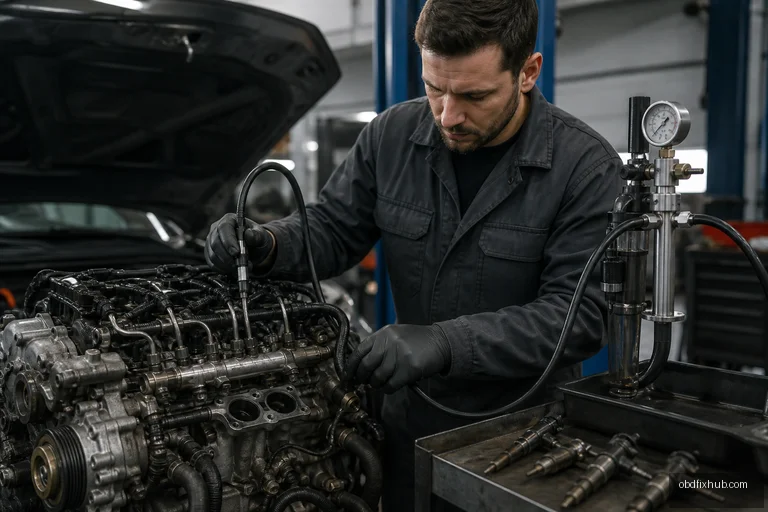
P268B means the engine control module has not successfully learned the calibration values for the high-pressure fuel pump. The code often appears after a high-pressure pump, fuel pressure control valve, engine computer, or related wiring has been repaired or replaced. In many vehicles, clearing the code or disconnecting the battery is not enough; the correct pump calibration or relearn procedure must be completed with a compatible scan tool.
What Does P268B Mean?
P268B is a manufacturer-specific powertrain diagnostic trouble code associated with high-pressure fuel pump calibration. The engine control module, also called the ECM or PCM, uses learned values to control pump output accurately across different engine speeds, loads, and fuel pressures.
On a gasoline direct-injection engine, the high-pressure fuel pump is usually driven mechanically by the camshaft. An electronically controlled metering valve or pressure-control valve adjusts how much fuel enters the pump. During calibration, the control module learns how the pump, valve, pressure sensor, and engine respond together.
The exact wording and test conditions vary by manufacturer. Therefore, the vehicle-specific service information is more reliable than a generic code description. A P268B on one model may require an automatic routine, while another may require a guided replacement procedure with specified fuel pressure and engine-temperature conditions.
Common Causes of P268B High-Pressure Fuel Pump Calibration Not Learned
- A high-pressure fuel pump was replaced without performing the required relearn.
- The fuel pressure control valve or metering valve was replaced.
- The ECM or PCM was replaced, reprogrammed, or reset.
- Battery voltage dropped during programming or calibration.
- The low-pressure fuel supply is weak because of a restricted filter, failing tank pump, or poor electrical supply.
- A fuel rail pressure sensor is inaccurate or has an intermittent connection.
- Open circuits, short circuits, corrosion, or loose terminals affect the pump control wiring.
- The pump is mechanically worn, contaminated, incorrectly installed, or supplied with the wrong part.
- Engine software is outdated or the calibration procedure was interrupted.
A useful diagnostic clue is when P268B returns immediately after a reset. That usually indicates the control module cannot complete the routine because a prerequisite is missing, not simply that the code was not erased correctly. Low system voltage and unstable fuel pressure are two of the most commonly overlooked prerequisites.
Symptoms of a P268B Fault
The vehicle may still start and drive normally when the learned calibration is missing, particularly if the engine can operate using backup fuel-pressure values. Other vehicles will limit engine power or prevent starting because the ECM cannot verify that commanded rail pressure is safe.
Possible symptoms include:
- Long cranking or a no-start condition.
- Hard starting when the engine is hot.
- Rough idle, hesitation, or misfire under acceleration.
- Reduced power or limp-home mode.
- Engine stalling during load changes.
- Low, unstable, or excessive fuel rail pressure.
- An illuminated check-engine light.
- Additional fuel-pressure, mixture, or injector-related codes.
Do not assume the high-pressure pump itself has failed solely because P268B is stored. A pump that is healthy mechanically may still produce this code if the control valve wiring is damaged or the calibration routine was never completed.
How to Diagnose P268B Properly
1. Record all codes and freeze-frame data
Use a scan tool that can access manufacturer-specific functions, not just a basic code reader. Record related codes, battery voltage, engine coolant temperature, commanded fuel pressure, and actual fuel pressure. Codes that appear together often reveal whether the primary problem is fuel supply, pressure sensing, electrical control, or calibration.
2. Check battery voltage before running the relearn
Many calibration procedures are rejected when system voltage falls below the required range. Connect a regulated battery support unit if the procedure is lengthy. A fully charged battery alone may not prevent voltage from dropping when the fuel pump and diagnostic equipment are operating.
3. Compare low- and high-pressure fuel readings
The high-pressure pump cannot create stable rail pressure if the tank-mounted pump is delivering insufficient fuel. Check the low-pressure supply first, then compare the scan-tool readings for desired and actual rail pressure during cranking, idle, and acceleration. A pressure reading that does not respond to commands may indicate a control valve, sensor, wiring, or pump problem.
4. Inspect the electrical circuit
Pay particular attention to the pump control valve connector, ground circuits, and wiring near the cylinder head or high-pressure pump. Heat and vibration can cause terminals to loosen or wires to break internally. A visual inspection should be followed by voltage-drop and continuity testing under load; a static continuity check can miss a connection that fails only when the harness moves.
5. Perform the manufacturer’s calibration routine
After correcting any mechanical or electrical fault, select the appropriate function in the scan tool. It may be labeled fuel pump replacement, high-pressure pump initialization, pump quantity calibration, fuel-pressure regulator relearn, or a similar term. Follow the instructions exactly, including fuel level, coolant temperature, ignition-cycle, engine-speed, and road-test requirements.
How Do I Reset a Fuel Pump Control Module?
A fuel pump control module is not normally reset by simply disconnecting the battery. The proper method is to use a bidirectional scan tool, identify the specific module involved, clear its learned values if the service procedure allows it, and then perform the required initialization or calibration routine.
- Connect a stable battery charger or power supply.
- Scan all modules and save the existing fault codes.
- Repair wiring, fuel-supply, pressure, or sensor faults first.
- Run the module reset, pump replacement, or calibration function specified for the vehicle.
- Cycle the ignition as instructed and complete any required engine-running or road-test procedure.
- Rescan the vehicle and confirm that the calibration status shows learned or completed.
Disconnecting the battery may erase some volatile data, but it usually does not replace a manufacturer-required relearn. It can also erase useful diagnostic information and reset other vehicle systems, so it should not be treated as the repair.
What Are the Symptoms of a Bad High-Pressure Fuel Pump?
A failing high-pressure pump commonly causes low rail pressure during cranking or acceleration, extended starting time, hesitation, misfires under load, poor performance, and stalling. Live data may show that actual rail pressure falls well below the commanded value, especially when the engine demands more fuel.
However, a bad pressure sensor, restricted low-pressure supply, leaking injector, faulty metering valve, or cam-driven pump follower can produce similar symptoms. The strongest diagnosis comes from testing pressure and control signals rather than replacing the pump based on symptoms alone.
Can a Bad Fuel Pump Cause a P228D Code?
Yes, a defective high-pressure fuel pump can contribute to P228D, but the code does not prove that the pump is bad. P228D generally indicates that the fuel pressure regulator has exceeded its control limits, although the precise definition and monitoring strategy depend on the manufacturer.
P228D may result from a weak pump, a sticking pressure-control valve, incorrect fuel pressure feedback, restricted fuel supply, wiring faults, or a software issue. If P228D appears with P268B, inspect the shared fuel-pressure system and complete the calibration procedure after repairs. If P228D remains by itself, diagnose its specific pressure-control conditions instead of assuming P268B is the cause.
Do You Have to Calibrate a Fuel Pump?
Not every fuel pump requires calibration. A conventional in-tank pump that operates at a fixed output may only need correct installation and fuel-system priming. A high-pressure pump on a direct-injection engine, particularly one with an electronically controlled metering valve, often does require initialization or learned-value calibration after replacement.
Calibration is also commonly required after replacing the ECM, fuel pressure regulator, pump control valve, or sometimes the rail pressure sensor. The vehicle repair manual determines whether the routine is mandatory. If the service information specifies calibration, skipping it can leave the vehicle with hard starting, incorrect pressure control, or a recurring P268B.
Safety Notes Before Testing
Direct-injection fuel systems can hold dangerous pressure after the engine is switched off. Never loosen a high-pressure fuel line to check for pressure, and never substitute a low-pressure gauge for the correct equipment. Follow the manufacturer’s depressurization procedure, wear eye protection, and keep ignition sources away from spilled fuel.
Bottom Line: The Correct Fix for P268B
P268B is a calibration-status fault, not an automatic high-pressure pump condemnation. Start with a full scan, stable battery voltage, low-pressure fuel testing, rail-pressure comparison, and wiring inspection. Once the underlying fault is corrected, perform the vehicle-specific pump calibration or relearn with a capable scan tool and verify that the learned status is complete.
If the code returns immediately, stop repeating resets and investigate the condition that prevents calibration. A professional diagnosis is especially important when the vehicle has a no-start condition, unstable rail pressure, or additional fuel-pressure codes.
Frequently Asked Questions
Can I clear P268B with a basic OBD scanner?
A basic scanner may erase the stored code, but it usually cannot perform the high-pressure fuel pump calibration. If the relearn is not completed, P268B may return as soon as the ECM runs its self-test.
Will disconnecting the battery fix P268B?
No. Battery disconnection may clear some temporary memory, but it does not normally complete the required pump initialization. It may also erase freeze-frame information that would help diagnose the fault.
Can I drive with P268B active?
Driving may be possible if the engine runs normally, but fuel pressure can become unstable without warning. Avoid heavy acceleration and towing until the cause is identified, particularly if the check-engine light is flashing, the engine is misfiring, or power is reduced.
Does replacing the high-pressure pump always solve P268B?
No. If the real problem is low battery voltage, a failed pressure sensor, damaged wiring, restricted fuel delivery, incorrect software, or a missed relearn, installing another pump will not solve the code.




