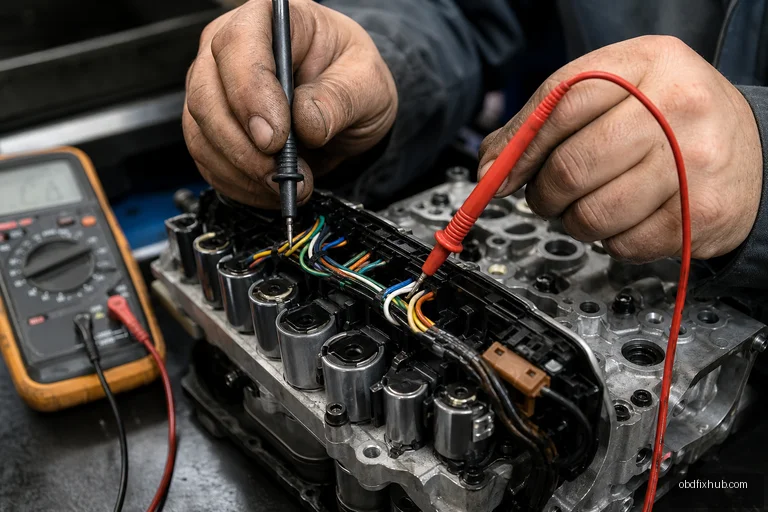
P28E2 Transmission Shift Motor Phase Circuit Open means the transmission control system has detected an interrupted electrical circuit in one phase of the motor that moves or selects the transmission mechanism. The vehicle may refuse to shift, stay in one gear, enter limp mode, or display a transmission warning. Do not assume the shift motor itself has failed: an unplugged connector, damaged harness, blown fuse, poor ground, or water intrusion can produce exactly the same code.
What Does P28E2 Mean?
P28E2 is a powertrain diagnostic trouble code associated with the transmission shift actuator or shift motor phase circuit. In many automated manual, dual-clutch, hybrid, and electronically controlled transmissions, a compact electric motor moves a selector fork, shift rail, or actuator assembly. The motor uses multiple electrical phases, and the transmission control module monitors current and movement through those circuits.
The word open indicates that the module sees an electrical path that is broken or electrically incomplete. This is different from a short circuit, excessive current, or an incorrect gear-ratio code. However, the exact definition and test procedure can vary by manufacturer, transmission type, and model year, so the vehicle-specific service manual should take priority over a generic code database.
P28E2 Symptoms You May Notice
Some vehicles will still drive after setting P28E2, while others will not select a gear at all. The transmission controller may disable shifting to prevent actuator damage or an unsafe gear selection.
- Transmission warning light, check-engine light, or a gear-system message
- Failure to select Drive or Reverse
- Transmission stuck in Neutral, one forward gear, or limp-home mode
- Harsh engagement, delayed shifting, or a loud actuator clicking sound
- Intermittent no-start condition because the control module cannot confirm Park or Neutral
- Reduced-power mode, especially on hybrid or electrified vehicles
An intermittent symptom after rain or washing the vehicle is especially significant. It often points to moisture in a transmission connector or harness rather than a permanently failed motor.
Common Causes of the P28E2 Transmission Code
- Open or broken wiring: The phase wires can break internally near the transmission, where heat, vibration, and movement repeatedly stress the harness.
- Loose or corroded connector pins: A terminal may look connected while failing to carry current under load.
- Failed shift motor or actuator: An open winding inside the motor can interrupt one phase and trigger the code.
- Blown fuse or faulty power supply: A fuse may fail because of a previous short, or a power relay may have high resistance.
- Bad ground or voltage drop: A weak ground can make a healthy actuator appear electrically open to the control module.
- Transmission control module fault: This is possible, but it should be considered only after power, ground, wiring, and the actuator have been tested.
- Mechanical binding: A seized selector mechanism can overload the motor and damage its circuit or cause repeated actuator faults.
How to Diagnose P28E2 Correctly
A professional diagnosis starts with the complete vehicle scan, not with replacing the shift motor. Record every stored, pending, and history code, along with freeze-frame data. A companion code for low voltage, actuator position, communication, or transmission temperature may reveal the original problem.
1. Check battery voltage and related codes
Low system voltage can create misleading actuator faults. Test the battery under load and confirm charging-system output. If the code appeared after a flat battery, jump-start, or battery replacement, clear the code only after checking the supply voltage and grounds.
2. Inspect the harness and connector
Disconnect the transmission actuator connector with the ignition off and inspect it for pushed-back terminals, green corrosion, oil contamination, bent pins, or water tracks. Follow the harness several inches in both directions. Look for rub marks against a bracket, crushed insulation, and sections stretched tight over the transmission mount.
3. Test continuity and resistance
Using the wiring diagram for the specific vehicle, test each phase wire from the transmission connector to the control module. A good continuity reading with the harness sitting still does not prove the circuit is reliable. Perform a wiggle test while monitoring resistance, and use a voltage-drop test when the circuit is commanded under load. Never substitute a random resistance specification; motor phase resistance can be extremely low and requires the manufacturer’s test limits and a suitable meter.
4. Test the actuator or shift motor
If wiring, power, and ground are correct, test the motor windings and actuator position feedback according to the service procedure. Some systems require a bidirectional scan-tool command or a transmission relearn after installation. On hybrid and high-voltage vehicles, the motor may be part of a high-voltage drivetrain assembly; follow the manufacturer’s isolation and personal-protection procedures rather than probing it casually.
5. Check for mechanical resistance
Before condemning an expensive actuator, verify that the selector shaft, shift rail, or gearbox mechanism moves as specified. A mechanically jammed selector can cause a new motor to fail shortly after installation. Technical service bulletins may also identify known harness routing problems or required software updates.
How Is P28E2 Repaired?
The repair depends on the failed part. A damaged wire may require a correctly sized sealed splice and proper harness protection; twisting wires together and covering them with ordinary electrical tape is not a durable transmission repair. Corroded terminals should be repaired with the correct connector components, not merely sprayed with contact cleaner.
If the shift motor or actuator winding is open, the assembly may need replacement. Afterward, many vehicles require clutch touch-point learning, shift actuator calibration, gear-position initialization, or a control-module adaptation procedure. A repair is not complete until the vehicle completes the relearn and performs a road test without returning the code.
Do not continue driving if the vehicle cannot select the correct gear, repeatedly drops into Neutral, or produces grinding and uncontrolled engagement. Towing is safer than risking loss of drive, transmission damage, or an unexpected gear selection.
Can You Drive With P28E2?
Only a short, cautious drive to a repair facility may be reasonable if the vehicle shifts normally and the code is intermittent. Even then, avoid traffic, steep hills, and long trips. If the transmission is stuck in one gear, will not select Reverse, or shows a red transmission warning, arrange a tow instead of repeatedly cycling the ignition and forcing the selector.
What Is the Shift App Used For?
The name Shift app can refer to several unrelated products. The Shift productivity browser is generally used to bring email accounts, calendars, messaging services, and web applications into one desktop workspace. Other apps named Shift are designed to block distracting apps, manage work schedules, or handle team communication. None of these apps diagnoses or repairs the P28E2 transmission code; automotive diagnosis requires a compatible OBD scan tool, wiring information, and vehicle-specific test procedures.
Estimated Repair Cost
Cost varies widely because the same code may be caused by a simple connector repair or a complete actuator assembly. A loose terminal or damaged wire is usually far less expensive than an actuator, transmission mechatronic unit, or hybrid drivetrain component. Ask the repair shop for the test results that justify the part replacement, including the measured power supply, ground, phase-circuit continuity, and actuator test outcome.
Summary: The Best Next Step for P28E2
P28E2 identifies an open shift-motor phase circuit, but it does not automatically prove that the transmission actuator is bad. Start with a full scan, battery and ground checks, a careful connector inspection, and vehicle-specific circuit tests. Repair the underlying electrical or mechanical fault, complete any required calibration, and verify the result with a controlled road test.
Practical action: If the vehicle will not select a gear or the code returns immediately, stop driving and have the transmission harness and actuator tested by a technician familiar with the exact transmission system.
Frequently Asked Questions
Is P28E2 always caused by a bad shift motor?
No. Broken wiring, connector corrosion, poor grounds, low voltage, and a seized selector mechanism are common alternatives. The motor should be replaced only after the circuit and mechanical operation have been verified.
Can a weak battery cause P28E2?
Yes. Low voltage can disrupt actuator operation and create misleading transmission codes. Check battery condition, charging voltage, and relevant grounds before replacing transmission components.
Does clearing P28E2 fix the problem?
No. Clearing the code only erases the warning temporarily. If the phase circuit remains open, the code and shifting problem will return as soon as the control module retests the actuator.
Will P28E2 require transmission replacement?
Usually not. Many repairs involve a harness, connector, fuse, actuator, or calibration procedure. A complete transmission replacement should not be recommended without evidence of internal mechanical damage.
Can I use a basic OBD reader to diagnose P28E2?
A basic reader may display the code, but transmission actuator testing often requires a manufacturer-capable scan tool, live data, bidirectional controls, and access to the correct wiring diagram.




