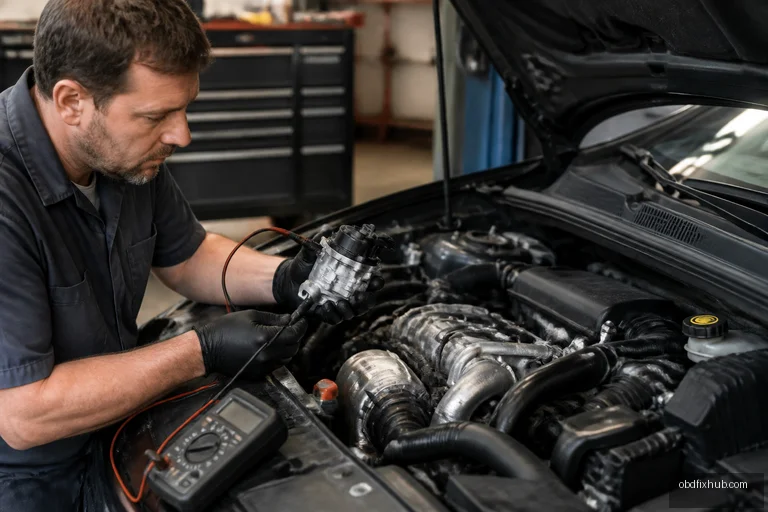
P2B7F Turbocharger Boost Control Module Calibration Not Learned means the engine control module could not complete or store the turbocharger actuator’s position calibration. The fault is usually caused by a sticking variable-geometry mechanism, an incorrectly installed actuator, wiring or voltage problems, or a calibration procedure performed with the wrong scan tool—not simply by a “bad turbo.”
What Does the P2B7F Code Mean?
P2B7F is a manufacturer-controlled OBD-II powertrain code associated with the turbocharger or supercharger boost control module, commonly identified as Calibration Not Learned. During a learn routine, the ECU commands the electronic wastegate or variable-geometry turbo actuator through its operating range and records the mechanical end positions.
If the actuator cannot reach the expected stops, moves too slowly, reports an implausible position, or loses its learned values, the ECU stores P2B7F. The exact wording and repair procedure vary by vehicle, engine, and actuator design, so the factory service information for that specific VIN matters.
How Turbocharger Calibration Works
A modern turbo actuator is more than an electric motor. It normally contains a position sensor, reduction gears, and a linkage connected to the wastegate or variable-geometry vanes. The ECU uses the sensor feedback to know whether the turbo is actually following the requested boost position.
During calibration, the actuator may sweep from one mechanical limit to the other. The ECU then saves values such as the closed position, open position, and permissible travel range. If the linkage is assembled one tooth out, the actuator can appear electrically healthy while still failing the learn process.
A useful diagnostic clue
If P2B7F returns immediately after a replacement actuator or turbocharger is installed, suspect installation indexing, an incompatible part, or a missing initialization procedure before condemning the new component. A replacement actuator that was bench-tested successfully can still fail once connected to a stiff or incorrectly adjusted turbo mechanism.
Common Causes of P2B7F
- Carbon or rust restricting movement: Variable-geometry vanes and wastegate pivots can stick, particularly on diesel engines used for short journeys or engines with heavy soot loading.
- Incorrect actuator installation: The actuator arm may be fitted in the wrong position, the linkage may be preloaded, or the mechanical stop may be misadjusted.
- Actuator gear or sensor failure: Stripped plastic gears, an internal position sensor fault, or water intrusion can make the reported position disagree with commanded movement.
- Open, shorted, or high-resistance wiring: Damaged harnesses near the turbo are exposed to heat, vibration, and oil contamination.
- Low system voltage: A weak battery, poor engine ground, or charging fault can interrupt the learn sequence and create misleading actuator codes.
- Incorrect software or scan-tool procedure: Some vehicles require a manufacturer-level guided function, security access, engine temperature range, or a specific ignition sequence.
- Turbocharger mechanical damage: Shaft play, contact between the compressor wheel and housing, or a seized vane ring can prevent the actuator from completing its travel.
P2B7F Symptoms You May Notice
The vehicle may drive almost normally at light throttle because the ECU can substitute a default boost strategy. Symptoms often become obvious under load, when accurate turbo control is essential.
- Reduced power or limp-home mode
- Slow acceleration, especially uphill or while towing
- Underboost or overboost symptoms
- Surging, hesitation, or inconsistent throttle response
- Illuminated Check Engine light
- Higher fuel consumption or increased exhaust smoke
- Turbo actuator clicking, buzzing, or repeatedly cycling after key-off
Do not assume every loss-of-power complaint is caused by P2B7F. A split charge-air hose, faulty boost pressure sensor, exhaust restriction, vacuum leak, or EGR problem can produce similar driving symptoms and may be the original cause of an actuator overload.
Correct Diagnostic Process for P2B7F
- Record every code and freeze-frame value. Note engine speed, requested boost, actual boost, battery voltage, and whether the code is current or stored. Related codes often reveal the direction of the fault.
- Check battery voltage and grounds. Perform the learn procedure with stable voltage. If the vehicle manufacturer specifies a support charger, use one rather than relying on a partially charged battery.
- Inspect the actuator connector and harness. Look for melted insulation, green corrosion, oil inside the plug, loose terminals, and harness sections rubbing against the turbo or heat shield.
- Run an actuator output test. Watch the commanded and actual position values. A smooth response is important; a sudden jump, flat spot, or position that stops short indicates a mechanical or feedback problem.
- Check mechanical freedom with the actuator disconnected only as specified by the manufacturer. The wastegate lever or vane mechanism should move through its specified range without binding. Never force a lever against its stop.
- Perform the official basic setting or adaptation. Use a capable OEM-level scan tool and follow the required temperature, ignition, and pedal conditions. Generic code clearing is not calibration.
- Verify the repair. Clear codes, complete the learn routine, road-test under controlled load, and rescan. Confirm that requested and actual boost track one another rather than relying only on the absence of a warning light.
What Does P00AF Mean in Relation to Turbocharger Boost Control?
P00AF generally means Turbocharger/Supercharger Boost Control “A” Performance. It indicates that the boost control system is not responding as expected or that the actuator position and boost result do not match the ECU’s command. P00AF is a performance or range problem, while P2B7F specifically points to a failed or incomplete calibration-learning event.
These codes can appear together. For example, a sticking variable-geometry mechanism may first prevent calibration, setting P2B7F, and then cause P00AF when the engine cannot achieve the requested boost during a road test.
What Does P0046 Mean?
P0046 means Turbocharger/Supercharger Boost Control “A” Circuit Range/Performance. It suggests that the control circuit, actuator feedback, or the mechanical response is outside the expected range. It is not automatically an electrical open circuit; it can also be caused by a sticking actuator, incorrect linkage position, poor power supply, or an implausible position signal.
Compare P0046 with circuit-specific codes before replacing parts. If a scan tool shows a position command changing but the feedback remains fixed, test the actuator sensor and wiring. If both command and feedback move but boost is wrong, inspect the air system, exhaust side, and turbo mechanism.
What Does VW P004500 Turbocharger Boost Control A Circuit Open Mean?
On many Volkswagen diagnostic systems, P004500 is the manufacturer’s display format for SAE P0045 with a zero failure-type suffix. It is commonly described as Turbocharger/Supercharger Boost Control “A” Circuit/Open. In practical terms, the ECU has detected an interruption in the electrical circuit serving the boost control actuator or its control path.
Check the actuator fuse, power feed, ground, connector pins, and continuity under harness movement. Because VW actuator systems differ by engine, confirm the wiring diagram and expected terminal voltages for the engine code. A circuit-open code should be electrically tested before replacing the turbocharger.
Can You Fix P2B7F Without Replacing the Turbo?
Often, yes. If the turbo shaft is sound and the vane or wastegate mechanism moves freely, the repair may be a connector repair, actuator replacement, correct installation, or software-guided adaptation. Replacing the complete turbo without checking actuator travel can leave the original wiring or calibration problem unresolved.
However, a turbocharger with seized vanes, damaged bearings, excessive shaft play, or a broken wastegate pivot requires mechanical repair or replacement. Do not repeatedly force the adaptation routine; each failed sweep can overheat a weak actuator and obscure the original fault.
Final Takeaway
P2B7F is a calibration failure, not a complete diagnosis. Start with voltage, wiring, actuator feedback, and mechanical travel, then perform the correct manufacturer-level learn procedure. If P00AF or P0046 is also present, use those codes to determine whether the problem is performance-related, range-related, or an actual open circuit. A disciplined test sequence is usually faster and cheaper than replacing the turbocharger by guesswork.
Frequently Asked Questions
Is P2B7F safe to drive with?
Short, gentle driving may be possible, but continued heavy-load operation is not advisable. Incorrect boost control can cause limp mode, overheating, smoke, or excessive turbo speed. Avoid towing and hard acceleration until the fault is diagnosed.
Does clearing P2B7F fix the problem?
No. Clearing the code only removes the stored fault temporarily. If the actuator cannot complete its learn routine, P2B7F will return, often immediately or during the next drive cycle.
Can a weak battery cause turbo actuator calibration failure?
Yes. A voltage drop during the actuator sweep can interrupt calibration or corrupt the learned position. Test the battery and charging system, and use a regulated support charger when the service procedure requires it.
Does P2B7F always mean the turbocharger is bad?
No. Wiring, actuator indexing, software requirements, carbon buildup, and low voltage are common alternatives. The turbo itself should be condemned only after actuator operation and mechanical movement have been verified.
Will a generic OBD scanner perform the calibration?
Usually not. Many generic scanners can read and clear P2B7F but cannot run the required basic setting or actuator adaptation. Use a vehicle-specific or OEM-level diagnostic tool with the correct guided function.




