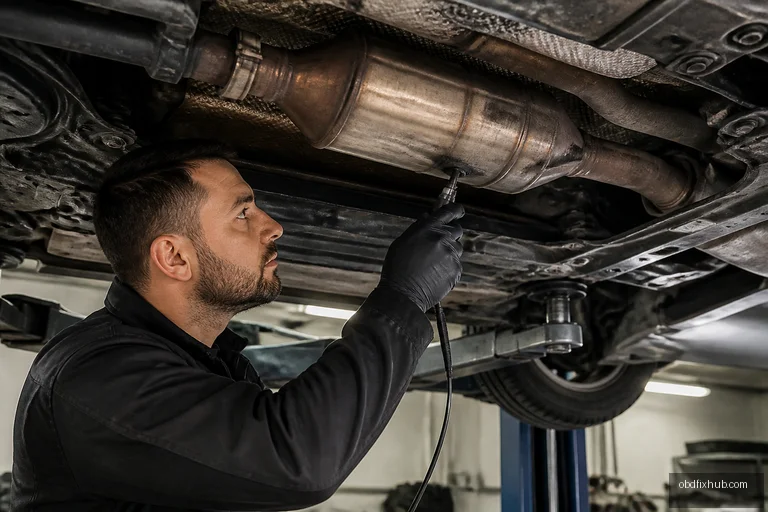
P2BA5 Particulate Filter Feedgas Performance: Meaning, Causes, Symptoms & Fix
P2BA5 Particulate Filter Feedgas Performance means the engine control module has detected that the exhaust gas entering the particulate filter is not behaving as expected. The fault may be caused by a restricted filter, inaccurate pressure or temperature data, an exhaust leak, incomplete regeneration, or an engine problem that produces excessive soot. Do not replace the particulate filter immediately; a structured diagnosis often identifies a smaller and less expensive fault.
What Does P2BA5 Mean?
P2BA5 is an OBD-II powertrain fault code associated with particulate filter feedgas performance. “Feedgas” refers to the exhaust gas conditions before the particulate filter, including pressure, temperature, oxygen content, soot loading, and exhaust flow. The control module compares sensor readings and calculated values with the conditions required for the filter to work correctly.
The exact wording and test strategy can vary between manufacturers. Some vehicles use the code to describe an implausible pressure relationship, while others focus on temperature behavior, regeneration conditions, or filter efficiency. Always verify the definition in the manufacturer’s service information rather than relying only on a generic scan-tool description.
Common Causes of P2BA5
In practice, P2BA5 is rarely caused by one component alone. The engine computer is evaluating a complete exhaust system, so the underlying problem may be upstream of the filter or even inside the engine.
- Restricted or ash-loaded particulate filter: Soot can normally be burned during regeneration, but ash from oil and combustion remains permanently. A filter with excessive ash volume may create abnormal backpressure even after a successful regeneration.
- Blocked or damaged differential-pressure sensor hoses: Small hoses can fill with soot, crack, melt, or become connected to the wrong ports. This can create a false pressure reading that looks like a filter-performance problem.
- Faulty exhaust gas temperature sensor: A sensor that reads too cold or too hot can prevent regeneration or cause the control module to reject otherwise normal feedgas conditions.
- Exhaust leaks before the filter: A cracked flex pipe, leaking gasket, or loose clamp can draw in outside air and disturb pressure and oxygen readings. Soot marks around a joint are a useful clue.
- Repeated failed regenerations: Short trips, extended idling, low exhaust temperature, interrupted regeneration, or low fuel level can allow soot loading to increase faster than it can be removed.
- Excessive soot production: Injector faults, turbocharger problems, EGR issues, restricted air intake, incorrect fuel pressure, and poor combustion can overload the filter.
- Software or calibration issues: Some vehicles require an engine or aftertreatment control-module update before a correct repair can be confirmed.
Symptoms You May Notice
The symptoms depend on whether the filter is mildly restricted, actively regenerating, or already in a protection strategy. A vehicle may still drive normally at first, which is why the fault should not be ignored.
- Check Engine Light or a particulate-filter warning
- Reduced engine power or limp mode
- Higher fuel consumption
- Cooling fans running after the engine is switched off
- Elevated idle speed during regeneration
- Hot exhaust smell or unusually high exhaust temperature
- Hard starting, poor acceleration, or frequent regeneration requests
- Increasing exhaust backpressure and turbocharger response problems
A useful real-world clue is the pattern of the warning. If the light appears after several interrupted city journeys, regeneration failure is more likely. If it returns immediately after clearing the code, suspect a sensor, wiring fault, incorrect pressure reading, or a severe restriction.
How to Diagnose P2BA5 Correctly
Professional diagnosis should begin with scan data, not parts replacement. Record all stored, pending, and manufacturer-specific codes before clearing anything. Codes for temperature sensors, EGR operation, fuel pressure, turbocharging, or differential pressure may explain why the filter cannot achieve the expected feedgas conditions.
1. Check live data and freeze-frame information
Compare the particulate-filter differential pressure, exhaust temperatures, calculated soot load, ash load, regeneration status, and engine speed. A pressure value that remains unusually high at idle, or fails to increase smoothly with engine speed, points toward a sensor or restriction problem. Compare the readings with the manufacturer’s specifications rather than using universal pressure limits.
2. Inspect the pressure sensor circuit
Remove and inspect both pressure hoses. They must be clear, correctly routed, heat-resistant, and connected to the correct upstream and downstream ports. Check the connector for oil contamination, corrosion, loose terminals, and wiring damage near the exhaust. A new sensor cannot correct a blocked hose.
3. Test temperature sensors and exhaust leaks
With the engine cold, exhaust temperature sensors should show plausible values close to ambient temperature. During warm-up, their readings should rise smoothly and in the correct order. Inspect the exhaust manifold, flex section, clamps, sensor bosses, and filter connections for leaks, especially where black soot has deposited around a joint.
4. Establish the actual soot and ash condition
Do not confuse soot loading with ash loading. A commanded regeneration may reduce soot, but it will not remove accumulated ash. If measured backpressure remains excessive after a verified regeneration, the filter may need professional off-vehicle cleaning or replacement.
5. Investigate why the filter loaded up
If the root cause is not repaired, a replacement filter can fail again quickly. Check injector correction values, fuel trim where applicable, EGR operation, boost pressure, air-filter condition, crankcase oil consumption, and turbocharger integrity. On diesel applications, confirm that the correct low-ash engine oil has been used.
P2BA5 Fix: What Repairs Usually Work?
The correct fix depends on the test results. A damaged pressure hose may require only a hose replacement and sensor recalibration. A temperature-sensor or wiring fault requires electrical repair and verification of the sensor signal. If an upstream exhaust leak is found, repair it before attempting a regeneration.
- Repair exhaust leaks and damaged wiring.
- Replace blocked hoses or a failed differential-pressure sensor.
- Repair injector, EGR, turbocharger, intake, or fuel-system problems causing excess soot.
- Perform a service regeneration only when the filter is within safe limits and the vehicle manufacturer permits it.
- Professionally clean or replace a filter that is ash-loaded, melted, cracked, or structurally damaged.
- Complete the required reset, adaptation, or learned-value procedure after filter or sensor replacement.
Forced regeneration is not a universal cure. If the filter is severely blocked, regeneration can produce extreme temperatures and damage the filter, turbocharger, or surrounding components. It should never be used to mask an injector, boost, or sensor problem.
Can You Keep Driving With P2BA5?
Short, gentle driving to a repair facility may be reasonable if the vehicle has normal power, no flashing warning light, and no signs of overheating. Avoid towing, heavy acceleration, and repeated attempts to force a regeneration. Stop driving and arrange professional assistance if the vehicle enters severe limp mode, shows excessive smoke, emits a strong burning smell, or displays an exhaust-temperature warning.
How to Prevent the Code From Returning
Follow the correct oil specification, service the engine on schedule, and address warning lights before the particulate filter becomes saturated. Vehicles used mainly for short trips benefit from occasional manufacturer-approved sustained driving that allows the exhaust to reach regeneration temperature. However, a highway drive cannot repair a faulty sensor or a filter that is already ash-blocked.
Summary
P2BA5 Particulate Filter Feedgas Performance indicates that the control module has detected abnormal conditions entering or affecting the particulate filter. The most reliable repair process checks pressure hoses, sensor signals, exhaust leaks, regeneration history, filter loading, and engine soot production in that order. Diagnose the cause before replacing the filter, then perform the required reset and confirm the repair with live data and a road test.
Frequently Asked Questions
Is P2BA5 caused by a bad particulate filter?
Not necessarily. A restricted filter is one possibility, but blocked pressure hoses, inaccurate temperature readings, exhaust leaks, and excessive soot from an engine fault can produce the same code.
Can I clear P2BA5 with a code reader?
You can erase the stored code, but it will return if the underlying condition remains. Clearing it without testing may also remove useful freeze-frame information needed for diagnosis.
Will a forced regeneration fix P2BA5?
It may help when the filter has a manageable soot load and all sensors and engine systems are working correctly. It will not remove ash, repair a sensor, or solve an injector or turbocharger problem.
How much does it cost to repair P2BA5?
The cost ranges widely. A hose or wiring repair may be inexpensive, while professional filter cleaning, filter replacement, or an underlying fuel and turbocharger repair can be substantially more expensive.
What should be checked first?
Start with all related trouble codes, freeze-frame data, differential-pressure sensor hoses, live pressure readings, exhaust leaks, and exhaust temperature sensor plausibility. This sequence prevents unnecessary particulate-filter replacement.




