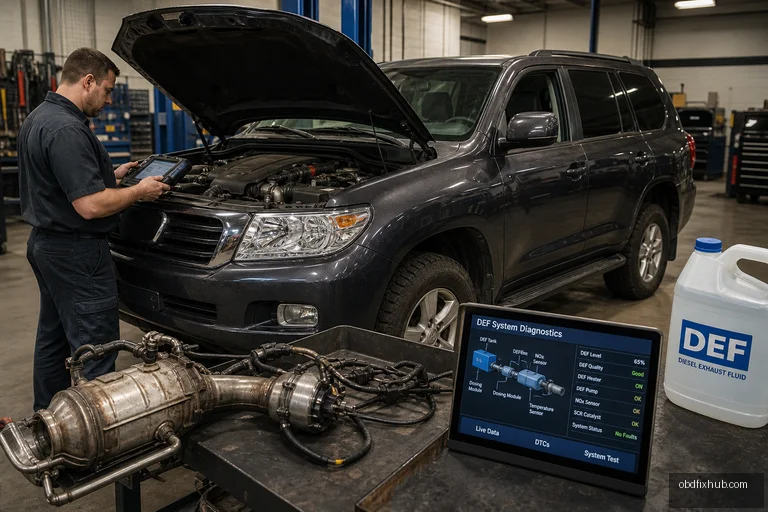
P2BAA NOx emissions exceeded due to low reagent consumption means the vehicle’s emissions computer has detected that the SCR system is not using enough diesel exhaust fluid (DEF/AdBlue) to reduce nitrogen oxide emissions. The code does not automatically prove that the DEF itself is bad. A low dosing rate, blocked injector, inaccurate NOx sensor, wiring fault, incorrect fluid, or software problem can all produce the same warning.
This is usually an emissions-system fault rather than an immediate engine failure, but ignoring it can activate a DEF countdown and eventually prevent the vehicle from restarting. The correct repair starts with measuring actual DEF pressure, dosing quantity, sensor data, and fluid quality—not simply clearing the code.
What Does the P2BAA Fault Code Mean?
P2BAA is a generic OBD-II fault code commonly described as NOx exceedance due to low reagent consumption or NOx exceedance—low reagent consumption. In practical terms, the engine control module or aftertreatment control module expected the SCR system to consume a certain amount of DEF, but the measured emissions result did not match that expectation.
DEF is injected into the exhaust upstream of the SCR catalyst. At operating temperature, it produces ammonia, which reacts with NOx and converts it mainly into nitrogen and water. If too little DEF reaches the catalyst, or if the catalyst cannot use it effectively, downstream NOx levels remain too high and P2BAA may be stored.
The exact wording and test strategy vary by manufacturer. GM trucks, diesel SUVs, European vehicles, and Jaguar models may use different supporting codes, countdown logic, and diagnostic names even when the underlying issue is similar.
P2BAA NOx Emissions Exceeded: Common Causes
1. Restricted or failed DEF dosing injector
The dosing injector can crystallize when DEF dries around its tip. White, chalky deposits near the injector or exhaust pipe are a strong clue, although the injector may also fail electrically without visible residue. A technician should command the injector with a scan tool and verify both spray pattern and measured delivery volume.
2. Low DEF pressure or a weak pump
The DEF pump must build and maintain pressure before injection. A failing pump, clogged pickup filter, frozen fluid, leaking line, or poor electrical connection can cause low consumption. A tank that appears full does not rule out a pressure problem; the pump and delivery circuit can still be unable to dose the system.
3. Incorrect, contaminated, or degraded DEF
Correct DEF must meet ISO 22241. Diesel fuel, tap water, coolant, cleaning chemicals, and old or contaminated fluid can damage the SCR system and trigger a quality warning. DEF can also degrade after prolonged heat exposure or contamination from an unclean funnel.
Do not judge fluid quality by color alone. Clear-looking fluid may still be contaminated, and a refractometer reading by itself does not confirm that the fluid is free of diesel, metals, or other chemicals. If contamination is suspected, the tank should be drained and inspected rather than repeatedly topped up.
4. NOx sensor or temperature sensor inaccuracies
The SCR system relies on upstream and downstream NOx sensors to calculate conversion efficiency. A biased downstream sensor can report excessive NOx even when DEF dosing is normal. Exhaust temperature sensors are equally important because the SCR catalyst cannot work correctly when it is too cold or when the control module receives an incorrect temperature signal.
5. Exhaust leaks or SCR catalyst damage
A leak near a NOx sensor can draw in outside air and distort readings. A damaged, poisoned, or thermally degraded SCR catalyst may also fail to convert NOx despite correct DEF pressure and injector operation. Catalyst replacement should not be the first guess; dosing and sensor tests should be completed first.
6. Wiring, software, and operating conditions
Corroded connectors, damaged harnesses, low battery voltage, and outdated control-module software can create false or intermittent faults. Short trips and repeated cold operation may prevent the SCR system from reaching the temperature needed for its self-tests, although these conditions alone should not be assumed to be the root cause of a persistent P2BAA code.
What Does It Mean If My DEF Quality Is Incorrect?
An “incorrect DEF quality detected” warning means the vehicle’s control system believes the fluid concentration or chemical behavior does not match approved DEF. It can mean the fluid is genuinely wrong, but it can also be caused by a defective quality sensor, contaminated tank, dosing problem, or implausible sensor data.
Use only sealed, certified DEF from a reputable supplier. Never dilute it with water or add fuel-system products. If the wrong fluid was added, do not start or drive the vehicle if possible; professional draining and flushing may prevent expensive damage to the pump, injector, and SCR catalyst.
Symptoms That Often Appear With P2BAA
- Check Engine or Service Engine Soon light
- “Service DEF System” or “Incorrect Diesel Exhaust Fluid Quality Detected” message
- DEF range or restart countdown on the instrument cluster
- Reduced engine power or limited vehicle speed
- Stored NOx, SCR efficiency, DEF pressure, or reductant quality codes
- Little or no visible change in DEF level despite normal driving
- White DEF crystals around the injector, exhaust, or tank components
Performance may feel completely normal at first. The countdown is often the most serious symptom because some vehicles eventually display “No restart after” a specified distance. The exact limit varies, so the warning should be diagnosed promptly rather than driven until the countdown reaches zero.
How to Diagnose P2BAA Correctly
- Scan every related module. Record stored, pending, and manufacturer-specific codes before clearing anything. Look for NOx sensor, reductant pressure, injector, temperature, quality, and communication faults.
- Check the service data. Review DEF temperature, tank level, calculated quality, pump pressure, upstream and downstream NOx values, exhaust temperature, and commanded dosing rate.
- Inspect the fluid and hardware. Look for contamination, crystallization, leaks, damaged lines, connector corrosion, and exhaust leaks around the sensors and injector.
- Run active tests. A capable scan tool can command the DEF pump and injector. The measured pressure and delivered volume should be compared with the manufacturer’s specification.
- Confirm the repair with a drive cycle. Many SCR monitors require a fully warmed engine, steady-speed driving, and specific load conditions before they will run. A code that stays cleared while parked is not proof of a successful repair.
A useful diagnostic clue is the relationship between commanded dosing and actual DEF consumption. If the module commands dosing but pressure remains low, suspect the pump, line, filter, or injector. If dosing is correct but downstream NOx remains high, investigate sensor accuracy, exhaust temperature, leaks, and catalyst efficiency.
How to Fix P2BAA
The repair depends on the test results. Common fixes include replacing contaminated DEF, cleaning or replacing a crystallized dosing injector, repairing a DEF line, replacing a failed pump, correcting wiring, updating control-module software, or replacing a defective NOx sensor. A failed SCR catalyst is possible, but it should be confirmed with pressure, dosing, temperature, and sensor-efficiency tests before installation.
Do not pour extra DEF into the tank as a way to “increase consumption.” The system controls injection electronically, and an overfilled tank will not correct a pressure, injector, or sensor fault. Similarly, replacing both NOx sensors without checking live data can create unnecessary expense.
How to Reset “Incorrect Diesel Exhaust Fluid Quality Detected”
There is no universal button sequence that permanently resets this warning. The dependable procedure is:
- Repair the cause and use the correct ISO 22241 DEF.
- Clear the stored code with a bidirectional scan tool capable of accessing the SCR or reductant module.
- Perform any required DEF quality, dosing, or reductant-system reset procedure.
- Complete the manufacturer’s SCR drive cycle so the monitor can verify the repair.
- Re-scan the vehicle and confirm that the countdown and warning do not return.
Disconnecting the battery may erase some temporary dashboard behavior, but it usually will not reset a locked DEF countdown or complete the required adaptation. On many vehicles, a dealer-level tool is necessary, especially after tank replacement, pump replacement, fluid contamination, or a no-start countdown.
What About “Incorrect Diesel Exhaust Fluid Quality Detected” on a Jaguar XF?
If a Jaguar XF displays this message, the vehicle may be reporting genuinely incorrect DEF, a reductant quality-sensor issue, or a broader SCR dosing fault. Jaguar systems can store related faults in more than one control module, so a basic generic code reader may show P2BAA but miss the manufacturer-specific code that identifies the failed component.
First verify the fluid source and inspect the tank, pump, lines, injector, and wiring. A Jaguar-capable diagnostic tool should then check quality data, DEF pressure, dosing quantity, NOx sensor readings, and required reset procedures. Adding more fluid or repeatedly clearing the warning is unlikely to solve the problem and may allow the restart countdown to continue.
Can You Keep Driving With P2BAA?
Short-distance driving to a repair facility is often possible when the vehicle runs normally, but the warning should not be ignored. Avoid towing, heavy loads, and long journeys while a DEF countdown is active. If the vehicle enters reduced power, shows a near-zero restart range, or has severe running problems, arrange professional assistance instead of risking a no-start condition away from home.
Frequently Asked Questions
What does the P2BAA fault code mean in a car?
It means the SCR system has detected excessive NOx emissions associated with low DEF or reductant consumption. The cause may be the fluid, dosing hardware, NOx sensors, exhaust temperature, wiring, software, or SCR catalyst.
How do I reset incorrect diesel exhaust fluid quality detected?
Correct the underlying fault, use compliant DEF, clear the code with a suitable scan tool, perform the required reductant reset, and complete the SCR drive cycle. A battery disconnect alone is rarely a reliable reset.
Does an incorrect DEF warning always mean the fluid is bad?
No. A failed quality sensor, low DEF pressure, restricted injector, inaccurate NOx sensor, or software fault can produce the same warning. Fluid testing and system diagnostics are needed before replacing parts.
Is P2BAA the same on every vehicle?
The basic OBD-II meaning is similar, but manufacturers use different supporting codes, countdown strategies, and reset procedures. Always check the vehicle-specific service information.
What is the best first step after P2BAA appears?
Scan for all related SCR and NOx codes before clearing anything. Record live data and inspect the DEF injector, pump pressure, fluid condition, and sensor wiring before deciding which part needs replacement.
Bottom Line
P2BAA is a warning that the vehicle’s NOx reduction system is not achieving the expected result, often because too little DEF is being consumed. Treat it as a system-level diagnostic problem, not proof that the tank simply needs more fluid. A proper scan, pressure and dosing test, sensor evaluation, and verified drive cycle are the safest route to a lasting repair.




