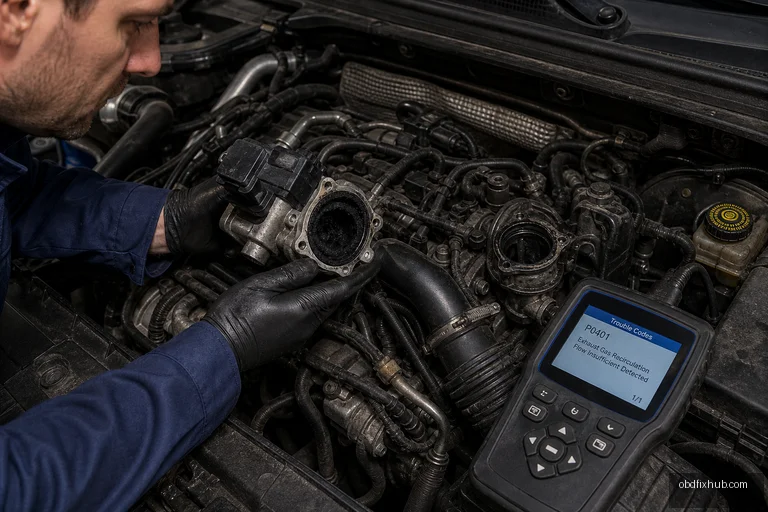
P2BAB NOx emissions exceeded due to incorrect EGR flow means the engine computer has detected that exhaust gas recirculation is not behaving as expected, allowing NOx emissions to rise above the permitted limit. The fault is usually caused by a restricted or carbon-blocked EGR passage, a sticking EGR valve, inaccurate airflow or pressure data, or an electrical problem—not automatically a failed EGR valve.
Because P2BAB is an emissions-performance code, the correct repair starts with testing the entire EGR and air-measurement system. Replacing the valve without checking the cooler, passages, sensors, and wiring is a common way to spend money without fixing the fault.
What Does the P2BAB Code Mean?
P2BAB is a manufacturer-supported OBD-II powertrain code associated with excessive NOx emissions caused by incorrect EGR flow. The engine control module compares expected and measured airflow, EGR position, intake pressure, exhaust conditions, and sometimes downstream NOx sensor data. If those values do not agree during specific operating conditions, it stores the code.
The code does not always identify the failed component. It identifies an emissions result: the engine is receiving too much, too little, or poorly timed exhaust gas recirculation. Exact code descriptions can vary slightly between manufacturers, so the vehicle-specific service information remains important.
Common Causes of P2BAB Incorrect EGR Flow
- Carbon-restricted EGR passages: Soot can narrow the intake manifold, EGR valve throat, cooler, or transfer pipe. A valve may move correctly while almost no gas reaches the intake.
- Sticking or contaminated EGR valve: Oil vapor mixed with soot creates a hard deposit that prevents the valve from reaching its commanded position.
- EGR cooler restriction or leakage: A blocked cooler reduces flow; an internal leak can introduce coolant into the exhaust or intake system and create additional symptoms.
- Faulty differential-pressure, MAP, MAF, or temperature sensor: The control module may calculate incorrect EGR flow if one of these sensors reports implausible data.
- Vacuum, actuator, or wiring faults: Vacuum-operated valves can suffer from split hoses or a weak solenoid. Electronic valves can have damaged wiring, poor grounds, or position-sensor failures.
- Air or exhaust leaks: A leak before the turbocharger, around the EGR system, or near a pressure sensor can distort the readings used to verify flow.
- NOx sensor or SCR-system issues: On diesel vehicles, a failing NOx sensor or an aftertreatment problem can contribute to a related NOx exceedance fault.
Symptoms You May Notice
Some vehicles show only a check-engine light, while others enter reduced-power or emissions-protection mode. Typical symptoms include rough idle, hesitation during acceleration, poor fuel economy, increased soot loading, delayed turbo response, or an engine that feels unusually flat under load.
Diesel drivers may also see an active regeneration message, frequent DPF regeneration, elevated exhaust temperatures, or a warning related to the emissions system. If coolant level is falling, white exhaust smoke appears, or the engine oil level rises, stop treating the problem as a simple valve-cleaning job and inspect for a possible EGR cooler or internal engine issue.
How to Diagnose P2BAB Correctly
- Scan all modules and record freeze-frame data. Note engine speed, load, coolant temperature, commanded EGR position, MAF, MAP, differential pressure, and NOx readings when the code was set. Other codes often provide the best clue.
- Inspect the basics first. Check the air filter, intake hoses, exhaust leaks, vacuum lines, electrical connectors, grounds, and visible soot tracks. A disconnected sensor or split hose can create a misleading EGR fault.
- Compare commanded and actual EGR movement. Use a bidirectional scan tool to command the valve open and closed. The actual position should respond smoothly rather than jumping, lagging, or remaining fixed.
- Verify airflow and pressure data. Compare MAF and MAP readings with known-good specifications. A sensor can be electrically functional yet contaminated enough to report an incorrect value.
- Check EGR differential pressure. A proper pressure change during an EGR command indicates that gas is moving. No change suggests a blocked passage, failed pressure sensor, or actuator problem.
- Inspect the passages physically. If testing points to restricted flow, remove the relevant components and examine the valve, cooler, transfer pipe, and intake ports. Cleaning only the visible valve may leave the main restriction untouched.
- Clear the code and complete a verification drive. The repair is not confirmed until the monitor runs under the conditions that originally triggered the fault.
How Can I Fix an EGR Insufficient Flow Error?
For an insufficient-flow fault, begin by identifying whether the restriction is mechanical or whether the computer is receiving incorrect data. Clean carbon from serviceable EGR passages, replace a valve that fails its position or actuation test, repair vacuum or wiring faults, and replace sensors only after their readings have been compared with specifications.
On high-mileage diesel engines, the intake manifold and EGR cooler can be more restricted than the valve itself. If the manifold is heavily coked, cleaning just the EGR valve may produce a temporary improvement but will not restore the required flow. Use manufacturer-approved cleaning procedures; aggressive solvents or loose carbon entering the engine can cause further damage.
What Causes High EGR Flow?
High EGR flow occurs when more exhaust gas enters the intake than the control module expects. The most common causes are an EGR valve stuck open, a damaged actuator, incorrect differential-pressure feedback, a failed position sensor, or calibration problems after a component replacement.
High flow can produce a rough or unstable idle, hesitation, smoke, reduced oxygen content in the intake, and low MAF readings. A leaking valve may remain slightly open even when the scan tool commands it closed. This is why a static visual inspection is not enough: the valve should be tested at operating temperature and under controlled commands.
How Do I Fix P2BAC on a 6.7 Cummins?
On a 6.7 Cummins, P2BAC is commonly associated with NOx exceedance related to EGR deactivation, although the exact wording depends on the calibration and scan tool. Start by checking for companion codes involving EGR position, MAF, MAP, exhaust pressure, NOx sensors, DPF operation, or aftertreatment efficiency.
For a reliable repair, test the EGR valve and actuator, inspect the EGR differential-pressure system, verify the intake throttle and airflow readings, and check for wiring damage around the hot exhaust components. Inspect the EGR cooler and passages for restriction or leakage. Software updates may be required when Cummins service information identifies a calibration issue, but programming should follow the manufacturer procedure rather than using emissions-delete software.
Do not permanently disable or remove the EGR system. That can create additional faults, violate emissions regulations, increase NOx output, and make the truck fail an inspection. A proper repair restores the original emissions controls and confirms operation with a complete drive cycle.
Is a P0401 Repair Expensive?
A P0401 insufficient-EGR-flow repair can be relatively inexpensive when the cause is a split vacuum hose, dirty sensor, or accessible carbon deposit. Typical costs may range from about $100 to $300 for diagnosis and a minor repair, while professional intake or EGR cleaning may cost several hundred dollars.
The bill becomes substantially higher if the vehicle needs an EGR valve, cooler, intake-manifold cleaning, NOx sensor, or extensive labor. Parts availability and access vary widely by vehicle. A diagnostic fee is worthwhile because replacing an EGR valve without confirming the restriction can turn a small repair into an unnecessary $500–$1,500 parts-and-labor expense.
When Should You Stop Driving?
Short trips to a repair shop are usually reasonable when the vehicle runs normally and only the warning light is on. Avoid continued driving if there is severe power loss, overheating, coolant loss, heavy smoke, uncontrolled regeneration, an oil-level increase, or an emissions countdown that may eventually limit starting.
Ignoring the fault can increase DPF loading and fuel consumption, cause repeated regeneration, and lead to additional NOx or aftertreatment codes. Addressing the underlying airflow problem early is usually cheaper than replacing several emissions components later.
Key Takeaway
P2BAB does not mean that the EGR valve is automatically defective. It means the vehicle detected incorrect EGR performance severe enough to raise calculated or measured NOx emissions. Diagnose airflow, pressure, position feedback, passages, sensors, and related emissions systems as one package, then verify the repair with a complete drive cycle. If you have the code read, freeze-frame data, engine type, and companion codes available, a qualified technician can usually narrow the fault much faster.
Frequently Asked Questions
Can I drive with the P2BAB code?
Limited driving may be possible if the engine runs normally, but the fault should be diagnosed promptly. Continued operation can increase soot loading, fuel consumption, and the risk of reduced-power mode.
Does P2BAB always require an EGR valve replacement?
No. Carbon restriction, inaccurate MAF or MAP data, a faulty pressure sensor, wiring damage, an EGR cooler problem, or an exhaust leak can all create the code.
Can a dirty MAF sensor cause P2BAB?
Yes. The engine computer uses measured airflow to evaluate EGR operation. A contaminated MAF sensor can falsely suggest too much or too little EGR flow.
Will clearing P2BAB permanently fix the problem?
No. Clearing the code only removes the stored warning until the monitor runs again. If the cause remains, P2BAB or a related fault will return.
Is an EGR delete a proper solution?
No. Removing or disabling emissions equipment is illegal in many regions and can increase NOx emissions. The correct solution is to repair the factory EGR and aftertreatment system.




