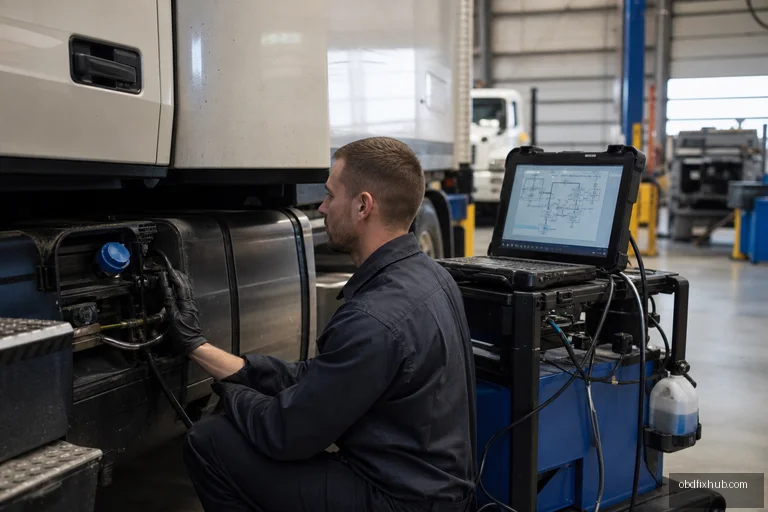
What Does P2BAF NOx System Driver Inducement Active Mean?
P2BAF NOx System Driver Inducement Active means the vehicle has activated an emissions-related driver warning or operating restriction because the NOx reduction system is not meeting its required conditions. On a diesel equipped with SCR and DEF, this may lead to warning messages, a speed or torque limitation, a countdown to no-start, or—in some vehicles—an inability to restart after the engine is switched off.
This is usually not a simple sensor code that can be erased permanently. The engine control module or aftertreatment control module has decided that the emissions system fault has reached the manufacturer’s inducement threshold. The exact trigger varies by make, model, engine family, and software calibration, so the complete scan report is more important than the P2BAF code alone.
P2BAF Search Intent: Are You Looking for a Repair?
Most drivers searching this code need two answers: whether the vehicle is safe to drive and what must be repaired before the inducement becomes more severe. The practical answer is to inspect the complete DEF/SCR system promptly. A short trip to a repair facility may be reasonable if the vehicle runs normally, but continuing to drive until a no-start or severe derate occurs can leave you stranded and make diagnosis more difficult.
Common Causes of P2BAF
P2BAF identifies the active inducement condition, not necessarily the failed component. In real workshop diagnosis, the underlying cause is often found in one of these areas:
- Low, contaminated, or incorrect DEF: Diesel exhaust fluid that is diluted, mixed with fuel, contaminated by dirt, or stored beyond its useful condition can prevent proper SCR operation.
- NOx sensor failure: A NOx sensor may report implausible readings, respond too slowly, or lose communication. Wiring damage and connector corrosion are common, especially near hot exhaust components.
- DEF dosing problems: A blocked injector, failed pump, restricted line, weak pressure, or crystallized DEF at the injector can stop the required amount of fluid from reaching the exhaust.
- SCR catalyst performance failure: An aging, damaged, overheated, or chemically contaminated catalyst may not convert enough NOx even when dosing appears normal.
- Exhaust temperature or pressure faults: Incorrect temperature readings, a plugged filter, exhaust leaks, or pressure sensor errors can make the control system miscalculate SCR performance.
- Electrical or communication faults: Low system voltage, damaged harnesses, poor grounds, and CAN-bus communication errors can trigger an inducement without a mechanically failed catalyst.
- Calibration or reset issues: After a component replacement, some vehicles require a learned-value reset, dosing test, SCR efficiency test, or software update before the warning will clear.
Symptoms You May Notice
The symptoms depend on how far the vehicle has progressed through its inducement strategy. A truck may initially drive normally, then display a warning such as Exhaust Fluid System Fault, Service Emissions System, or Engine Will Not Restart.
- Amber or red emissions warning light
- Check engine light with additional SCR or DEF messages
- Remaining-mileage or remaining-time countdown
- Reduced engine torque, limited speed, or limp mode
- Difficulty completing an automatic regeneration
- High DEF consumption or no visible DEF consumption
- Crystallized white deposits around the DEF injector or exhaust pipe
- No-start condition after the vehicle is turned off, depending on the calibration
A useful field clue is the combination of a countdown and normal engine operation. That often indicates the vehicle is enforcing an emissions compliance strategy rather than suffering an immediate internal engine failure. It still requires prompt repair; the absence of poor drivability does not mean the problem is harmless.
How to Diagnose P2BAF Correctly
Do not begin by replacing the most expensive NOx sensor. P2BAF is commonly a secondary code, and the primary fault may be stored under a different code in the engine, aftertreatment, or dosing module.
- Record every stored and pending code. Use a scan tool that can access the OEM aftertreatment module, not only a basic generic OBD reader. Note freeze-frame data, inducement level, vehicle speed, exhaust temperatures, DEF pressure, and battery voltage.
- Check for manufacturer-specific faults first. Codes related to NOx sensor plausibility, DEF quality, dosing pressure, reductant level, SCR efficiency, temperature sensors, or communication should be diagnosed before P2BAF is cleared.
- Inspect the DEF system physically. Look for white crystallization, damaged lines, leaking connections, a frozen or failed pump, and a dosing injector restricted by dried DEF. Never introduce water, fuel, or additives into the DEF tank.
- Verify sensor data under operating conditions. Compare upstream and downstream NOx readings, exhaust temperature values, and commanded versus actual DEF dosing during a road test or controlled test. A sensor that remains fixed, reacts implausibly, or disagrees with the other sensors is suspect.
- Test wiring and power supplies. Check sensor reference voltage, grounds, heater circuits, connector pins, and CAN communication. Heat-damaged wiring close to the exhaust is a frequent cause that visual inspection alone can miss.
- Perform required service routines. After repair, the vehicle may need a reductant pressure test, injector quantity test, SCR efficiency test, NOx sensor adaptation, or inducement reset. Clearing codes without completing these routines often causes P2BAF to return.
How to Fix P2BAF
The correct repair depends on the failed root cause. If testing confirms poor DEF quality, the tank may need to be drained and refilled with fresh, certified DEF, followed by a quality reset if the manufacturer requires it. If the fluid is contaminated with diesel fuel or another liquid, simply topping it off is not a repair; the tank, pump, lines, and injector may all need inspection.
A failed NOx sensor should be replaced with the correct sensor for that exhaust position. Upstream and downstream sensors are not automatically interchangeable. After installation, many systems require a sensor replacement procedure or adaptation, and the harness must be routed away from heat and vibration.
For a dosing fault, the technician should confirm pump pressure and injector operation before replacing the injector. White DEF crystals can sometimes be cleaned from the outside of the nozzle, but a nozzle that is internally restricted or electrically failed should be replaced and tested with the manufacturer’s dosing routine.
SCR catalyst replacement should be the last conclusion, not the first guess. A genuine efficiency failure should remain after the NOx sensors, temperature sensors, exhaust leaks, DEF quality, and dosing quantity have been verified. Replacing a catalyst without proving those inputs can result in an expensive repeat failure.
Can You Clear P2BAF Without Repairing It?
A generic scanner may erase P2BAF temporarily, but the code and inducement normally return when the vehicle runs its next emissions monitor. Some vehicles will not reset the countdown through a simple code clear because the control module stores a confirmed inducement state.
Do not disconnect the battery as a substitute for diagnosis. It may erase useful adaptive data, create additional communication or readiness faults, and leave the underlying problem untouched. The proper approach is to repair the cause, complete the required reset or verification test, and confirm that the monitor passes during a drive cycle.
Is It Safe to Drive With P2BAF?
If there is no overheating, loss of oil pressure, severe misfire, or major drivability problem, a brief drive to a qualified diesel or emissions specialist is often possible. However, follow the displayed countdown and avoid long-distance operation. Once the inducement reaches a severe derate or no-start stage, towing may be cheaper than attempting to continue driving.
Commercial vehicles deserve extra caution because an unexpected speed limitation can create a safety risk in traffic. Photograph the warning message, record the remaining mileage, and tell the repairer exactly when the warning appeared and whether DEF was recently added.
Key Takeaway
P2BAF does not identify one guaranteed bad part; it confirms that the vehicle’s NOx/SCR system has activated a driver inducement. Start with all related codes and live data, verify DEF quality and dosing, inspect NOx sensors and wiring, and complete the required manufacturer reset after the repair. Prompt diagnosis is the best way to prevent a minor emissions fault from becoming a no-start event.
Frequently Asked Questions
What is the fastest fix for P2BAF?
There is no universal fastest fix. If the DEF tank is genuinely empty, filling it with approved DEF may resolve the warning on some vehicles, but a confirmed inducement often requires a scan-tool reset or drive-cycle verification. If the warning returns, the underlying fault still exists.
Does P2BAF mean the NOx sensor is bad?
Not necessarily. A failed NOx sensor is common, but P2BAF can also result from poor DEF, a blocked dosing injector, low DEF pressure, an SCR catalyst problem, exhaust leaks, wiring faults, or incorrect temperature data. Related codes and live readings must be checked first.
Can bad DEF cause a no-start countdown?
Yes. Incorrect, contaminated, or poor-quality DEF can cause the SCR system to fail its quality or conversion checks. If the fault remains unresolved, the vehicle may progress from a warning to a speed limitation or restart restriction, depending on its calibration.
How long can I drive after P2BAF appears?
The available distance is determined by the vehicle manufacturer and is usually shown on the dashboard. Treat the displayed mileage as a maximum warning period, not as a recommendation. Arrange diagnosis as soon as possible, especially if a no-start countdown is present.
Will replacing the DEF fluid alone clear P2BAF?
Only if poor DEF quality was the actual cause and the control system accepts the repair. Many vehicles still require a quality check, inducement reset, or completed drive cycle. If the code returns, further testing of the dosing system, sensors, wiring, and SCR catalyst is necessary.




