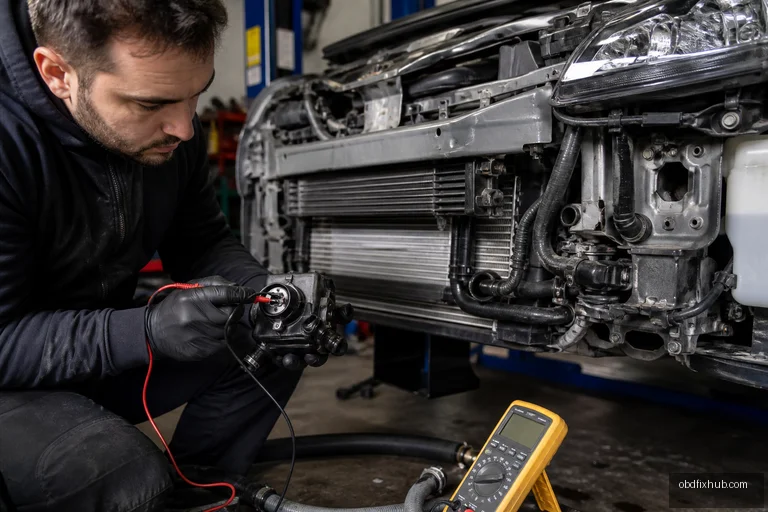
P2BC1 means the engine computer has detected that the charge-air cooler coolant pump is stuck or is not responding as commanded. The fault can be caused by a failed electric pump, an air-locked cooling circuit, damaged wiring, a blocked hose, low coolant, or a control-module problem. Although the vehicle may still drive, continuing to use it under boost can raise intake-air temperatures and reduce engine performance.
What Does P2BC1 Mean?
P2BC1 is a powertrain diagnostic trouble code related to the low-temperature cooling circuit used by a liquid-cooled charge-air cooler. On turbocharged or supercharged engines, compressed air becomes hot before it reaches the intake manifold. The charge-air cooler removes that heat, and a dedicated electric coolant pump circulates coolant through the cooler, heat exchanger, and connecting lines.
The word “stuck” does not always mean the pump motor is physically locked. In practice, the engine control module may set P2BC1 when the pump does not start, runs too slowly, draws abnormal current, fails a commanded test, or produces no detectable coolant flow. The exact wording and test strategy vary by manufacturer, so the vehicle-specific service information should be checked before replacing parts.
Common Causes of P2BC1
- Failed charge-air cooler coolant pump: Internal brush wear, bearing damage, seized impeller, or electronic failure can stop the pump.
- Air trapped in the circuit: An air pocket can prevent the pump from priming. This is common after coolant work or when the reservoir has been allowed to run low.
- Low or incorrect coolant level: A leak, poorly filled circuit, or incorrect coolant mixture can prevent reliable circulation.
- Blocked hoses or heat exchanger: Kinked lines, sediment, or a restricted charge-air cooler can make the pump appear to be stuck.
- Electrical faults: A blown fuse, failed relay, corroded connector, poor ground, or open control wire can interrupt pump operation.
- Control or software issue: In some vehicles, a powertrain control module update or a failed driver circuit may be required after the mechanical system has been proven sound.
Symptoms You May Notice
P2BC1 often appears with a check-engine light, but the first noticeable symptom may be a loss of turbocharger performance. The vehicle can feel normal during gentle driving and then become sluggish during acceleration, towing, or climbing a hill because the control module limits boost to protect the engine.
- Reduced power or intermittent limp mode
- Higher intake-air temperature readings
- Turbocharger or supercharger performance warnings
- Cooling-fan operation after switching off the engine
- Uneven acceleration under heavy load
- Additional coolant-pump, bypass-valve, or temperature-sensor codes
A useful real-world clue is a pump that remains silent during an active test, followed by a sudden increase in intake temperature while the engine is under boost. However, sound alone is not proof that the pump is working; a worn pump may spin without producing sufficient flow.
How to Diagnose P2BC1 Correctly
1. Scan all modules and record freeze-frame data
Use a scan tool that can access the powertrain and body modules, not only a basic code reader. Record coolant temperature, intake-air temperature, vehicle speed, engine load, battery voltage, and whether the code is current or stored. Other codes can change the diagnostic direction; for example, a low-voltage code may explain why the pump stopped.
2. Inspect the coolant circuit before testing the pump
With the engine cold, check the correct reservoir and verify the level against the manufacturer’s mark. Look for dried coolant residue around pump connections, the charge-air cooler, the front heat exchanger, and hose junctions. Do not open a pressurized cooling system when hot.
3. Command the pump with a bidirectional scan tool
Run the manufacturer’s actuator test and listen for the pump. Some pumps are nearly silent, so confirm operation by watching coolant movement, temperature changes, or a scan-tool flow parameter where available. If the pump is commanded on but the current draw is zero, suspect an open circuit or failed motor. Excessive current points more toward a seized pump or restricted circuit.
4. Test power, ground, and the control signal
Do not rely on a simple voltage check with the connector unplugged. A corroded terminal can show battery voltage with no load and still fail when the pump is connected. Use a loaded test or voltage-drop test across the power and ground circuits while the pump is commanded on. Check the fuse, relay, connector pins, harness routing, and control wire for chafing or coolant contamination.
5. Confirm circulation and bleed the system
If the pump receives correct power and ground but no flow is present, inspect for a seized impeller, blocked hose, or air lock. Follow the factory bleeding procedure; some systems require a scan-tool routine to run the pump and open an electronically controlled valve. Replacing a pump without removing trapped air can lead to an immediate repeat failure.
P2BC1 Repair: What Usually Fixes It?
The correct repair depends on the test results. A failed pump should be replaced with the correct part for the charge-air cooling circuit, followed by coolant bleeding and a functional test. If the problem is wiring, repair the circuit using sealed automotive connections and secure the harness away from hot or moving components.
After repairs, clear the code and perform a road test while monitoring intake-air temperature, commanded pump speed, actual pump feedback, and boost pressure. A short idle test is not enough because the fault may only return when the engine is under sustained load. Check again for leaks after the system cools completely.
Can I Drive With a Bad Coolant Bypass Valve?
Short, gentle driving may be possible if the engine temperature remains normal and the vehicle has no severe power loss, but it is not a good idea to continue driving aggressively or towing. A failed bypass valve can prevent coolant from reaching the correct circuit, cause unstable temperatures, and contribute to charge-air overheating.
Stop driving and arrange a repair if the temperature warning appears, the vehicle enters repeated limp mode, coolant is leaking, or the engine runs poorly. A bypass-valve fault and P2BC1 can be related, but they should be diagnosed separately rather than assuming that the pump is defective.
What Does “Coolant Pump A Control Circuit Open” Mean?
This description usually refers to an electrical fault in the circuit controlling coolant pump A. “Open” means the module cannot detect a complete electrical path, often because of a broken wire, unplugged connector, blown fuse, failed relay, or an internally open pump motor. It is different from a pump that has power but is mechanically unable to circulate coolant.
Before installing a pump, verify the circuit designation. Vehicles with multiple electric pumps may label the charge-air cooler pump as pump B, while another manufacturer may use pump A for the same general cooling function.
How Do You Fix Code P2681?
P2681 is commonly defined as Engine Coolant Bypass Valve Control Circuit/Open, although wording can vary by vehicle. Diagnose it by checking the bypass-valve connector, fuse, power supply, ground, control signal, and valve movement. Inspect for coolant intrusion because a leaking valve or nearby hose can contaminate the connector and create an intermittent open circuit.
- Verify the code and freeze-frame information with a full scan.
- Inspect the valve and harness for physical damage or coolant residue.
- Command the valve with a bidirectional scan tool if supported.
- Measure voltage and voltage drop under load.
- Replace the valve only after proving the wiring and control circuit are good.
- Bleed the cooling system and confirm temperature control during a road test.
What Does VW Fault Code P261C Mean?
On many Volkswagen applications, P261C refers to Coolant Pump B Control Circuit Low. It generally means the control module sees a voltage lower than expected in the pump B circuit. Possible causes include a short to ground, a failing pump, damaged wiring, connector corrosion, or a control-stage fault.
VW systems can use more than one electric coolant pump, so identify pump B using the vehicle’s wiring diagram and component location information. Testing the wrong pump can waste time and may create a second fault. A proper diagnosis includes a loaded circuit test and an output test rather than simply clearing the code.
When Should You Replace the Pump?
Replace the charge-air cooler coolant pump when it fails the commanded test, has correct power and ground but does not run, draws abnormal current, or runs without producing measurable circulation. Do not replace it solely because P2BC1 is stored. A low coolant level, trapped air, blocked heat exchanger, or wiring failure can produce the same code.
If the vehicle has a history of repeated pump failures, investigate the cause before fitting another unit. Excessive heat, contaminated coolant, restricted flow, poor electrical connections, and incorrect bleeding are common reasons a replacement pump fails prematurely.
Summary and Next Step
P2BC1 points to a charge-air cooler coolant pump that the control module believes is stuck or not delivering the expected result. Start with coolant level and leaks, then test the pump under command, verify power and ground under load, and confirm actual coolant flow. Once repaired, bleed the system correctly and validate the fix under real driving conditions.
If you do not have a bidirectional scan tool or are unsure which coolant pump the code refers to, professional diagnosis is usually cheaper than replacing multiple pumps and valves by guesswork.
Frequently Asked Questions
Can P2BC1 cause engine damage?
It can contribute to excessive intake-air temperature and reduced engine protection if the vehicle is driven hard for an extended period. The control module often reduces boost, but that protection should not be treated as a permanent solution.
Will adding coolant clear P2BC1?
Adding the correct coolant may restore operation if the level was low, but it will not repair a failed pump, electrical fault, leak, or air lock. The code must be diagnosed and cleared after the underlying issue is corrected.
Is P2BC1 the same as P026E?
No. Both codes can involve the charge-air cooler coolant system, but their definitions and triggering conditions differ. Always use the exact vehicle-specific code description and service procedure.
Can a bad battery set a coolant pump code?
Yes. Low system voltage can prevent an electric pump from starting or can cause an actuator test to fail. Check battery voltage and charging-system performance before condemning the pump.




