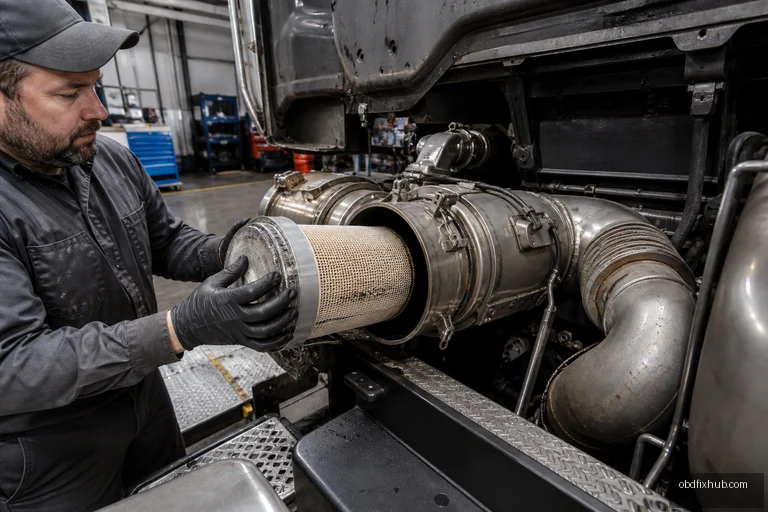
If your scan tool displays P2BD2 Exhaust Aftertreatment System Leak, the engine computer has detected that exhaust is escaping from the emissions-treatment system or that measured exhaust flow does not match the expected value. The leak may be at a clamp, flex pipe, DPF, SCR component, sensor port, or exhaust connection. It should be diagnosed promptly because even a small leak can produce incorrect NOx readings, trigger reduced-power operation, and allow dangerous exhaust gases into the vehicle.
This is primarily an informational search intent: the driver wants to understand the code before deciding whether the vehicle is safe to drive and what repair is likely to be required. The exact fault description and test procedure vary by manufacturer, so the code should always be checked against the vehicle’s service information.
What Does the P2BD2 Exhaust Aftertreatment System Leak Code Mean?
P2BD2 is a powertrain diagnostic trouble code associated with a leak in the diesel exhaust aftertreatment system. That system can include the diesel oxidation catalyst, diesel particulate filter (DPF), selective catalytic reduction (SCR) catalyst, diesel exhaust fluid (DEF) injector, exhaust temperature sensors, NOx sensors, pressure lines, clamps, and connecting pipes.
The engine control module or aftertreatment control module does not always detect the leak with a single dedicated leak sensor. Depending on the vehicle, it may compare differential pressure, exhaust pressure, oxygen or NOx readings, temperature changes, and calculated exhaust flow. When those values are implausible, it can set P2BD2 even when the leak is too small to hear.
That is why P2BD2 does not automatically mean the DPF or SCR catalyst needs replacement. In many real-world repairs, the actual fault is a split flex section, a loose V-band clamp, a failed gasket, or a sensor bung leaking around its threads.
Common Causes of P2BD2
- Loose or damaged exhaust clamps: V-band clamps and slip joints can loosen after repeated heat cycles, especially when the exhaust has been removed for previous DPF or sensor work.
- Cracked flex pipe: Engine movement and vibration fatigue the braided flex section. Soot around the braid is a strong clue.
- Failed exhaust gasket: Gaskets at the turbocharger, DPF, SCR catalyst, or exhaust manifold can leak without creating an obvious exhaust roar.
- Cracked DPF or catalyst housing: Corrosion, impact damage, thermal shock, or excessive backpressure can split the casing or its welded seams.
- Leaking sensor or pressure connection: A loose NOx sensor, temperature sensor, pressure tube, or threaded bung can release exhaust and distort sensor data.
- Incorrectly installed aftermarket parts: Poorly aligned replacement pipes, missing seals, and incompatible clamps are common after exhaust modifications or component replacement.
- Excessive exhaust pressure: A restricted DPF can stress weak joints and create a leak. In this situation, repairing the visible leak alone may not solve the underlying problem.
Symptoms You May Notice
P2BD2 can appear with only a check engine light, but many drivers notice additional symptoms. The pattern depends on where the leak is located and whether it is upstream or downstream of the sensors used for emissions calculations.
- Check engine light or service emissions system warning
- Reduced engine power, limited RPM, or limp mode
- More frequent or unsuccessful DPF regeneration cycles
- Exhaust smell inside or around the cabin
- Hissing, ticking, or puffing noise during acceleration
- Black soot marks near a flange, clamp, weld, or sensor fitting
- Higher fuel consumption or reduced turbocharger response
- Additional NOx, DPF pressure, exhaust temperature, or DEF-related codes
A leak before a turbocharger or before a pressure sensor may affect boost and engine performance. A leak near the DPF or SCR system may mainly affect emissions calculations. A leak after the final catalyst may be less noticeable to the driver but can still violate emissions requirements and allow exhaust fumes beneath the vehicle.
How to Diagnose P2BD2 Correctly
Replacing an expensive DPF based only on this code is a common and costly mistake. A reliable diagnosis should confirm the leak location and determine whether another fault, such as excessive DPF restriction, caused the joint or housing to fail.
- Record all codes and freeze-frame data. Note engine speed, exhaust temperature, calculated soot load, differential pressure, and whether the code appeared during regeneration. Related codes often identify the affected section.
- Inspect the system cold. Look for soot trails, white or gray residue from condensation, missing hardware, distorted flanges, cracked welds, and damaged heat shields. A clean-looking joint is not automatically sealed; some leaks leave little soot.
- Listen during a cold start. Cold metal contracts and often makes a small leak easier to hear. Check for a sharp tick or rhythmic puffing, but keep hands, clothing, and tools away from moving belts and hot components.
- Use a smoke or low-pressure leak test. A professional shop can introduce approved smoke into the exhaust and watch for smoke escaping from joints. High shop air pressure should not be forced into the system because it can damage sensors or seals.
- Verify differential pressure and sensor readings. Compare key-on readings, idle pressure, and loaded pressure with manufacturer specifications. Pressure readings that remain abnormal after a leak repair may indicate a restricted or damaged DPF.
- Check live data after the repair. Clear the codes only after the physical fault is corrected, then road-test the vehicle and confirm that exhaust temperatures, pressure, NOx values, and regeneration status behave normally.
A practical inspection tip
When the vehicle has recently received DPF, SCR, or sensor work, inspect the last disturbed connection first. Mechanics frequently find a reused gasket, a clamp that was tightened while misaligned, or a pressure hose routed against a hot pipe. The timing of the code after a repair is valuable diagnostic evidence, not a coincidence to ignore.
How Is P2BD2 Repaired?
The repair depends on the confirmed leak point. A loose clamp may only require correct alignment and tightening, while a failed gasket requires replacement with the correct heat-rated seal. A cracked flex pipe or exhaust section is normally replaced rather than patched, because temporary wraps often fail after another regeneration cycle.
If the DPF or SCR housing is cracked, the component must be inspected for internal damage and excessive restriction before replacement. The shop should also check the cause of the failure, such as a blocked DPF, failed temperature sensor, poor regeneration history, engine oil contamination, or an exhaust mounting problem. Otherwise, the replacement component may fail again.
After repair, the system may require an adaptation reset, exhaust leak verification, forced regeneration, or a manufacturer-specific drive cycle. Do not perform a forced regeneration in a garage or near dry grass; exhaust temperatures can become extremely high.
Can You Drive With P2BD2?
Short-distance driving to a repair facility may be possible if there is no exhaust smell in the cabin, no severe power loss, no flashing warning light, and no abnormal temperature indication. Avoid towing, heavy loads, long highway trips, and repeated attempts to force a regeneration.
Stop driving and arrange professional inspection if fumes enter the cabin, the vehicle enters limp mode, the exhaust is visibly damaged, the engine temperature rises, or multiple emissions warnings appear. Carbon monoxide is odorless, so the absence of a smell does not prove the vehicle is safe.
P2BD2 Repair Cost: What Affects the Price?
Repair cost varies significantly by vehicle and by the location of the leak. A clamp or gasket is usually a relatively minor repair. A flex pipe or sensor fitting costs more, while a DPF, SCR catalyst, or complete aftertreatment assembly can be expensive because of part price, access time, and required programming or regeneration procedures.
Ask for a diagnosis that identifies the exact leaking joint or component rather than an estimate based only on the trouble code. A proper estimate should separate inspection, parts, labor, sensor testing, and any required post-repair regeneration.
Summary: The Right Next Step
P2BD2 means the vehicle’s control system has detected a possible leak in the diesel exhaust aftertreatment system. Start with a visual and smoke inspection, verify sensor and pressure data, and investigate DPF restriction before authorizing a costly catalyst or filter replacement. Repair the physical leak, clear the code, and confirm the system under real operating conditions.
Do not ignore P2BD2, but do not assume it means a failed DPF. An accurate leak test can turn an apparently major emissions problem into a straightforward clamp, gasket, flex pipe, or sensor-port repair.
Frequently Asked Questions
Is P2BD2 the same as a bad DPF?
No. P2BD2 indicates a possible aftertreatment system leak, not automatically a failed diesel particulate filter. The DPF may be cracked, restricted, or completely healthy; pressure and leak testing are needed to tell the difference.
Can a small exhaust leak trigger P2BD2?
Yes. A small leak can alter pressure, oxygen, NOx, or exhaust-flow calculations even when it produces little noise. Soot marks around a flange or sensor fitting are often more useful than sound alone.
Will clearing P2BD2 fix the problem?
No. Clearing the code only removes the stored warning temporarily. If the leak remains, the code will usually return after the vehicle completes its monitoring tests.
Is it safe to drive with the P2BD2 code?
Drive only as far as necessary for diagnosis if the vehicle has normal power and no exhaust fumes are entering the cabin. Stop driving if there is a strong exhaust smell, limp mode, visible damage, or additional serious warning signs.
Does P2BD2 require a forced DPF regeneration?
Not necessarily. Regeneration should be performed only after the leak and any restriction-related problem are diagnosed. A forced regeneration with a leaking or damaged exhaust system can increase heat and worsen the failure.




