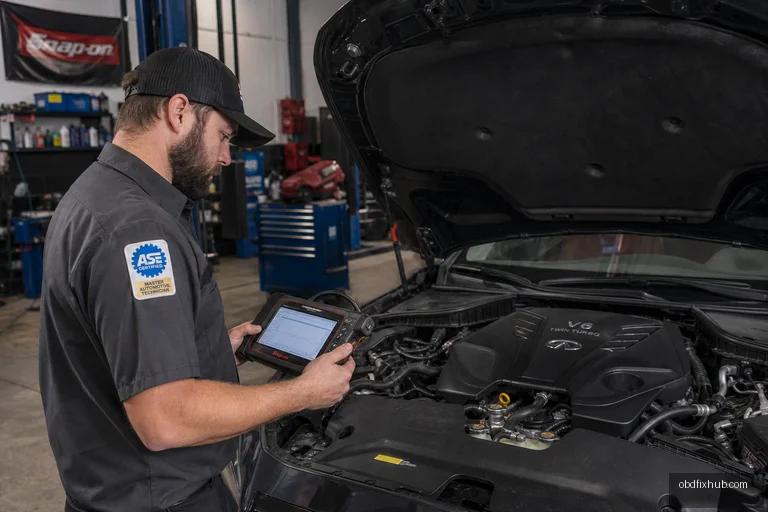
P2BEF Fuel Control System Too Rich generally means the engine computer has detected excessive fuel, or insufficient oxygen, in the exhaust from Bank 2. The usual causes include incorrect fuel pressure, leaking injectors, a contaminated MAF sensor, a biased air-fuel sensor, or an engine temperature reading that falsely indicates a cold engine. Diagnose the data before replacing an oxygen sensor, because the sensor may only be reporting the real problem.
What Does the P2BEF Code Mean?
P2BEF is an emissions-related powertrain code associated with a rich fuel condition on Bank 2. Bank 2 is the side of the engine that does not contain cylinder 1. On a V6 or V8, that distinction matters because the fault may be limited to one cylinder bank rather than affecting the entire engine.
The description may appear slightly differently depending on the vehicle manufacturer and scan tool. Some systems identify the code as Fuel Control System A Too Rich Bank 2, while others use a more general fuel-control description. In these definitions, System A normally refers to one fuel-control path or sensor strategy, not necessarily a physical part that should be replaced immediately.
Common P2BEF Symptoms
A rich Bank 2 condition can be subtle at first. The vehicle may still start and drive normally, but the long-term effects can be expensive if the fault remains active.
- Check Engine Light, sometimes with reduced fuel economy
- Strong gasoline odor from the exhaust
- Black smoke or dark exhaust soot
- Rough idle, hesitation, or poor throttle response
- Hard starting after the engine is warm
- Misfire codes affecting Bank 2 cylinders
- Failed emissions testing and elevated hydrocarbon readings
- Engine oil that smells like fuel or has an unusually high level
On a scan tool, the most useful clue is fuel trim. If Bank 2 short-term and long-term fuel trims are strongly negative, the ECU is removing fuel because it believes the mixture is too rich. If trims are near zero but the code returns, the issue may be a sensor signal, a catalyst problem, or a manufacturer-specific monitoring condition.
What Causes a P2BEF Fuel Control System Too Rich Fault?
1. Excessive fuel pressure
A failed fuel-pressure regulator, restricted return line, or incorrect replacement fuel pump can force too much fuel through the injectors. Compare actual pressure with the manufacturer specification, both at idle and after the engine is switched off. Pressure that remains unusually high after shutdown can also point toward a regulator or leaking injector problem.
2. Leaking or stuck fuel injectors
An injector that does not close completely can enrich one cylinder or the entire bank. A practical test is a fuel-pressure leak-down check: pressurize the rail, switch off the pump, and observe whether pressure drops faster than the service manual allows. A borescope may also reveal a wet or unusually clean piston crown on the affected bank.
3. Incorrect airflow information
A contaminated or damaged MAF sensor can under-report incoming air, causing the ECU to command too little air and too much fuel. Inspect the sensor for oil or aftermarket filter residue, check the intake duct for damage, and compare live MAF readings with known-good values for that engine. Do not spray a MAF sensor with brake cleaner; use a dedicated MAF cleaner and allow it to dry fully.
4. Faulty coolant temperature or intake air temperature data
If the coolant temperature sensor tells the ECU that the engine is colder than it really is, the computer may maintain cold-start enrichment. Compare the displayed coolant temperature with the actual engine temperature. After an overnight cold soak, coolant and intake air temperature should usually be close to ambient temperature; a major difference is a strong diagnostic clue.
5. A biased oxygen or air-fuel ratio sensor
An upstream sensor that incorrectly reports a lean mixture can make the ECU add fuel. This is why replacing the Bank 2 sensor immediately is risky. Check the sensor signal, heater operation, wiring, connector condition, reference voltage, and fuel trims first. A sensor that is stuck rich can also set related O2 codes, but a rich code does not automatically prove the sensor itself has failed.
6. EVAP purge or ignition problems
A purge valve stuck open can feed fuel vapor into the intake, especially at idle and during warm restarts. A weak ignition coil, worn spark plug, or damaged plug boot can leave unburned fuel in the exhaust and create confusing oxygen-sensor readings. Check for misfire counters and inspect the Bank 2 plugs; wet, black, or fuel-fouled plugs help distinguish a real over-fueling problem from a reporting problem.
How to Fix System Too Rich Bank 2
The correct repair depends on whether the mixture is genuinely rich or only appears rich because of a bad input. Use this sequence rather than replacing parts based on the code alone:
- Record all codes and freeze-frame data. Note engine temperature, RPM, load, fuel trims, and vehicle speed when P2BEF was stored.
- Check Bank 2 fuel trims. Negative trims at idle and under load suggest excess fuel. A rich condition only at idle may point toward an injector leak or purge valve.
- Inspect for wiring and intake problems. Look for damaged sensor wires, loose grounds, disconnected vacuum lines, and intake leaks near the Bank 2 manifold.
- Test fuel pressure and leak-down. Follow the vehicle’s pressure specification; do not rely on a generic value because direct-injection and port-injection systems differ significantly.
- Test injectors and ignition components. Swap a suspected coil or injector only when the test procedure allows it, then see whether the fault follows the component.
- Validate sensor data. Compare MAF, coolant temperature, oxygen-sensor or air-fuel-sensor readings with scan-tool and multimeter tests.
- Repair the confirmed cause, clear the code, and perform a complete drive cycle. Recheck trims and pending codes after the engine reaches operating temperature.
After repairing the cause, inspect the spark plugs and engine oil. Fuel contamination can reduce oil viscosity, while prolonged rich running can overheat and damage the catalytic converter. If the oil smells strongly of gasoline, change it after completing the repair rather than waiting for the normal service interval.
Is It Safe to Drive With a System Too Rich Error?
A short, gentle drive to a repair facility is often possible when the Check Engine Light is steady, the engine is running smoothly, and there is no strong fuel leak or severe fuel odor. It is not a condition to ignore for weeks. Excess fuel can dilute engine oil, foul spark plugs, increase emissions, and overheat the catalytic converter.
Stop driving and arrange immediate diagnosis if the Check Engine Light is flashing, the engine is misfiring badly, black smoke is visible, fuel is leaking, or the oil level is rising. A flashing light usually indicates an active misfire capable of damaging the catalytic converter within a short period.
What Does the P2BEE Code Mean?
P2BEE is a related but opposite fuel-control code: it generally indicates that Fuel Control System A on Bank 2 is too lean. In simple terms, the ECU is detecting too much oxygen or too little fuel. Possible causes include a vacuum leak, low fuel pressure, restricted injector, MAF error, exhaust leak before the sensor, or a faulty air-fuel sensor.
Do not confuse P2BEE with P2BEF. P2BEE points toward a lean condition, while P2BEF points toward a rich condition. Because manufacturer definitions can vary, confirm the exact description in the service information for the specific vehicle before ordering parts.
Final Diagnostic Takeaway
P2BEF is a symptom code, not a diagnosis. Start with fuel trims and freeze-frame data, then test fuel pressure, injector leakage, airflow measurement, temperature inputs, ignition performance, and Bank 2 sensor wiring. This approach is faster and more reliable than installing an oxygen sensor based solely on the code description.
If the vehicle has a flashing Check Engine Light, fuel in the oil, or severe drivability symptoms, stop driving it. For a steady light with normal operation, arrange testing soon and verify the repair with a complete warm-up and road-test cycle.
Frequently Asked Questions
How do I fix System Too Rich Bank 2?
Test fuel pressure, injector leakage, MAF accuracy, coolant temperature data, purge-valve operation, ignition components, and the Bank 2 air-fuel sensor. Repair the confirmed cause, then clear the code and verify fuel trims during a complete drive cycle.
What sensors can cause a rich fuel mixture?
A faulty MAF, MAP, engine coolant temperature, intake air temperature, upstream oxygen, or air-fuel ratio sensor can contribute to a rich mixture. A sensor that falsely reports a lean condition is especially likely to make the ECU add excessive fuel.
Is it safe to drive with a system too rich error?
Only a short drive may be reasonable when the Check Engine Light is steady and the engine runs normally. Avoid driving if the light flashes, the engine misfires, black smoke appears, or the oil smells like gasoline.
What does the P2BEE code mean?
P2BEE generally means Fuel Control System A Too Lean Bank 2, which is the opposite direction from P2BEF. Check the manufacturer-specific definition because wording and system designations can vary by vehicle.




