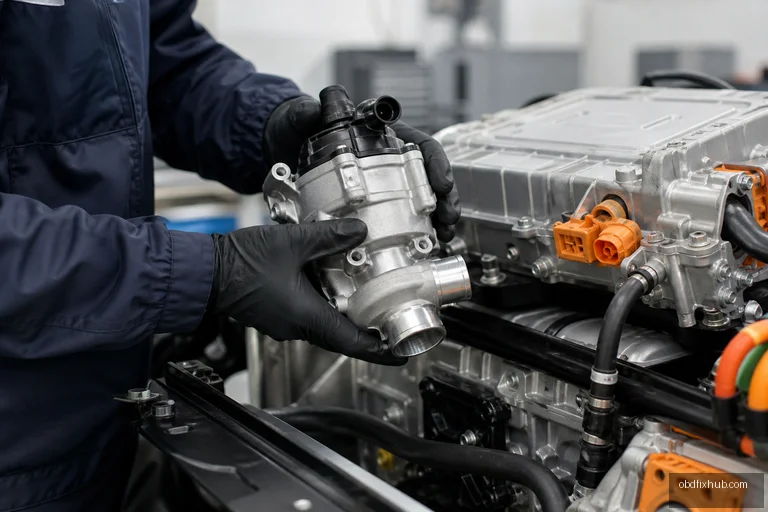
P2E45 means the hybrid or EV control system has detected a problem in the enable circuit for electronics coolant pump B. In practical terms, the vehicle cannot reliably command or verify that pump, so it may disable electric drive, limit power, turn on the warning light, or reduce heating and cooling performance. The exact circuit design varies by make and model, but the fault is commonly caused by a low supply voltage, damaged wiring, a poor ground, connector corrosion, or a failing pump.
What Does P2E45 Mean?
P2E45 is a hybrid/EV diagnostic trouble code associated with the electronics coolant pump B enable circuit. This pump usually belongs to a low-temperature cooling loop that protects components such as the inverter, DC-DC converter, onboard charger, power electronics module, or traction battery cooling assembly.
The word enable is important. It does not always mean that the pump motor itself has completely stopped. The vehicle may be reporting that the control module cannot send the correct enable signal, cannot see the expected electrical response, or detects a circuit voltage outside its calibrated range.
Because P2E45 is not interpreted identically on every vehicle, the factory wiring diagram and service information should be treated as the final authority. On one model, pump B may have a dedicated enable wire. On another, it may use a power, ground, control, and feedback arrangement controlled by a hybrid vehicle control module.
What Does Coolant Pump B Control Circuit Low Mean?
A coolant pump B control circuit low condition means the control circuit voltage is lower than the module expects. That can happen because the circuit is shorted to ground, the pump has an internal electrical fault, the power supply is weak, or excessive resistance exists in a connector or ground path.
It does not automatically prove that the pump needs replacement. For example, a corroded connector can create a voltage drop that looks like a failed pump. A weak 12-volt battery can also prevent the pump from reaching its commanded speed during a self-test, especially after the vehicle has been parked overnight.
Why Is There an Electric Coolant Pump for the Heater Core Circuit?
Hybrid vehicles often use an electric coolant pump for the heater core because the gasoline engine may shut off while the vehicle is moving or stopped. A belt-driven water pump cannot circulate hot engine coolant when the engine is not running, but an electric pump can continue moving coolant through the heater core.
This allows the cabin heater to operate independently of engine speed. It also supports stop-start operation, engine-off driving, remote climate control, and efficient heat management. Some hybrids use a separate electric pump for the heater loop, while others use electrically controlled valves and several pumps across different thermal circuits.
However, do not assume that pump B is the heater-core pump. On many vehicles, the pump associated with P2E45 cools the hybrid electronics rather than the cabin heater. The coolant hose routing, pump location, and factory diagram are needed to identify its exact role.
Common Causes of P2E45
- Failed electronics coolant pump: The motor may be seized, worn, internally open, or drawing abnormal current.
- Low 12-volt system voltage: A weak battery, poor battery terminal, or charging problem can interrupt the pump command.
- Open or shorted enable wire: Harness damage near the pump, radiator support, underbody, or inverter area is common after repairs or collision damage.
- Corroded or loose connector: Coolant, road salt, water intrusion, and terminal tension problems can create intermittent faults.
- Bad ground or power feed: A ground strap or fuse connection with high resistance may pass a basic voltage check but fail under load.
- Blown fuse or defective relay: Some systems protect the pump with a dedicated fuse, relay, or solid-state driver.
- Control module or software issue: Less frequently, a hybrid control module, power management module, or calibration problem can generate the code.
- Air or contamination in the cooling loop: This may not directly create an electrical code, but it can overheat or damage a pump and trigger related thermal faults.
Symptoms You May Notice
P2E45 can appear with very few symptoms during a cold start, then become serious when the hybrid system is under load. The vehicle may still start normally because the gasoline engine and 12-volt systems can operate while the electronics cooling fault remains temporarily unchallenged.
- Check hybrid system, service hybrid system, or check engine warning message
- Reduced EV driving capability or limited power output
- Cooling fan running more often than normal
- Overheating warnings for the inverter or power electronics
- Loss of regenerative braking or restricted charging
- Weak cabin heat if the affected pump serves a heater-related loop
- Pump noise, intermittent operation, or no audible operation during an active test
- Additional codes for inverter temperature, DC-DC converter cooling, or battery thermal management
How to Diagnose P2E45 Correctly
Diagnosis should begin with the complete code list, not just P2E45. Record whether the code is current, pending, or history, and check freeze-frame data such as vehicle speed, coolant temperature, system voltage, and the commanded pump state.
- Verify 12-volt battery condition. Test the battery at rest and under load. Check voltage during key-on and while commanding the pump. Low system voltage can create misleading hybrid faults.
- Identify pump B from the wiring diagram. Do not test the first visible electric pump. Hybrid vehicles may have separate pumps for the engine, heater core, battery, and power electronics.
- Inspect the connector and harness. Look for green corrosion, pushed-back terminals, moisture, melted plastic, rodent damage, and harness chafing. A terminal can look clean yet fail when the pump draws current.
- Run an actuator test. With a capable scan tool, command pump B on and compare the requested state with actual pump speed or feedback. Listen for operation, but do not treat noise alone as proof of correct flow.
- Measure voltage under load. Test power and ground at the pump while it is commanded on. A circuit can show battery voltage with the connector disconnected and collapse when the motor is connected.
- Check voltage drop. Measure between battery positive and the pump power terminal, then between the pump ground and battery negative. Excessive voltage drop points to resistance in the fuse, relay, wiring, terminals, or ground.
- Check coolant flow and air. If the pump runs but temperature rises, inspect the coolant level, bleed procedure, restrictions, and signs of a seized impeller. Follow the manufacturer’s specific filling procedure.
Use extreme caution around hybrid systems. Never probe orange high-voltage cables or disconnect high-voltage components without the required training and isolation procedure. The pump circuit may be low voltage, but it can be mounted close to high-voltage hardware and hot coolant.
Repair Options for P2E45
The correct repair depends on the test result. Repair or replace damaged terminals rather than simply spraying cleaner into a loose connector. If the pump has proper power, ground, and command but does not operate, pump replacement is usually justified. If the supply collapses during operation, repair the high-resistance connection before installing a new pump.
After the repair, refill and bleed the relevant cooling circuit using the factory method. Some vehicles require a scan-tool routine to run the pump, open electronic valves, or remove trapped air. Clear the codes only after recording the original data, then perform the specified drive cycle and rescan for current or pending faults.
A useful real-world distinction is this: a pump that is silent may have no power, a failed motor, or a disabled command; a pump that runs continuously may have a feedback problem, a stuck control request, or an overheating condition. The command and feedback data normally separate these possibilities faster than replacing parts by guesswork.
Can You Drive With P2E45?
Short-distance driving may be possible if the vehicle has no overheating warning, no reduced-power message, and the pump operates correctly during testing. It is not wise to continue driving normally if the hybrid warning is active, power is limited, charging is disabled, or coolant temperature is rising. A failed electronics cooling pump can turn an electrical fault into an expensive inverter or power module failure.
Final Takeaway
P2E45 points to an electrical or control problem involving hybrid/EV coolant pump B, not automatically a bad pump. Start with the 12-volt supply, identify the correct pump, inspect the connector, test the circuit under load, and verify coolant flow. If the warning returns after clearing, use manufacturer-specific wiring data and scan-tool tests rather than continuing to replace parts at random.
Frequently Asked Questions
Is P2E45 always caused by a failed coolant pump?
No. Wiring damage, connector corrosion, poor ground, low 12-volt voltage, a fuse, relay, or control-module problem can all produce P2E45. Electrical testing should come before pump replacement.
Does P2E45 affect the heater core?
It can, but not always. Some vehicles use an electric pump for the heater core, while pump B may instead cool the inverter, onboard charger, or another electronics circuit.
Can a weak 12-volt battery cause P2E45?
Yes. Hybrid systems depend on stable 12-volt power to operate relays, controllers, and electric pumps. Test battery health and charging voltage before diagnosing the pump itself.
Can I replace the pump without bleeding the system?
Usually not. Air trapped in a hybrid cooling loop can prevent proper circulation and cause repeat faults. Follow the vehicle’s specified refill and bleed procedure, which may require an active pump routine.
What should I do if P2E45 returns after repair?
Rescan for related codes, compare commanded and actual pump operation, and perform voltage-drop tests while the pump is running. An intermittent connector or damaged harness is often missed by a simple continuity check.




