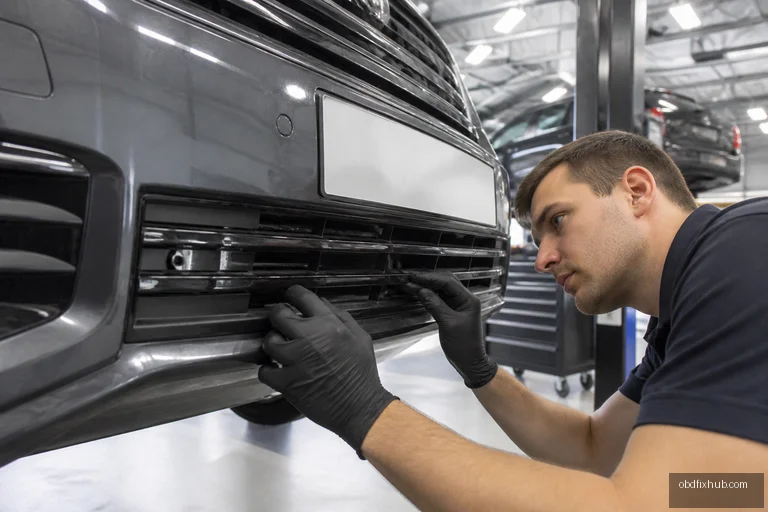
P2EAA Active Radiator Airflow Control Module Performance means the engine computer has detected that the active radiator airflow system is not responding or operating within its expected range. In most vehicles, this refers to motorized grille or radiator shutters, their position sensor, wiring, or control module—not automatically a failed radiator fan. The code can affect fuel economy, warm-up time, emissions, and engine cooling, so it should be diagnosed rather than simply cleared.
What Does the P2EAA Code Mean?
P2EAA is a manufacturer-defined OBD-II powertrain code associated with the performance of an active radiator airflow control system. The exact wording and test strategy vary by vehicle, but the underlying issue is usually a mismatch between the airflow actuator position the control unit requested and the position it actually observed.
Active grille shutters close at certain speeds or during cold starts to reduce aerodynamic drag and help the engine reach operating temperature. They open when the powertrain needs additional airflow through the radiator and condenser. Depending on the vehicle, the system may use one or more electric actuators, integrated position sensors, a dedicated control module, and communication over the vehicle network.
Common Symptoms of P2EAA
Some drivers notice only a check engine light, while others see clear evidence that the shutters are stuck. A failed system does not always cause overheating immediately because conventional cooling fans and the thermostat may still function normally.
- Check Engine Light or Service Engine Soon warning
- Active grille shutters visibly stuck open or closed
- Longer warm-up time and reduced cabin heater performance in cold weather
- Reduced fuel economy at highway speed
- Cooling fan operation that seems excessive or occurs earlier than expected
- Engine temperature rising under load if airflow is restricted
- Additional communication, actuator, or low-voltage fault codes
A useful distinction is whether the shutters are stuck closed or stuck open. A shutter stuck closed can restrict airflow during towing, climbing, or hot-weather traffic. A shutter stuck open is generally less likely to cause immediate overheating, but it can increase drag and prevent the engine from reaching its intended operating temperature.
Most Likely Causes of P2EAA
1. Physical obstruction or damaged shutters
Road debris, ice, mud, leaves, and small stones can jam the blades or linkage. Minor bumper damage can also shift the shutter frame enough to increase motor load. Inspect the entire assembly, not just the visible front blades; one broken connecting link can make the actuator feedback appear incorrect.
2. Failed actuator or position sensor
The electric actuator may have worn gears, an overheated motor, or an internal sensor that reports an implausible position. A common real-world pattern is a brief buzzing or clicking sound behind the grille during startup, followed by P2EAA when the commanded movement does not complete.
3. Wiring, connector, or ground problems
Water intrusion, corrosion, stretched harnesses, and damaged wires near the bumper are frequent causes. Do not rely on a visual inspection alone: a wire can look intact yet fail a voltage-drop test when the actuator is loaded. Check connector terminals for pushed-back pins and verify power and ground under operating conditions.
4. Low system voltage or communication faults
A weak battery, poor ground strap, or charging-system problem can interrupt the actuator initialization cycle. If P2EAA appears alongside multiple unrelated module codes, record the battery voltage and scan all modules before replacing the grille shutter assembly.
5. Software, calibration, or incorrect replacement part
Some vehicles require an active grille shutter relearn, initialization, or control-module software update after replacement. An aftermarket actuator with a different feedback range may physically fit but still fail the performance test. Always compare the vehicle identification number, part number, and software requirements.
How to Diagnose P2EAA Correctly
A code reader that only displays generic faults is rarely enough. The most useful tools are a manufacturer-capable scan tool, a digital multimeter, wiring information, and access to actuator command and position data.
- Record the freeze-frame data. Note coolant temperature, vehicle speed, battery voltage, and engine load when the code set. A fault during a cold start points toward initialization or obstruction, while a fault at highway speed may indicate position feedback or communication trouble.
- Scan every control module. Look for related body, network, voltage, or cooling-system codes. Repairing a low-voltage or CAN communication fault first may resolve P2EAA without replacing the shutter actuator.
- Inspect the mechanism with the ignition off. Look for broken blades, ice, dirt, impact damage, and a linkage that binds. Do not force motor-driven shutters by hand; the gears and position sensor can be damaged.
- Run the actuator test. Use the scan tool to command the shutters open and closed while watching actual position. A command that changes but an actual-position value that remains fixed strongly suggests a mechanical, actuator, or sensor problem.
- Test electrical integrity. Confirm supply voltage, ground quality, signal circuits, and network communication using the wiring diagram. Voltage-drop testing is more informative than checking resistance with the connector unplugged.
- Check for calibration or software procedures. After a repair, perform the specified initialization or relearn. Clear the code only after the actuator completes its commanded sweep and the vehicle passes a road test.
One practical diagnostic trap is checking the shutters while the engine is idling and concluding that they are failed because they do not move. Many systems keep the shutters stationary under those conditions. Use the scan tool’s active test or follow the manufacturer’s enable criteria instead of waiting for movement that may never occur at idle.
How to Fix P2EAA
The correct repair depends on the failed part, not the code name alone. Remove debris and repair minor wiring damage where appropriate, but replace a shutter assembly when its frame is bent, blades are broken, or the internal actuator cannot hold position. Repair corroded terminals rather than spraying contact cleaner and reconnecting a damaged plug.
- Clear ice, dirt, or debris and confirm free movement without forcing the blades.
- Repair damaged harnesses, terminals, power feeds, and grounds.
- Replace the actuator or complete shutter assembly when gears or feedback sensors have failed.
- Install the correct software level or perform the required actuator calibration.
- Verify coolant temperature and cooling-fan operation separately if overheating is present.
If the engine temperature is climbing, stop driving and investigate the cooling system immediately. A P2EAA code may be an airflow-control issue, but it can coexist with a failing fan, thermostat, coolant leak, or restricted radiator. Never treat a normal-looking dashboard temperature gauge as proof that the cooling system is safe.
Can You Drive With P2EAA?
Short-distance driving may be possible when the engine temperature remains stable and the shutters are stuck open, but the vehicle should not be treated as fully repaired. Avoid towing, steep grades, extended idling, and hot-weather traffic until the fault is diagnosed. If the shutters are closed, the temperature rises, or a red temperature warning appears, shut the engine off and have the vehicle inspected.
How Much Does a P2EAA Repair Cost?
Cost varies widely because the fault may be a simple obstruction, a damaged connector, a separate actuator, or a complete active grille shutter assembly. Diagnostic labor is often the most valuable first expense; replacing the visible grille assembly without checking live data can turn a wiring fault into an unnecessary parts bill. Dealer software access may also be required for calibration on some models.
Final Takeaway
P2EAA indicates an active radiator airflow control system performance problem, usually involving shutter movement, actuator feedback, wiring, voltage, or calibration. Start with freeze-frame data, a physical inspection, and commanded-versus-actual position testing. Repair the confirmed cause, complete any required relearn, and verify operation under real driving conditions before considering the problem solved.
Frequently Asked Questions
Is P2EAA the same as a radiator fan problem?
Not necessarily. P2EAA usually concerns active grille or radiator airflow shutters, while radiator fan faults commonly use different codes. However, both systems affect cooling and should be tested if engine temperature rises.
Can a dead battery cause P2EAA?
Yes. Low voltage during startup can interrupt shutter initialization or communication. Test battery state of charge, charging voltage, and grounds before replacing the actuator.
Can I clear P2EAA without fixing it?
You can clear the stored code with a scan tool, but it will return if the performance test fails again. Clearing it without checking the mechanism can hide a developing overheating risk.
Do active grille shutters move all the time?
No. Their position depends on coolant temperature, vehicle speed, air-conditioning demand, engine load, and manufacturer strategy. Use a bi-directional scan tool to test them rather than assuming they should move at idle.
Should the complete grille shutter assembly be replaced?
Only when testing confirms mechanical damage, an integrated actuator failure, or a non-serviceable position sensor. A wiring, connector, obstruction, or calibration fault may be repaired without replacing the entire assembly.




