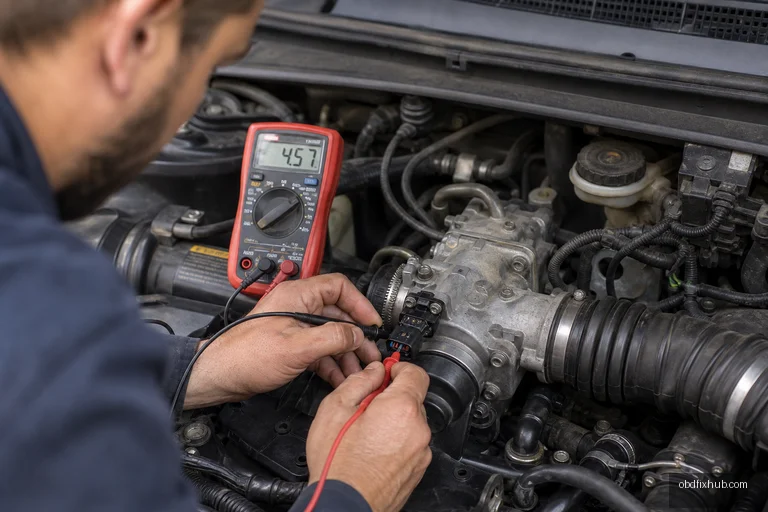
P2EB0 Throttle Valve Intake Air Pressure Sensor Circuit indicates that the engine control module has detected an electrical or implausible-signal problem in the intake air pressure sensor associated with the throttle valve. The fault may come from the sensor, wiring, connector, power supply, ground, or the throttle valve assembly itself—not necessarily the sensor alone. Proper diagnosis with live data and a multimeter is essential before replacing parts.
What Does the P2EB0 Code Mean?
P2EB0 is an OBD-II powertrain fault code related to the throttle valve intake air pressure sensor circuit. Because P2 codes can be manufacturer-specific, the exact sensor location and test values vary between vehicles, especially on diesel engines and applications using an electronically controlled intake throttle.
The sensor measures pressure in or near the intake tract and sends a voltage signal to the engine control module (ECM). The ECM uses this information to verify airflow, control exhaust gas recirculation (EGR), manage turbocharger operation, and calculate the correct fuel and air strategy. If the pressure reading is missing, electrically out of range, or does not agree with other sensors, P2EB0 may be stored.
Why the wording can be confusing
Many vehicles combine the throttle valve, intake pressure sensor, temperature sensor, and position sensor in one housing. On some models, the pressure sensor is a separate component mounted in the intake manifold. Always check the vehicle-specific service information rather than assuming that P2EB0 identifies a universal part.
P2EB0 Symptoms You May Notice
The vehicle may still drive normally when the fault first appears, but the ECM often activates a backup strategy. Symptoms depend on whether the signal is intermittently inaccurate or completely absent.
- Check Engine or Service Engine Soon light
- Reduced engine power or limp-home mode
- Sluggish acceleration, particularly under load
- Rough idle or hesitation after starting
- Increased fuel consumption
- Unusual turbocharger or EGR behavior
- Hard starting or stalling in more severe cases
- Additional codes for EGR flow, boost pressure, intake temperature, or throttle position
A useful clue is the driving condition recorded in the freeze-frame data. If P2EB0 appears during acceleration, inspect harness movement and engine vibration. If it appears immediately after key-on, suspect a power, ground, reference-voltage, or signal plausibility problem before blaming airflow hardware.
Common Causes of the P2EB0 Fault
- Failed intake air pressure sensor: Internal contamination, electrical failure, or a damaged sensing element can produce a fixed or erratic voltage.
- Oil or soot contamination: Crankcase vapour and EGR deposits can coat the pressure port and slow the sensor response. A sensor that looks clean externally may still have a restricted pressure passage.
- Damaged wiring: Wires can rub against the intake, battery tray, brackets, or engine cover. Heat near the turbocharger may harden the insulation and create intermittent shorts.
- Loose or corroded connector: Water intrusion, pushed-back terminals, and poor pin tension are frequent causes of circuit faults.
- Missing 5-volt reference or sensor ground: A shared reference circuit may be affected by another failed sensor, so replacing the P2EB0 sensor alone may not solve the problem.
- Throttle valve assembly problem: A sticking plate, failed internal electronics, or a damaged integrated sensor can trigger the code.
- Intake or boost leak: A split hose or leaking gasket can create pressure readings that do not match the ECM’s expected values.
- Software or calibration issue: On some vehicles, an ECM update or a required throttle adaptation procedure is part of the repair.
How to Diagnose P2EB0 Correctly
1. Confirm the code and inspect freeze-frame data
Use a scan tool capable of reading manufacturer-specific data. Record all stored and pending codes, engine speed, coolant temperature, intake pressure, throttle position, and battery voltage. Do not clear the code before saving this information; the conditions that set it often identify the failure.
2. Compare pressure readings with the engine off
With the engine off and the ignition switched on, intake pressure should usually be close to local barometric pressure, allowing for sensor location and manufacturer tolerances. If the scan tool shows an extreme value, such as near zero pressure or an implausibly high reading, test the circuit before running the engine.
This comparison is particularly valuable because it separates a pressure problem from an electrical problem. If the sensor reads incorrectly with no engine vacuum or boost present, the sensor signal, reference voltage, ground, or wiring is suspect.
3. Test the electrical circuit
Use the wiring diagram for the exact vehicle. A typical three-wire pressure sensor has a 5-volt reference, a low-reference ground, and a variable signal, although some systems use different configurations.
- Check the reference voltage with the connector attached when possible.
- Verify voltage drop on the ground circuit under load; a simple continuity check can miss a poor ground.
- Back-probe the signal wire and watch for a smooth voltage change as pressure changes.
- Perform a gentle wiggle test on the harness while monitoring live data.
- Inspect terminals for spread pins, green corrosion, moisture, or signs of previous repairs.
A sensor signal that suddenly jumps when the harness is moved points toward wiring or terminal tension. A stable but incorrect signal with a good reference and ground points more strongly to the sensor or a blocked pressure port.
4. Inspect the throttle valve and intake system
Remove the intake duct only as needed and look for heavy soot, oil pooling, a restricted sensor port, or a throttle plate that cannot move freely. Do not force an electronically actuated throttle plate by hand unless the service manual specifically permits it; the gears and position electronics can be damaged.
Also inspect charge-air hoses, clamps, intercooler connections, and intake manifold seals. A leak may not be visible at idle. Smoke testing or a controlled pressure test is more reliable than simply listening for hissing under the hood.
5. Check related systems before replacing parts
Compare the throttle position, intake pressure, boost pressure, and EGR data during a road test. If one sensor reports an impossible value while the others respond normally, concentrate on that sensor circuit. If all readings are inconsistent, investigate shared grounds, reference circuits, power supply, and ECM connectors.
How to Fix P2EB0
The correct repair depends on the test results. Clean a contaminated pressure port only when the manufacturer allows it and use an appropriate sensor-safe method. Do not insert a sharp tool into the sensing element or spray aggressive solvent into the sensor.
- Repair damaged wires using sealed automotive splices and route the harness away from heat and vibration.
- Replace corroded terminals or a damaged connector instead of relying on contact cleaner alone.
- Replace the intake air pressure sensor if its reference, ground, and signal tests fail.
- Replace the complete throttle valve assembly when the sensor is integrated and the assembly fails its actuator or position tests.
- Repair boost or intake leaks and correct excessive EGR or crankcase contamination.
- Perform throttle adaptation, sensor calibration, or ECM relearn if required by the vehicle manufacturer.
- Clear the code and complete a drive cycle that includes idle, moderate acceleration, and loaded operation.
After the repair, verify the result with live data rather than relying only on the absence of the warning light. The pressure reading should respond smoothly and agree with the other intake sensors. A code that returns only after a long drive may indicate heat-related wiring damage or a marginal connector, not a failed replacement sensor.
Can You Drive With P2EB0?
Short-distance driving may be possible if the engine runs smoothly and no red warning lights are present, but continued use is not advisable when power is reduced, the engine smokes, or the vehicle enters limp mode. Incorrect intake pressure information can affect EGR and boost control, increase emissions, and cause poor performance. A vehicle that stalls, surges, or loses power in traffic should be repaired before further driving.
Final Takeaway
P2EB0 is a throttle valve intake air pressure sensor circuit fault, but the root cause may be a sensor, contaminated port, wiring defect, connector, throttle assembly, intake leak, or shared electrical circuit. Begin with freeze-frame data, compare key-on pressure with barometric pressure, and test the reference, ground, and signal circuits. This approach prevents the common and expensive mistake of replacing the throttle body without proving that it has failed.
Frequently Asked Questions
Is P2EB0 always caused by a bad pressure sensor?
No. Wiring damage, poor grounds, connector corrosion, a blocked sensor port, a throttle valve fault, or an intake leak can produce the same code. Electrical testing should come before parts replacement.
Can I clean the intake air pressure sensor?
Only if the vehicle manufacturer permits it. Some sensors tolerate careful cleaning of the external pressure passage, while others can be permanently damaged by solvent, compressed air, or physical contact with the sensing element.
Will disconnecting the battery fix P2EB0?
Disconnecting the battery may erase the stored code temporarily, but it does not repair the fault. If the underlying problem remains, P2EB0 will return after the ECM completes its monitoring tests.
Does P2EB0 require a new throttle body?
Not necessarily. If the pressure sensor is separate and its wiring or sensor tests fail, only that component may be needed. A complete throttle valve assembly is usually required only when the sensor is integrated or the actuator and position tests also fail.
Should P2EB0 be diagnosed by a professional?
A basic visual inspection is reasonable, but accurate diagnosis often requires a wiring diagram, back-probing equipment, live-data interpretation, and manufacturer-specific test procedures. Professional testing is especially advisable on turbocharged diesel engines.




