P2EB7 Replace 12-Volt Battery usually means the vehicle has detected a weak, deteriorated, incorrectly charged, or poorly monitored 12-volt battery. It does not always prove that the battery itself is the only fault. A proper diagnosis should also check the battery terminals, ground connections, battery sensor, charging system, and any parasitic electrical drain before installing a replacement.
What Does P2EB7 Replace 12-Volt Battery Mean?
P2EB7 is a powertrain-related diagnostic trouble code used by certain manufacturers, particularly on electrified vehicles and vehicles with advanced 12-volt battery management. The exact factory definition can vary by make, model, software version, and control module. In practical terms, the code is commonly linked to 12-volt battery state-of-health, state-of-charge, or battery-management data that falls outside the expected range.
The 12-volt battery still powers important systems even when a vehicle has a high-voltage hybrid or electric battery. It wakes up control modules, operates relays, supplies lighting and safety systems, and allows the vehicle to complete its startup sequence. If its voltage drops too far, the vehicle may report several unrelated-looking warnings at the same time.
Common Causes of P2EB7
- A worn-out 12-volt battery: A battery may show acceptable voltage at rest but fail under load. This is common after three to five years, although heat, cold, and frequent short trips can shorten its life.
- Low state of charge: A vehicle parked for an extended period, used mainly for short journeys, or left with accessories operating may not fully recharge the battery.
- Loose or corroded connections: Resistance at the positive terminal, negative terminal, chassis ground, or battery fuse can create voltage drops that confuse the battery monitoring system.
- Incorrect battery type or capacity: Many modern vehicles require an AGM battery with a specific amp-hour rating. Installing a conventional flooded battery where an AGM battery is required can cause charging and monitoring problems.
- Battery sensor or wiring fault: An intelligent battery sensor mounted near the negative terminal measures current, voltage, and temperature. A damaged connector or sensor can produce a battery-related code even when the battery is healthy.
- Charging-system malfunction: Depending on the vehicle, charging may come from an alternator or a DC-to-DC converter. A fault in that system can repeatedly discharge a new battery.
- Parasitic draw: An aftermarket alarm, dash camera, tracker, faulty door module, or infotainment system may continue consuming power after the vehicle is locked.
P2EB7 Symptoms to Watch For
The most obvious symptom is a dashboard message telling you to replace or service the 12-volt battery. However, drivers often notice other symptoms first. The vehicle may crank slowly, refuse to enter Ready mode, or display multiple warning lights immediately after starting.
- Intermittent no-start or no-Ready condition
- Flickering interior or exterior lights
- Clock, radio, or personalized settings resetting
- Electronic parking brake, ABS, traction-control, or airbag warnings
- Remote locking or keyless-entry problems
- Stop-start system or hybrid system temporarily unavailable
- Repeated P2EB7 code after clearing
A particularly useful clue is timing. If several warnings appear after the vehicle has been parked overnight but disappear after a jump-start, low 12-volt voltage is more likely than a serious high-voltage battery failure. A jump-start, however, is only a temporary recovery method and should not be treated as a repair.
How to Diagnose P2EB7 Correctly
Do not begin by clearing the code and replacing parts at random. Use a digital multimeter and, ideally, a professional battery conductance tester or load tester. The following checks provide a reliable starting point.
- Inspect the battery physically. Look for swelling, cracks, leaking electrolyte, damaged insulation, and loose hold-down hardware. A loose battery can suffer internal damage from vibration.
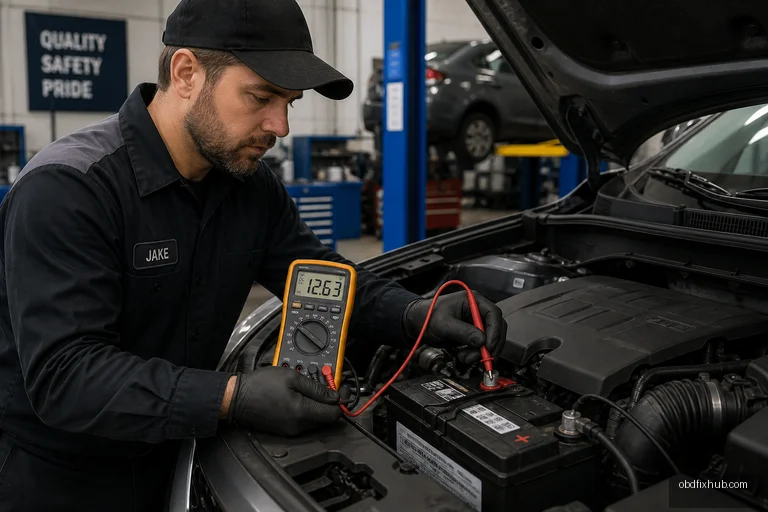
- Measure resting voltage. After the vehicle has been switched off for several hours, a healthy fully charged 12-volt battery will generally measure close to 12.6 volts. Around 12.2 volts indicates a substantially discharged battery, while readings near 12.0 volts or lower require immediate testing.
- Perform a load or conductance test. Voltage alone cannot determine battery health. A battery with a short-lived surface charge may read normally but collapse when the starter, contactors, or vehicle electronics demand current.
- Check voltage drop at the connections. Test between the battery negative terminal and the engine or chassis ground while the vehicle is under load. A noticeable voltage drop points to a poor ground or cable connection.
- Verify charging voltage. On conventional vehicles, alternator output should be checked under different electrical loads. On hybrids and EVs, the DC-to-DC converter must be tested according to the manufacturer’s procedure; do not assume an alternator is present.
- Scan every relevant control module. A basic code reader may show P2EB7 but miss battery sensor, gateway, body-control, or charging-system codes that explain why it set.
How to Fix P2EB7 Replace 12-Volt Battery
If the battery fails a professional test, install the correct replacement specified for the vehicle. Match the battery chemistry, physical dimensions, terminal layout, cold-cranking rating, and amp-hour capacity. For vehicles equipped with AGM batteries, use AGM again unless the manufacturer explicitly permits another type.
Many newer vehicles require battery registration or configuration after replacement. Registration tells the battery-management system that a new battery has been installed and resets its charging strategy. Depending on the model, this may require a capable scan tool, a manufacturer-level diagnostic system, or a specialist workshop. Skipping this step can overcharge the new battery or leave the P2EB7 warning active.
After fitting the battery, clean the terminals with the power disconnected, tighten the connections correctly, and inspect the negative battery sensor connector. Do not bypass the sensor or attach accessories directly in a way that prevents the system from measuring current accurately.
When P2EB7 Returns After Battery Replacement
If P2EB7 returns within days or weeks, the new battery is often not the real problem. Measure the vehicle’s sleep current after all modules have shut down, which can take considerably longer than the few minutes many technicians allow. A vehicle that remains awake because of a door latch, telematics module, charging cable, or aftermarket device can drain a healthy battery overnight.
On hybrid and electric vehicles, never probe orange high-voltage cables or open high-voltage battery components to diagnose this code. The 12-volt battery may be serviceable, but the high-voltage system can remain dangerous even when the vehicle appears switched off. Leave DC-to-DC converter, isolation, and high-voltage contactor testing to a properly trained technician.
Can You Drive With P2EB7?
Short-distance driving may be possible if the vehicle starts normally and no critical warning is present, but it is not wise to ignore the code. A weak 12-volt battery can fail without warning and may prevent the vehicle from starting or entering Ready mode at the next stop. Arrange testing promptly, especially if the message is accompanied by charging, brake, steering, or hybrid-system warnings.
Key Takeaway
P2EB7 Replace 12-Volt Battery is best treated as a battery-system diagnosis, not an automatic instruction to buy a battery. Test the battery under load, inspect grounds and terminals, verify charging, check for parasitic drain, and complete battery registration when the vehicle requires it. This approach fixes the underlying fault and prevents a replacement battery from failing prematurely.
Frequently Asked Questions
Is P2EB7 always caused by a bad 12-volt battery?
No. A weak battery is common, but loose connections, a faulty battery sensor, charging-system problems, or a parasitic draw can also trigger the code.
Can I clear P2EB7 with an OBD scanner?
You can clear the stored code with a compatible scanner, but it will return if the underlying voltage or battery-management problem remains. Clear it only after testing and repairing the system.
Does a new 12-volt battery need programming?
Many modern vehicles need battery registration, capacity coding, or battery-type configuration. Check the service procedure for the exact make and model before completing the replacement.
How long should a 12-volt battery last?
Three to five years is a reasonable general range, but climate, driving patterns, storage time, and electrical accessories can make the actual lifespan shorter or longer.
Can P2EB7 prevent a hybrid or EV from starting?
Yes. The high-voltage battery cannot always activate the vehicle if the 12-volt system is too weak to power control modules and close the high-voltage contactors.




