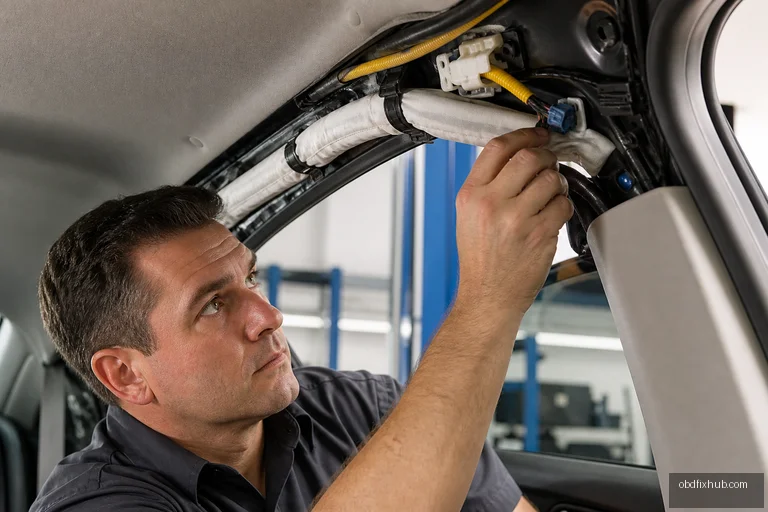
B0029 Right Curtain Deployment Control 1 indicates a fault in the electrical circuit used to control the vehicle’s right-side curtain airbag. In most cases, the airbag itself has not deployed or failed mechanically; the restraint control module has detected an open circuit, high resistance, short, poor connector contact, or communication problem. Because the SRS system may disable part of the airbag protection when this code is active, it should be diagnosed promptly rather than cleared and ignored.
What Does B0029 Mean?
B0029 is a manufacturer-specific or manufacturer-expanded SRS diagnostic trouble code. “Right curtain” normally refers to the roof-mounted side curtain airbag on the passenger side, while “deployment control 1” identifies one of the firing circuits, commonly called a squib or igniter circuit.
The exact subcode is important. For example, B0029-11, B0029-12, B0029-13, or B0029-1A can point to different electrical conditions depending on the vehicle manufacturer. One brand may use B0029 for an open circuit, while another may define the base code differently. Always check the factory service information for the specific year, model, and SRS module installed in the vehicle.
Common Symptoms of the B0029 Airbag Code
The most obvious symptom is an airbag or SRS warning light that remains illuminated after the engine starts. Unlike an intermittent check-engine fault, an SRS warning should be treated as a safety-system problem: the vehicle may still drive normally, but one or more airbags or pretensioners may not deploy correctly in a crash.
- Airbag, SRS, or restraint warning light on the instrument panel
- “Service airbag system” message or a warning chime
- Stored B0029 or a related curtain-airbag circuit code
- Several airbag codes appearing after a battery replacement or collision repair
- An intermittent warning that changes when the passenger-side roof trim or door area is moved
A useful real-world clue is whether the fault appeared after interior trim work, a windshield replacement, water intrusion, a side-impact repair, or installation of a dash camera and wiring. Those events commonly disturb curtain-airbag harnesses and retainers.
What Causes B0029 Right Curtain Deployment Control 1?
The most frequent cause is increased resistance in the circuit rather than a defective airbag module. A connector may look connected while its terminal has backed out, lost tension, or developed corrosion. SRS systems monitor resistance very closely, so a small change that would not affect an ordinary electrical accessory can set a deployment-circuit code.
- Loose, damaged, or partially unlatched curtain-airbag connector
- Open circuit caused by a broken wire in the roof, B-pillar, or headliner area
- Chafed wiring contacting the body or another circuit
- Water or condensation entering a connector
- Damaged right curtain airbag squib or inflator
- Previous collision repair with an incorrect harness or poor splice
- Low battery voltage or a voltage event that created multiple SRS faults
- Faulty airbag control module, although this is less common than wiring or connector problems
How to Diagnose B0029 Safely
Airbag circuits contain pyrotechnic devices. Do not test a curtain-airbag connector with a test light, incandescent bulb, or ordinary multimeter resistance function. Applying current to an inflator circuit can cause accidental deployment. Professional technicians use approved SRS test resistors, breakout leads, and manufacturer-specific procedures.
- Confirm the exact code and subcode. Use a scan tool that can communicate with the airbag control module, not only the engine computer. Record whether the code is current, stored, or history.
- Check for related codes. Multiple open-circuit codes may indicate a shared power, ground, connector, or module issue. A single right-curtain code points more strongly toward that branch of the harness.
- Inspect the service history. Ask whether the vehicle had a roof liner removed, side repair, water leak, accident, or battery issue. This often identifies the failure faster than replacing parts.
- Visually inspect the harness and connectors. With the battery disconnected according to the manufacturer’s SRS procedure, inspect the right curtain airbag connector, roof harness, B-pillar area, and connector locks for damage or intrusion.
- Test the circuit using the service manual. A qualified technician can substitute an approved dummy load and check continuity, isolation, terminal tension, and module-side wiring without energizing the inflator.
- Clear the code and perform a final scan. The warning should be cleared only after the underlying fault is repaired. If B0029 returns immediately, the fault is still present or the replacement component is incompatible.
Battery disconnection alone does not make an SRS system safe. Waiting time, connector locations, backup capacitors, and testing procedures vary. If you are not trained to work on pyrotechnic restraint systems, have the diagnosis performed by a qualified repair facility.
Repair Options and Typical Cost
If the problem is a loose terminal or damaged connector, the repair may involve terminal replacement, connector repair, or a short section of correctly specified harness. Do not solder or splice a squib circuit unless the manufacturer explicitly permits that repair; many manufacturers require a replacement harness or approved crimp procedure.
A damaged curtain airbag typically requires replacement of the airbag module and sometimes nearby trim or clips. If the vehicle was involved in a collision, the restraint control module may also contain crash data or require replacement and configuration. Approximate costs vary widely:
- Diagnostic scan and SRS inspection: approximately $80–$180
- Connector or wiring repair: approximately $150–$500
- Right curtain airbag replacement: often $500–$1,500 or more
- Airbag module replacement or programming: commonly $300–$1,000, depending on the vehicle
These figures are general estimates, not a quote. OEM parts, labor rates, vehicle design, collision history, and required programming can change the final price substantially.
How Do I Know If My Airbag Control Module Is Bad?
A bad airbag control module cannot be confirmed simply because the SRS light is on. The module is more suspect when it will not communicate with a known-good scan tool, has verified power and ground, shows internal-fault codes, or sets several unrelated deployment-circuit faults that remain after the wiring and squib circuits pass testing.
In contrast, one B0029 code with normal module communication usually points first to the right curtain circuit, connector, or inflator. A technician should verify power, grounds, network communication, and the circuit itself before condemning the module. Replacing an expensive SRS module without these checks is a common and avoidable misdiagnosis.
Related Airbag Codes Explained
What Does B1B06 Mean for the Driver’s Airbag Squib 2 Circuit Open?
B1B06 generally means the second firing circuit for the driver’s airbag has an open circuit. Common causes include a damaged clockspring, loose steering-wheel connector, broken wiring, an incorrectly installed driver airbag, or a failed squib. Because the driver’s airbag connects through the clockspring, steering-wheel work is a particularly important clue. The exact definition still depends on the manufacturer, so the vehicle’s service information should take priority.
What Does the B0020-13 Airbag Code Mean?
B0020-13 usually describes an airbag deployment-control circuit with an “open circuit” subfault, because the “13” failure-type suffix is commonly used for an open circuit. However, the component identified by B0020 differs between manufacturers; it may refer to a side, curtain, or other deployment loop. Do not assume it is the same component as B0029 without checking the vehicle-specific code chart.
Can You Drive With B0029?
The vehicle may start and drive, but driving with an SRS warning light means you cannot rely on the complete restraint system in a collision. Depending on the fault, the right curtain airbag, another airbag, or a pretensioner may be disabled. Avoid disturbing the headliner or unplugging yellow SRS connectors yourself, and arrange a proper diagnosis as soon as practical.
Final Takeaway
B0029 is an electrical fault in the right curtain airbag deployment circuit, not a generic engine problem. Start with the exact subcode, related SRS codes, connector and harness history, and safe circuit testing before replacing an airbag control module. If the SRS light is on, use an airbag-capable scan tool and a technician trained in pyrotechnic restraint systems; clearing the code without repairing the circuit does not restore crash protection.
Frequently Asked Questions
Is B0029 always caused by a bad curtain airbag?
No. Connector damage, wiring faults, terminal resistance, water intrusion, and prior repair work are often more likely than an internally failed airbag.
Can a weak battery cause the B0029 code?
Low voltage can create or store SRS faults, especially during starting or battery replacement. Voltage-related codes should be diagnosed, but a persistent B0029 still requires inspection of the right curtain circuit.
Can I clear B0029 with a basic OBD2 scanner?
Usually not. Many basic scanners communicate only with the engine computer and cannot access or clear the SRS module. Clearing the code also will not fix the underlying fault.
Is it safe to unplug the yellow airbag connector?
Not without following the vehicle’s service procedure. SRS connectors and backup capacitors can remain hazardous after the battery is disconnected, so use qualified equipment and proper waiting times.




