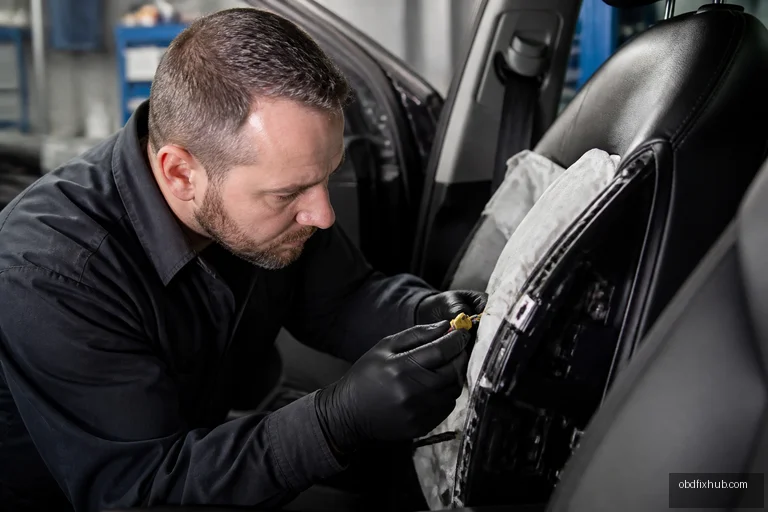
B0020 means the airbag control system has detected a fault in the left-side airbag deployment circuit. In many vehicles, this refers to the driver-side seat-mounted side airbag, although the exact component depends on the manufacturer. The most common causes are a loose or damaged connector under the seat, high circuit resistance, wiring damage, a failed side airbag module, or a problem inside the SRS/airbag control module. Because the warning light can indicate that the airbag may not deploy in a crash, driving should be limited to reaching a qualified repair facility rather than treating the code as a normal engine fault.
What Does the B0020 Left Side Airbag Deployment Control Code Mean?
B0020 is a manufacturer-defined body or restraint-system diagnostic trouble code. “Left side” generally identifies the vehicle’s left-hand side when sitting in the vehicle, which is normally the driver’s side in left-hand-drive markets. “Deployment control” refers to the electrical circuit and monitoring logic used to activate the airbag safely when the restraint control module detects a qualifying collision.
The code does not automatically prove that the airbag itself is defective. The SRS module continuously checks the circuit for open wires, short circuits, unexpected resistance, and communication or internal control faults. Some vehicles also store a more specific suffix, such as B0020-13, B0020-1A, or another manufacturer-specific subcode. That suffix can distinguish an open circuit from a resistance, voltage, or internal-module problem, so a generic OBD scanner may not provide enough information.
Common Causes of B0020
- Loose seat-airbag connector: Seat movement, vibration, or a connector that was not fully locked after interior work can interrupt the circuit.
- Damaged wiring under the seat: Wires can become pinched by the seat rails, stretched when the seat is adjusted, or damaged by moisture and corrosion.
- High resistance in a terminal: A weak crimp, partially backed-out pin, or oxidized contact may trigger the code even when the wire looks intact.
- Previous collision damage: A deployed airbag, impact sensor, pretensioner, or crash-damaged harness may leave a permanent SRS fault.
- Incorrect seat replacement or aftermarket equipment: Seat swaps, seat heaters, audio wiring, and poorly installed accessories can disturb the side-airbag circuit.
- Defective left side airbag: The inflator or internal airbag wiring can fail and require replacement.
- Airbag control module fault: Less commonly, the restraint control module has an internal failure or retains crash data that must be handled according to the manufacturer’s procedure.
B0020 Symptoms to Watch For
The clearest symptom is an illuminated SRS, airbag, or supplemental restraint system warning light on the instrument panel. The light may appear immediately at key-on, remain on after the normal bulb check, or return after the seat is moved. Some vehicles display a message such as “Service Airbag System” and may disable one or more airbags or pretensioners.
A code caused by a marginal connector often behaves differently from a permanent component failure. For example, a driver may report that the warning light appears after sliding the seat fully forward, disappears after restarting, and returns when the seat is adjusted again. That pattern strongly suggests a harness, connector, or terminal problem, but it still requires proper SRS testing rather than repeated code clearing.
Can You Drive With a B0020 Airbag Fault?
You may be able to drive the vehicle mechanically, but it is not safe to assume that the restraint system will work correctly. With an SRS warning light on, the left-side airbag may not deploy, may deploy incorrectly, or other connected restraint devices may also be disabled. The horn, engine, and brakes can continue to operate normally, which makes this fault easy to underestimate.
Arrange repair as soon as possible and avoid unnecessary driving, especially with passengers. Do not place tools, cargo, or children near the affected seat while the fault remains unresolved. If the warning appeared after a crash, flooding, or visible wiring damage, have the vehicle transported rather than attempting roadside electrical repairs.
How to Diagnose B0020 Correctly
Airbag circuits use pyrotechnic devices and must be treated as safety-critical systems. A technician should use the manufacturer’s service information, an SRS-capable scan tool, and the specified safety procedure. Never test an airbag inflator with a test light, ordinary multimeter, jumper wire, or improvised resistor.
- Confirm the exact code: Scan the SRS module, not only the engine computer, and record all current, pending, and history codes.
- Check related faults: Additional codes may identify a seat pretensioner, crash sensor, power supply, communication, or control-module problem.
- Inspect the seat area visually: Look for trapped harnesses, stretched wires, damaged insulation, water intrusion, and connectors that are not fully seated. Do not disconnect SRS connectors while the system is powered.
- Follow the OEM shutdown procedure: This commonly involves switching off the ignition, disconnecting the battery, and waiting the specified time before handling restraint-system connectors. The exact procedure varies by vehicle.
- Measure only as directed: Use approved breakout tools or a manufacturer-approved simulator where required. Resistance values and connector pinouts are not universal.
- Repair, clear, and retest: After the underlying fault is repaired, clear the code with an SRS-capable tool and verify that the warning light completes its normal self-test.
How Is B0020 Fixed?
The repair depends on what the diagnostic tests find. A connector may need to be correctly locked or a terminal repaired, while a damaged harness may require an approved replacement section rather than a casual splice. If the side airbag has failed or deployed, it normally must be replaced; used restraint parts can be unsafe or incompatible even when they look undamaged.
An airbag control module may need programming, replacement, or specialist crash-data service. Clearing a stored code without correcting the circuit is not a repair. In particular, a “module reset” may be inappropriate if the actual problem is an open connector or a damaged inflator circuit.
How Much Does It Cost to Fix an Airbag Fault?
Prices vary significantly by vehicle, location, and whether parts are required. A diagnostic scan and inspection commonly costs about $80–$180. A connector or minor wiring repair may be approximately $100–$400, while a damaged harness, side-airbag replacement, or seat-related repair can range from $400 to more than $1,500.
An airbag control module may add roughly $500–$1,500 or more when programming or replacement is necessary. These are practical estimates, not a quote. Ask the repairer whether the price includes SRS diagnosis, replacement parts, module programming, post-repair scanning, and verification of the warning-light self-test.
What Triggers Airbag Deployment?
Airbags deploy when the restraint control module receives impact data from crash sensors and determines that the direction, severity, and timing meet the vehicle’s deployment strategy. The threshold is not simply a fixed speed. Deceleration, impact angle, occupant protection strategy, seat-belt status, and the specific airbag zone all influence the decision.
A B0020 code by itself does not normally trigger an airbag deployment. It indicates a fault that can prevent or limit deployment. Airbags can deploy during a crash even when the vehicle has little visible exterior damage, while a serious-looking collision may not deploy every airbag because deployment is controlled by impact direction and sensor data.
Signs the Airbag Control Module May Be Malfunctioning
- The SRS warning light stays on after known-good circuit and connector checks.
- Several unrelated airbag, pretensioner, or crash-sensor codes appear together.
- The scan tool cannot communicate with the SRS module, or communication repeatedly drops out.
- The module reports internal memory, processor, calibration, or crash-data faults.
- The warning returns immediately after a verified repair and correct code clearing procedure.
These signs do not prove the module is bad. Power supply, ground, network wiring, low battery voltage, and unresolved crash damage can produce similar symptoms. Replacing an expensive control module before checking those basics is a common and avoidable diagnostic mistake.
Bottom Line: Do Not Ignore B0020
B0020 is best treated as a safety-system fault, not a nuisance warning. Start with a complete SRS scan and a careful inspection of the left-seat harness and connector, but leave live airbag-circuit testing to a trained technician with the correct service information. Repair the cause, not just the stored code, and confirm that the airbag light performs its normal startup check before returning the vehicle to regular use.
Frequently Asked Questions
Can a low battery cause the B0020 code?
Low voltage can create SRS faults and communication errors, particularly during starting, but it does not automatically mean the left-side airbag is defective. Battery voltage, charging output, and related codes should be checked before replacing restraint components.
Is B0020 always the driver-side airbag?
Not always. “Left side” usually identifies the driver-side position in a left-hand-drive vehicle, but component definitions vary by manufacturer and market. Confirm the exact description in the factory service information for your VIN.
Can I fix B0020 by reconnecting the plug under the seat?
A loose connector may be the cause, but do not disconnect or reconnect SRS plugs with the system powered. Follow the vehicle’s battery-disconnection and waiting procedure, and have the repair verified with an SRS-capable scan tool.
Will clearing B0020 turn off the airbag light permanently?
Only if the underlying fault was temporary and has been corrected. If the circuit still has excessive resistance, an open wire, a damaged airbag, or a module problem, the code and warning light will return.




