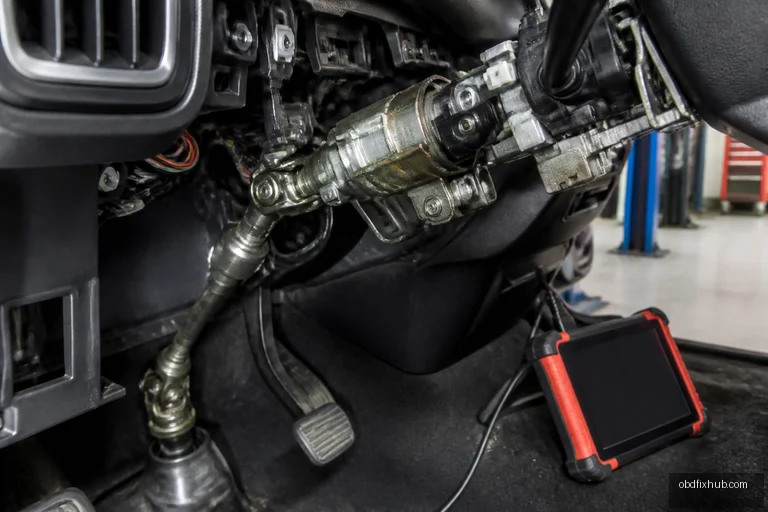
B0005 collapsible steering column is a body or restraint-system fault related to the circuit that controls or monitors the steering column’s crash-collapse function. On many Ford vehicles, B0005:13 means the circuit is open; the additional 8B suffix is a manufacturer-specific failure or status detail that should be decoded with Ford service information. This does not automatically mean the entire steering column must be replaced, but it does require careful diagnosis because the system is part of the vehicle’s crash protection strategy.
What Is the Purpose of a Collapsible Steering Column?
A collapsible steering column is designed to absorb energy and reduce the risk of serious chest, head, and upper-body injuries during a severe frontal collision. Instead of remaining completely rigid, the column is engineered to shorten or deform in a controlled way when specified crash forces are present.
Depending on the vehicle, the column may use a mechanical energy-absorbing structure, a pyrotechnic actuator, an electronic deployment control circuit, or a combination of these components. It works alongside the driver airbag, seat belt pretensioner, crash sensors, and restraint control module. A fault in the deployment-control circuit can therefore illuminate the airbag warning lamp even when the steering wheel itself feels normal.
What Does Ford Error Code B0005 13 8B Mean?
Ford scan tools commonly display this fault in a format such as B0005:13-8B or B0005 13 8B. The important part is B0005:13: it generally identifies an open circuit in the collapsible steering column deployment-control circuit.
- B0005: identifies the collapsible steering column deployment-control system.
- 13: typically means circuit open, meaning the module detects excessive resistance or no complete electrical path.
- 8B: is an additional Ford or scan-tool failure-status byte. Its exact interpretation can vary by model, restraint-control module, and diagnostic database.
Do not treat “8B” as a universal OBD-II definition. Generic code readers often present manufacturer-specific subcodes incompletely or label them differently. For an exact interpretation, compare the code with the vehicle’s Ford workshop manual or read it with a compatible Ford diagnostic platform such as IDS or FDRS.
Common Causes of B0005:13
In real diagnostic work, an open-circuit code is often caused by a connector or wiring problem rather than a failed column assembly. The fault may be permanent, or it may appear intermittently when the steering wheel is tilted, the column is adjusted, or the vehicle drives over a sharp bump.
- Loose, partially seated, corroded, or damaged steering-column connector
- Broken wire near the column, bracket, or harness retaining clip
- Incorrectly routed wiring after dashboard, ignition-switch, or column work
- Damaged clockspring or steering-wheel harness, where applicable
- Open circuit inside the collapsible-column actuator or sensor
- Previous collision damage or a column that has already deployed
- Water intrusion under the dashboard or near the restraint-control wiring
- Low battery voltage or a poor ground that caused misleading module faults
- Restraint control module software or internal failure
A useful clue is timing. If B0005 appeared immediately after a windshield replacement, dashboard removal, steering-column adjustment, or collision repair, inspect disturbed connectors and harness routing before condemning an expensive component.
Symptoms of a Bad Steering Column or B0005 Fault
The most common symptom is an illuminated airbag or supplemental restraint system warning light. Many drivers do not notice any change in steering feel because the fault concerns deployment control, not necessarily the column’s normal mechanical operation.
- Airbag, SRS, or restraint-system warning light
- “Service AdvanceTrac,” “Restraint System Fault,” or similar dashboard message
- B0005 stored as current, intermittent, or history data in the restraint module
- Failure to pass a safety inspection where SRS lights are checked
- Steering-wheel controls, horn, or airbag-related functions affected if the clockspring or shared wiring is involved
- Visible impact damage, abnormal column movement, looseness, or incorrect tilt-lock operation
Heavy steering, grinding, or excessive play usually points to a mechanical steering problem rather than B0005 alone. Those symptoms should still be treated urgently, because a deployment-control code and a mechanical column defect can exist at the same time.
How to Diagnose B0005 Collapsible Steering Column Correctly
Diagnosis should begin with the restraint-control module, not with random parts replacement. A basic engine-code reader may not access the airbag module or may erase only generic powertrain codes, so use a scan tool that supports the vehicle’s SRS system and Ford-specific data.
- Record all module codes and freeze-frame information. Look for related voltage, crash-event, clockspring, or communication faults.
- Check battery voltage and grounds. Low voltage during starting can create several restraint codes at once, although it will not repair a genuine open circuit.
- Inspect the column and harness visually. Look for pinched wires, pulled terminals, damaged insulation, missing clips, and connectors that are not fully locked.
- Check technical service bulletins. Some model years have known harness-routing or connector-retention issues that change the recommended repair.
- Perform circuit tests only with the correct procedure. The service manual may specify a breakout harness, resistance test, or module-side test. Follow its limits exactly.
- Clear the code and perform a controlled retest. Turn the wheel, adjust the column if permitted, and road-test only after the system has been safely reassembled.
Important safety warning: Never probe an airbag, pretensioner, or pyrotechnic deployment circuit with an ordinary test light or an unsuitable ohmmeter. Disconnecting the battery is not a substitute for the manufacturer’s restraint-system shutdown procedure; many vehicles require a specified waiting period and additional precautions.
Repair Options: Wiring, Sensor, or Complete Column?
The correct fix depends on where the open circuit is found. A loose connector may need terminal repair and proper locking. A damaged wire can often be repaired with an approved automotive splice and protected routing, while a failed actuator or internal column sensor may require a replacement component.
If the vehicle has been involved in a collision and the column has deployed, do not simply clear B0005. The column, steering wheel, airbag, pretensioners, crash sensors, and restraint module may all require inspection. A used column can also be risky if its deployment history is unknown or if its part number does not match the vehicle’s equipment and calibration.
Is Replacing a Steering Column a Big Job?
Usually, yes. The difficulty ranges from moderate to major depending on the Ford model and whether the column is electrically adjustable, equipped with a motorized locking system, or integrated with steering-wheel and restraint wiring. Access may require removal of lower dashboard panels, the steering wheel, clockspring, column shrouds, mounting bolts, and sometimes portions of the instrument panel.
After installation, the vehicle may require steering-angle calibration, module configuration, a restraint-system self-test, or a specific initialization procedure. A mistake during clockspring installation can damage the part when the wheel is turned. For that reason, replacement is best handled by a technician familiar with SRS systems rather than treated as a simple bolt-on repair.
Practical Decision Guide
- Only B0005:13 is present and the vehicle has no collision history: start with voltage, connectors, wiring, and terminal tension.
- The code returns when the column moves: suspect harness routing, a strained connector, or an internal column connection.
- Several airbag codes appeared after an accident: have the complete restraint system inspected before clearing anything.
- There is mechanical looseness or difficult steering: stop driving until the column and steering linkage are professionally checked.
- The code remains after verified wiring tests: use the Ford service procedure to determine whether the actuator, sensor, or restraint module is defective.
Final Takeaway
Ford B0005:13-8B most often points to an open or electrically invalid circuit associated with collapsible steering-column deployment control. It can be caused by wiring, connectors, prior repairs, collision damage, or an internal component failure. Because the system protects the driver during a crash, diagnose it with proper SRS equipment and manufacturer procedures instead of replacing the column or repeatedly clearing the warning light without testing.
Frequently Asked Questions
Can I drive with a B0005 code?
The vehicle may steer normally, but an active restraint-system fault can mean the collapsible-column deployment function or related SRS operation is not available. Have it diagnosed promptly, and avoid driving it if there is mechanical looseness, impact damage, or a serious steering symptom.
Does B0005 always mean the steering column must be replaced?
No. An open connector, damaged wire, poor terminal connection, or previous repair can produce the code. Replacement should follow a confirmed circuit and component test, not the code description alone.
Will disconnecting the battery clear B0005?
Usually not permanently. The code may remain stored, and it will return if the module still detects the fault. Battery disconnection also does not replace the required SRS safety procedure.
What are the symptoms of a physically bad steering column?
Mechanical symptoms can include excessive play, looseness, abnormal noises, difficult adjustment, incorrect tilt-lock operation, or steering-wheel misalignment. These differ from an electrical B0005 fault, which may produce only an SRS warning light.
How much does a B0005 repair cost?
Cost varies widely. A connector or wiring repair may be relatively inexpensive, while a collision-damaged column, restraint module, or related calibration can be substantially more costly. The diagnostic inspection should be completed before requesting a replacement estimate.




