B0090 Left Frontal Restraints Sensor means the airbag control module has detected a fault involving the left-front crash sensor circuit or its signal. It does not automatically mean the airbag has deployed, but it can disable part of the Supplemental Restraint System (SRS), so the warning should be diagnosed promptly rather than simply cleared.
This code is commonly seen on vehicles using manufacturer-specific restraint terminology, including some Chrysler, Dodge, Jeep, and Ram models. The exact definition, sensor location, and repair procedure can vary by year and model, so the full scan-tool description and any suffix attached to B0090 matter.
What Does B0090 Left Frontal Restraints Sensor Mean?
The vehicle’s SRS control module continuously checks the left frontal impact sensor, its wiring, connectors, power supply, and communication with the module. The sensor helps the restraint controller determine whether a frontal impact is severe enough to require airbag or seat-belt pretensioner deployment.
When the module sees an open circuit, short circuit, implausible sensor data, communication problem, or incorrect installation, it stores B0090 and turns on the airbag warning light. On some vehicles, a related code may identify the problem more precisely, such as a low voltage, high voltage, missing message, or internal sensor fault.
Common Symptoms of B0090
- Airbag or SRS warning light remains illuminated.
- A message such as Service Airbag System appears in the instrument cluster.
- The vehicle may fail an inspection that checks restraint-system warning lamps.
- One or more airbags or seat-belt pretensioners may be disabled as a safety precaution.
- The code returns immediately after being cleared.
- Other restraint-related codes may appear at the same time, especially after a collision, water intrusion, or interior repair.
The vehicle will usually continue to start and drive normally because B0090 is not an engine or transmission fault. That apparent normal operation is misleading: the SRS warning light means the restraint system may not provide its full designed protection in a crash.
What Causes a B0090 Fault?
Damaged wiring or a loose connector
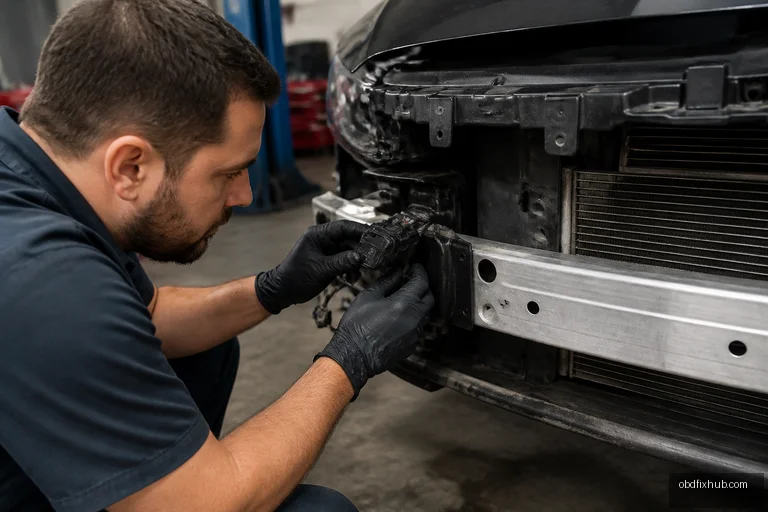
The left-front sensor is typically mounted near the front structure, where wiring can be affected by a minor collision, bumper work, corrosion, road debris, or a previous repair. A connector that looks connected can still have a pushed-back terminal, damaged locking tab, or moisture inside it.
Previous front-end impact
A low-speed impact may not visibly damage the bumper but can shift the sensor bracket or stretch its wiring. If the sensor is mounted at the wrong angle or on a bent support, the SRS module may reject its signal even though the sensor itself is electrically sound.
Water or corrosion intrusion
Water entering through the grille, wheel well, headlamp area, or a poorly repaired front-end panel can corrode the sensor terminals. Intermittent corrosion is particularly difficult to find because the code may appear only during wet weather or when the vehicle travels over bumps.
Faulty sensor or restraint control module
The impact sensor can fail internally, although replacing it should not be the first diagnostic step. A damaged SRS module, poor ground, low system voltage, or communication fault can produce a sensor code that points attention in the wrong direction.
Incorrect installation after repairs
After bumper, radiator support, or body repairs, a sensor may be installed on the wrong side, left loose, mounted backward, or attached to a replacement bracket that does not match the original design. Restraint sensors must be installed exactly as specified by the manufacturer.
How to Diagnose B0090 Safely
Airbag circuits contain pyrotechnic devices that can deploy with significant force. Do not probe yellow SRS connectors with a test light, jumper wire, or ordinary ohmmeter, and do not unplug restraint components with the battery connected.
- Record every SRS code. Use a scan tool that can communicate with the airbag control module; a basic engine-code reader may not access it. Note whether B0090 is current, stored, or intermittent and record any two-digit or manufacturer-specific suffix.
- Check the vehicle history. Ask whether the bumper, grille, fender, headlights, or radiator support has recently been removed. A recent collision or body repair is an important diagnostic clue.
- Follow the manufacturer’s safety procedure. This commonly includes switching off the ignition, disconnecting the negative battery cable, and waiting the specified time before inspecting connectors. The service manual, not a generic internet guide, determines the correct waiting period.
- Inspect the left-front sensor area. Look for a bent bracket, missing fastener, crushed harness, chafing, corrosion, water marks, or a connector that is not fully locked. Never force a connector back together.
- Check power, ground, and continuity only as instructed. Use the wiring diagram and approved SRS test equipment. Do not assume the sensor wiring follows the same pinout as another model or year.
- Repair the root cause before clearing the code. After the repair, scan the SRS module again and perform any required system initialization, calibration, or crash-data procedure.
How to Fix B0090
The correct repair depends on the failed part. A loose connector may require terminal repair and proper locking, while damaged wiring may need a manufacturer-approved harness repair rather than a twist-and-tape splice. If the sensor bracket is bent, the supporting structure should be inspected before a new sensor is installed.
If testing confirms a failed left-front impact sensor, replace it with the correct part for the exact vehicle configuration. Do not install a used sensor without confirming compatibility and condition. Some vehicles also require a post-repair scan, module reset, or calibration before the SRS warning light will stay off.
After a serious crash, replacing the sensor alone may not solve the problem. The restraint control module can retain crash data, and deployed airbags or pretensioners may create additional codes. In that situation, a qualified SRS technician should follow the vehicle’s collision-repair procedure rather than repeatedly clearing codes.
Can You Drive With B0090?
You can often drive the vehicle mechanically, but it is not wise to treat it as fully safe. Until the SRS light is repaired, the left-front sensing function or another restraint component may be unavailable. Avoid delaying diagnosis, especially if the vehicle carries children, if the code appeared after a collision, or if multiple airbag codes are present.
Key Takeaway
B0090 identifies a problem in the left-front restraint sensor system, not necessarily a bad sensor. Start with a capable SRS scan, inspect the sensor mounting and harness after safely disabling the system, and use the exact factory wiring and repair procedure for the vehicle. Do not replace parts blindly or test airbag circuits with improvised equipment.
Frequently Asked Questions
Is B0090 the same as a left-front airbag code?
Not exactly. B0090 generally concerns the left-front restraint or impact-sensor circuit. The code does not by itself prove that the airbag module, airbag cushion, or pretensioner has failed.
Will disconnecting the battery clear B0090?
Usually not. SRS faults are stored in the restraint control module and normally require a compatible scan tool after the underlying problem is repaired. Disconnecting the battery can also create additional electrical issues if done incorrectly.
Can a recent bumper replacement cause B0090?
Yes. During bumper or front-end work, the sensor may be unplugged, mounted incorrectly, installed on a damaged bracket, or connected to a harness with a pulled terminal. This is one of the first areas to inspect when the code appears immediately after body repairs.
Should I replace the left-front sensor first?
No. Confirm the code status, inspect wiring and mounting, and test power and communication according to the service manual first. Replacing a sensor will not fix a corroded connector, damaged harness, poor ground, or locked SRS module.




