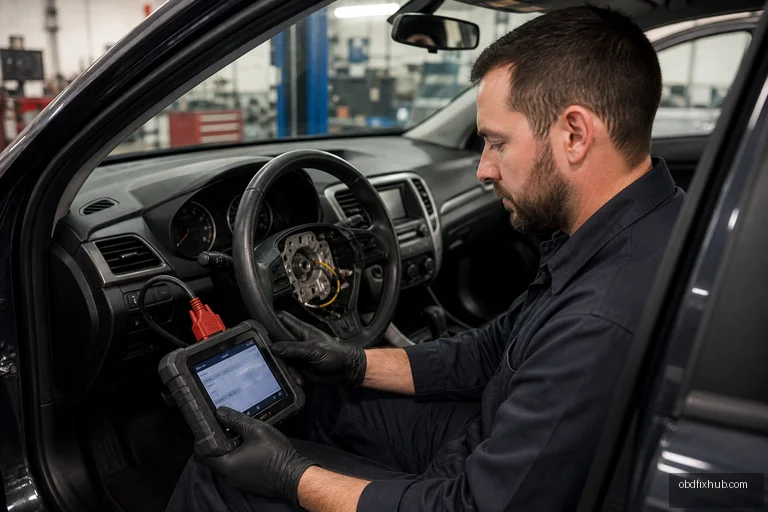
B0099 roll over sensor is an airbag and restraint-system fault code indicating that the vehicle has detected a problem with the sensor or circuit used to recognize a rollover event. The airbag warning light may stay on, and the rollover protection system may be disabled until the fault is properly diagnosed. Do not replace the sensor immediately: damaged wiring, low system voltage, water intrusion, or a failed airbag control module can produce the same code.
What Does the B0099 Code Mean?
B0099 is a body-related diagnostic trouble code associated with the supplemental restraint system, commonly called the SRS or airbag system. The exact definition varies by manufacturer, but it generally refers to the roll-over sensor, its electrical circuit, or the control module’s ability to interpret its signal.
Some vehicles use a dedicated roll-over sensor mounted in the center of the vehicle, while others integrate rollover sensing into the airbag control module. Certain models also use multiple acceleration and yaw sensors to calculate whether the vehicle is tipping or rolling. For that reason, the repair procedure must follow the manufacturer’s wiring diagram and service information rather than a generic code description alone.
B0099 Roll Over Sensor Symptoms
The warning signs are usually electrical rather than mechanical. A vehicle can drive normally while the restraint system remains unavailable, which makes this fault easy to underestimate.
- The airbag or SRS warning light remains illuminated.
- A “Service Airbag,” “Service Restraint System,” or similar message appears.
- The scan tool shows B0099, sometimes with a suffix such as B0099-96.
- Rollover curtain airbags or pretensioners may be disabled as a safety precaution.
- Additional communication, voltage, or sensor codes may appear at the same time.
A normal-looking dashboard after starting the engine does not prove the system is healthy. The SRS module continuously monitors resistance, reference voltage, communication, and sensor plausibility. A fault can return only after the vehicle is driven over bumps or experiences a voltage fluctuation.
Common Causes of B0099
1. Damaged wiring or connectors
Wiring under the seats, beneath the center console, or near the transmission tunnel can be pulled, pinched, or contaminated. Yellow connectors are normally associated with restraint circuits. A loose terminal may pass a continuity test while failing when vibration changes the connection.
2. Failed roll-over sensor
The sensor itself can fail internally because of age, impact, corrosion, or a previous water leak. If the scan tool identifies a stable internal sensor fault while the power, ground, and communication circuits test correctly, sensor replacement becomes more likely.
3. Low battery voltage or a charging problem
A weak battery, poor ground strap, or alternator problem can create misleading SRS codes. Voltage that drops sharply during cranking may interrupt sensor initialization. Check the battery and charging system before condemning an expensive airbag module.
4. Water intrusion
Carpet dampness is an important clue. HVAC leaks, blocked sunroof drains, flood exposure, and spilled liquids can corrode a sensor or the airbag control module. If corrosion is visible, replacing only the sensor may provide a temporary result while the underlying connector continues to fail.
5. Previous collision or incorrect module installation
After a crash, the SRS module may contain stored deployment data or may not have been correctly replaced and configured. A used module from another vehicle can also create compatibility, calibration, or vehicle-configuration errors.
How to Diagnose B0099 Correctly
- Read every SRS code. Use a scan tool that can access the airbag module; a basic engine-only OBD scanner may not see B0099 or its subcode.
- Record the exact suffix and freeze-frame data. B0099-96, for example, may indicate a component internal failure, but the meaning must be confirmed for that vehicle’s manufacturer.
- Inspect the battery and grounds. Confirm stable battery voltage, clean terminals, and a secure chassis ground.
- Inspect the sensor area and harness. Look for crushed wiring, bent terminals, moisture, corrosion, and evidence that a seat or console has recently been removed.
- Check live data and circuit values. Compare the roll-over sensor’s signal with the manufacturer’s specified range. Do not substitute random resistance values for an airbag component.
- Clear the code only after repairing the cause. If B0099 returns immediately during the next self-test, the fault is still present or the module requires calibration.
Safety warning: Disconnect the battery and follow the manufacturer’s waiting period before working near airbag wiring. Never test an airbag or pretensioner circuit with a test light, incandescent bulb, or an unsuitable multimeter connection. Accidental deployment can cause serious injury.
How Do I Know If My Airbag Control Module Is Bad?
An airbag control module is more likely to be faulty when it has correct power and ground, communicates reliably with a professional scan tool, and still reports a confirmed internal failure after the sensor and wiring have been tested. A module that will not communicate at all may have a power, ground, CAN-bus, or internal failure; communication loss alone does not prove the module is defective.
Technicians should also check for water damage, crash data, software updates, and vehicle configuration. If several unrelated SRS sensors report faults simultaneously, suspect shared power, ground, communication wiring, or the module before replacing multiple sensors. Module replacement may require programming, coding, or a crash-data reset, depending on the vehicle.
What Does the B0018 Airbag Code Mean?
B0018 is a different airbag code from B0099. It commonly relates to a deployment loop or side airbag circuit, such as a seat-mounted or curtain airbag, but the precise component and failure type depend on the vehicle manufacturer and the code suffix.
Do not assume B0018 and B0099 have the same cause. B0018 may be triggered by an open circuit, high resistance, short circuit, connector problem, or deployment-loop fault. If both codes are present, inspect shared wiring and recent seat or interior work, but diagnose each circuit using the vehicle-specific service manual.
Repair Options and Typical Cost Factors
The correct repair may be as simple as repairing a corroded terminal or as extensive as replacing and programming an SRS module. Cost depends on sensor location, access time, parts availability, whether the module is integrated with other sensors, and whether crash data must be cleared.
- Wiring or connector repair: often the least expensive option when damage is accessible.
- Sensor replacement: followed by code clearing and, on some models, zero-point or rollover calibration.
- Airbag module service or replacement: may require coding, software setup, or a new module after deployment.
- Water-damage repair: requires correcting the leak as well as replacing affected electrical components.
A practical example is a vehicle that develops B0099 after a wet winter and has damp carpet under the center console. Replacing the roll-over sensor without drying the carpet, repairing the leak, and cleaning the connector usually leads to a repeat warning. The pattern and environment are diagnostic evidence, not just background details.
Can You Keep Driving With B0099?
The vehicle may remain drivable, but the SRS system may not protect occupants as designed in a crash or rollover. Treat the illuminated airbag light as a safety fault, avoid unnecessary driving, and arrange professional diagnosis promptly. Never ignore the code simply because the car starts and drives normally.
Key Takeaway
B0099 identifies a problem involving rollover detection, but it does not automatically mean the roll-over sensor needs replacement. Start with a full SRS scan, the exact code suffix, battery voltage, grounds, connectors, wiring, and signs of water or collision damage. Because airbag circuits can deploy with dangerous force, use the manufacturer’s procedure or have the diagnosis performed by a qualified restraint-system technician.
Frequently Asked Questions
Is B0099 always caused by a bad roll-over sensor?
No. Wiring damage, corrosion, low voltage, communication faults, water intrusion, and a defective airbag control module can all set B0099.
Can a generic OBD2 scanner diagnose B0099?
Usually not reliably. You need a scan tool capable of communicating with the vehicle’s SRS or airbag module and reading manufacturer-specific subcodes.
What does B0099-96 usually indicate?
On many vehicles, the “-96” suffix points toward a component internal failure. Confirm the definition for the specific make, model, year, and restraint module before replacing parts.
Will disconnecting the battery clear B0099?
It may erase temporary information on some vehicles, but it does not repair the fault. The code commonly returns during the next SRS self-test, and battery disconnection can also create additional issues.
Should I replace the airbag module or sensor first?
Neither should be replaced by guesswork. Test power, grounds, communication, wiring, and sensor data first; then follow the manufacturer’s replacement and calibration procedure.




