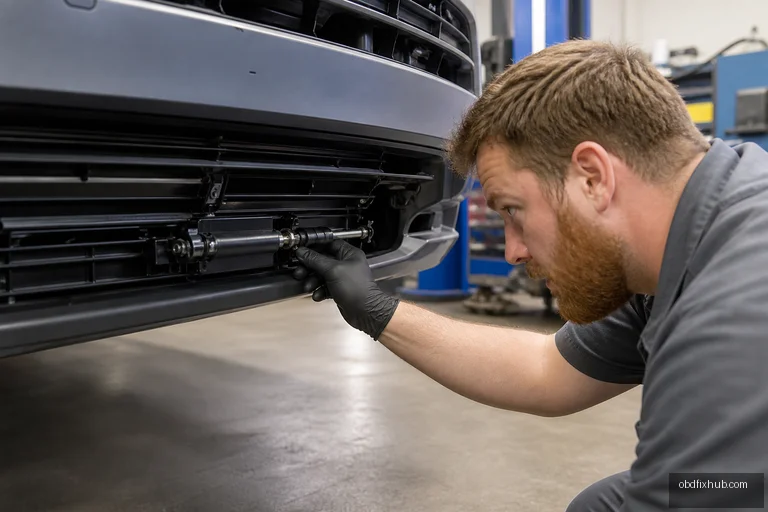
B3A35 Active Aerodynamic Feature A Actuator Performance means the vehicle has detected that actuator A is not moving, responding, or reporting position as expected. The actuator may control an active grille shutter, front air deflector, cooling flap, rear spoiler, or another electronically controlled aerodynamic device. Do not replace the actuator immediately: wiring damage, ice, road debris, a seized mechanism, calibration loss, or a control-module fault can produce the same code.
What Does the B3A35 Code Mean?
B3A35 is a manufacturer-specific body or chassis diagnostic trouble code rather than a universal generic powertrain code. “Active aerodynamic feature” identifies the system, “A” identifies one actuator or circuit group, and “performance” indicates that the commanded movement does not match the feedback received by the control module.
On one vehicle, Feature A may refer to a left-side grille shutter. On another, it may identify a front spoiler actuator or an aerodynamic flap assembly. The exact component must be confirmed with the vehicle’s factory service information or a scan tool that displays OEM definitions. A basic code reader may show an incomplete description.
Common Symptoms of B3A35
The vehicle may continue to drive normally because active aerodynamics are often non-essential systems. However, the module can disable the feature and store the code to prevent repeated motor operation. Typical signs include:
- A check-engine, service, or aerodynamic-system warning lamp.
- Active grille shutters or a spoiler that remain open, closed, or partly extended.
- Clicking, buzzing, or repeated actuator movement after the ignition is switched off.
- Reduced fuel economy at highway speed or increased aerodynamic noise.
- Cooling-system warnings if a closed grille shutter restricts airflow.
- A code that returns immediately after clearing or during a commanded actuator test.
A fixed-open grille shutter usually creates an aerodynamic penalty but may still allow adequate cooling. A fixed-closed shutter is more serious, especially in traffic, hot weather, or while towing, because it can limit airflow through the radiator and condenser.
Most Likely Causes
- Blocked or mechanically seized feature: Ice, mud, gravel, leaves, or a bent shutter can prevent the motor from reaching its target position.
- Failed actuator motor: Internal gears can strip, the motor can wear out, or an integrated position sensor can lose its signal.
- Damaged wiring or connectors: Front-mounted components are exposed to water, salt, impact, and harness chafing.
- Low system voltage: A weak battery, poor ground, or charging problem can interrupt actuator initialization.
- Lost calibration: Battery disconnection, component replacement, or a software event may require a relearn procedure.
- Control-module or software fault: This is possible, but it should be considered only after the actuator, mechanism, power, ground, and network communication have been tested.
How to Diagnose B3A35 Properly
A professional diagnosis starts with the entire vehicle scan, not just the stored B3A35 code. Record all current, pending, and history codes, including low-voltage, communication, and cooling-system faults. A related voltage or network code may explain why the aerodynamic actuator never completed its self-test.
1. Identify Feature A on the Specific Vehicle
Use the VIN-specific service manual or an OEM-capable scan tool to locate Feature A. Check whether it is a grille shutter, air dam, spoiler, or flap and note its normal park position. This step prevents a common mistake: replacing the visible actuator when the code actually refers to a different aerodynamic assembly.
2. Inspect the Mechanism Before Testing the Electronics
With the ignition off and the vehicle safely supported, inspect the assembly for broken mounts, impact damage, packed dirt, ice, and foreign objects. Move the linkage only as permitted by the manufacturer; forcing an electronically indexed gear can damage the actuator. If the shutter or flap binds by hand, electrical testing alone will not solve the problem.
3. Check Power, Ground, and Connector Condition
Look for green corrosion, pushed-back terminals, water inside the connector, and harness damage near the bumper or radiator support. Test voltage under load rather than relying only on an open-circuit reading. A circuit may show battery voltage with no load but collapse when the actuator is commanded because of a corroded terminal or broken conductor.
4. Run an Active Test and Compare Position Feedback
Use a scan tool with bidirectional controls to command the actuator through its operating range. Watch commanded position, actual position, motor current, and any position-sensor percentage. A motor that runs but never changes feedback points toward stripped gears, a failed sensor, or a disconnected linkage; no movement with correct power and ground points more strongly toward the actuator itself.
5. Perform Calibration or Relearn When Required
Some systems learn end stops automatically, while others require a dedicated “active aerodynamic feature initialization” procedure. Perform the relearn only after confirming that the mechanism moves freely. If calibration fails at the same position every time, inspect that physical point for a damaged stop, misalignment, or excessive resistance.
Repair Options
The correct repair depends on the test results. Remove debris and repair the harness if the component is mechanically sound. Replace the actuator when its motor, gears, or integrated position sensor fails. If the actuator is sold only with the grille-shutter or spoiler assembly, the complete unit may be required, followed by calibration.
After repair, clear the code and repeat the active test. Then road-test the vehicle while monitoring live data, especially if the feature changes position with vehicle speed, coolant temperature, air-conditioning demand, or engine load. A code that stays cleared in the workshop can return at highway speed if the actuator loses synchronization under vibration.
Can You Drive With B3A35?
Short-distance driving is often possible when there is no overheating, no loose component, and no spoiler or air dam creating a safety hazard. Avoid continued driving if the feature is stuck closed and the engine temperature rises, if the actuator is repeatedly clicking, or if a loose aerodynamic panel could detach. Monitor the temperature gauge and treat any overheating warning as an immediate stop condition.
Key Takeaway
B3A35 is a performance or position-control fault for an active aerodynamic actuator, not proof that the actuator alone is defective. Identify Feature A with vehicle-specific information, inspect for mechanical blockage, test power and ground under load, use a bidirectional actuator test, and complete the required calibration. This sequence avoids unnecessary parts replacement and is the fastest route to a reliable fix.
Frequently Asked Questions
Is B3A35 the same on every vehicle?
No. The code family and wording are manufacturer-specific, so Feature A can represent different aerodynamic hardware depending on the make, model, year, and equipment level.
Can a dead battery cause B3A35?
Yes. Low voltage can interrupt actuator initialization or calibration. Check battery and charging voltage, but do not assume the battery is the only fault if the code returns after voltage is restored.
Will clearing B3A35 fix the problem?
Clearing the code may remove the warning temporarily, but it will return if the actuator still cannot reach or report its commanded position. A physical inspection and active test are necessary.
Does B3A35 mean the grille shutter must be replaced?
Not necessarily. Debris, a damaged connector, broken wiring, a seized linkage, or a calibration problem can produce the same code. Test the complete circuit before ordering an assembly.
Should I keep driving if the code is active?
Only if the vehicle is not overheating and the aerodynamic component is secure. Stop driving if the engine temperature increases, the shutter is stuck closed, or a panel is loose or rubbing.




