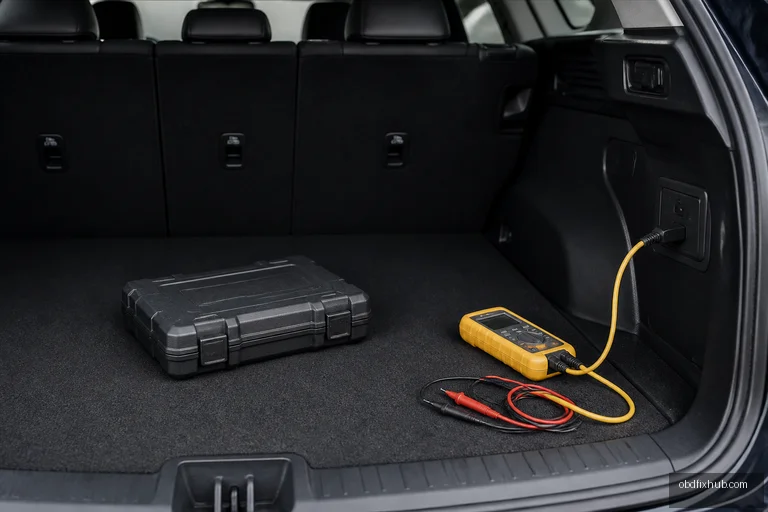
Search intent: Informational. Drivers searching for the B0127 DC/AC Converter A High Voltage Power Outlet “A” Circuit/Open code usually want to know whether the vehicle is safe to drive, why the power outlet stopped working, and whether the fault requires an expensive converter replacement. In most applications, B0127 indicates that the vehicle’s body control system has detected an open or electrically incomplete circuit associated with a high-voltage DC/AC inverter and its power outlet circuit. It does not automatically prove that the inverter itself has failed.
What Does B0127 Mean?
B0127 is generally a manufacturer-specific body or hybrid-system diagnostic trouble code, not a universal powertrain code with exactly the same definition on every vehicle. The wording “DC/AC Converter A High Voltage Power Outlet Circuit/Open” points to an inverter system that converts the vehicle’s high-voltage DC battery supply into AC power for an onboard outlet.
The word “open” means the control module expected to see a complete electrical path, but the circuit voltage, resistance, or feedback signal was outside the permitted range. The fault may be in the outlet wiring, a connector, a fuse, a relay, an enable signal, a ground, or the converter’s internal monitoring circuit.
Symptoms of the B0127 DC/AC Converter A High Voltage Power Outlet Circuit/Open
The most obvious symptom is an AC power outlet that does not supply electricity. Depending on the vehicle, the outlet may be located in the cargo area, center console, rear cabin, or under a dedicated power-inverter cover.
- The 110/120-volt or 220/240-volt outlet is completely dead.
- The outlet works intermittently, especially over bumps or after moisture exposure.
- An “AC Power Off,” “Power Outlet Fault,” or inverter warning appears on the instrument cluster.
- The power button or outlet indicator flashes, refuses to activate, or switches off immediately.
- A body, hybrid, or electric-powertrain warning light illuminates.
- Additional communication or low-voltage supply codes appear with B0127.
A useful practical clue is load behavior. If the outlet shuts down only when a high-wattage appliance is connected, overload protection may be involved. If it is dead even with a small phone charger, an open circuit, blown fuse, missing enable signal, or failed inverter becomes more likely.
Common Causes of B0127
1. Blown outlet or inverter fuse
A fuse can open because of an overloaded appliance, a damaged extension cord, a shorted outlet, or repeated use near the system’s maximum wattage. Do not install a higher-rated fuse. The original rating is part of the circuit’s safety design, and an oversized fuse can damage wiring or create a fire risk.
2. Loose, corroded, or damaged connector
Connectors near the rear cargo area and underbody are exposed to vibration, condensation, spilled liquids, and road salt. A terminal can look connected while its crimp is loose or its locking tab has not fully engaged. Technicians often find that moving the harness while monitoring live data makes an intermittent B0127 fault appear.
3. Open low-voltage control or ground circuit
The inverter may have a separate 12-volt power supply, ground, ignition feed, outlet-enable wire, and fault-feedback circuit. A broken ground strap or damaged control wire can disable the outlet even when the high-voltage battery and inverter hardware are healthy.
4. Outlet or switch failure
The AC receptacle, power button, protective shutter, or outlet temperature sensor can fail internally. A liquid spill may also trip an integrated protection device. In this situation, the inverter may report an open outlet circuit because the expected feedback signal never returns.
5. Failed DC/AC converter or internal protection device
If the wiring, fuse, ground, and command signals test correctly, the inverter may have an internal relay, current sensor, semiconductor, or control-board failure. Replacement is not always the first answer: some manufacturers provide a separate outlet assembly or service procedure, while others require replacement of the complete converter.
How to Diagnose B0127 Safely
High-voltage vehicles can contain battery systems capable of causing severe injury or death. The orange high-voltage cables, inverter housing, and converter terminals must not be probed casually. If testing requires removing covers, disconnecting the traction battery, or measuring high-voltage terminals, use a qualified hybrid/EV technician with the manufacturer’s service procedure and appropriate insulated equipment.
- Confirm the code with a capable scan tool. Record every stored, pending, and history code before clearing anything. Generic readers may display B0127 but omit the manufacturer’s detailed subcode or freeze-frame information.
- Check the owner’s manual. Verify the outlet’s maximum wattage, activation procedure, and whether the vehicle must be in READY, ON, or Park mode.
- Test the outlet with a known-good low-wattage load. A small approved charger is safer for initial testing than a heater, kettle, compressor, or power tool.
- Inspect the relevant low-voltage fuse and connectors. Look for heat discoloration, bent terminals, water intrusion, loose locks, and harness damage. Power must be isolated according to the service manual before connector work.
- Check live data and command tests. A professional scan tool may show outlet requested state, inverter enable status, outlet temperature, overcurrent status, and converter feedback voltage.
- Perform continuity and voltage-drop tests. An ordinary resistance test can miss a connection that fails under load. Voltage-drop testing under the correct conditions is often more revealing.
- Clear the code and verify operation. After repair, operate the outlet with a modest load, road-test if necessary, and rescan to confirm that B0127 does not return.
What Is the Correct Fix?
The repair depends on the failed point. A blown fuse may be the complete fix only if the original overload or short circuit has been identified. A corroded terminal should be repaired with the correct terminal and sealing method rather than merely sprayed with contact cleaner and pushed back together.
For a damaged outlet, replacement of the receptacle or outlet module may restore operation. If a wire is broken inside the harness, the repair must match the manufacturer’s wire gauge, shielding, routing, and crimping requirements. If the converter fails its internal self-test, replacement or specialist repair may be necessary, followed by calibration or initialization with a factory-level scan tool.
Can You Drive With B0127?
If the vehicle drives normally and only the AC outlet is disabled, many vehicles can be driven short-term without using that outlet. However, do not ignore B0127 when it appears with hybrid-system warnings, reduced power, charging faults, overheating messages, burning smells, or repeated fuse failures. Stop using the outlet immediately if it becomes hot, smells of melted plastic, sparks, or trips protection.
How Much Does B0127 Repair Cost?
Cost varies widely by vehicle and failure location. Diagnosis may be relatively inexpensive, while a fuse or connector repair is usually modest. An outlet module costs more, and a complete DC/AC converter can be a major repair because it is connected to the vehicle’s high-voltage system and may require programming, isolation testing, and post-repair verification.
Key Takeaway
B0127 means the vehicle has detected an open or abnormal circuit related to the DC/AC converter’s high-voltage power outlet “A” circuit. Start with the fuse, outlet, low-voltage wiring, connectors, grounds, and live-data commands before condemning the converter. Because the system is associated with high voltage, professional diagnosis is the safest and most cost-effective path when basic visual checks do not identify the fault.
Frequently Asked Questions
Is B0127 a high-voltage battery failure?
Not necessarily. B0127 is associated with the inverter and AC outlet circuit. The fault may be limited to a fuse, connector, outlet, control wire, or low-voltage ground rather than the traction battery.
Can a blown fuse cause B0127?
Yes. A blown outlet or inverter fuse can interrupt the expected power or feedback circuit and set an open-circuit code. The reason the fuse failed should still be identified before installing a replacement.
Can I test the inverter with a multimeter?
Low-voltage wiring may be tested when the service procedure permits it, but high-voltage inverter terminals should not be measured without EV safety training and the correct insulated equipment. Incorrect testing can cause serious injury or additional damage.
Why does the outlet work sometimes and fail at other times?
Intermittent operation commonly points to a loose terminal, damaged harness, moisture intrusion, thermal protection, or an internal relay that fails when warm. A technician should monitor the circuit while flexing the harness and checking live data.
Will clearing B0127 fix the outlet?
Clearing the code may turn the warning off temporarily, but it will not repair an open circuit. If the underlying problem remains, the code and outlet failure will return during the next self-test or load event.




