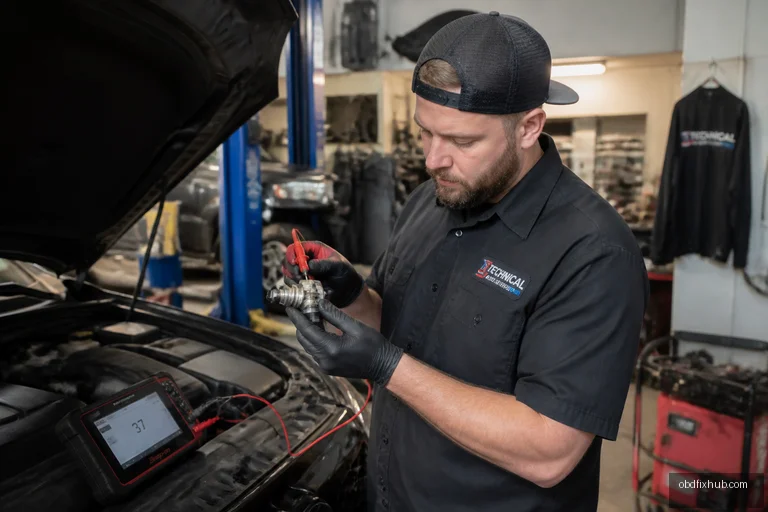
B3A02 A/C Refrigerant Distribution Valve Actuator C Control Circuit Low means the vehicle has detected an abnormally low electrical signal in the control circuit for actuator C of the air-conditioning refrigerant distribution system. The fault is usually caused by a short to ground, damaged wiring, a poor connector, a failed actuator, or a control module problem—not simply low refrigerant. Because the exact valve design varies by vehicle, always confirm the code definition and test values in the manufacturer’s service information.
What Does B3A02 Mean?
The B3A02 code belongs to the body or HVAC control system rather than the engine management system. In vehicles with electronically controlled air conditioning, refrigerant flow may be managed by one or more electrically operated valves. These valves can regulate refrigerant routing between the compressor, evaporator, condenser, chiller, rear HVAC unit, or battery thermal-management circuit.
“Actuator C” identifies one specific valve or actuator in a group. It does not necessarily mean the third component physically installed in a row, and it is not interchangeable with actuator A or B without checking the wiring diagram. “Control circuit low” indicates that the module sees voltage or signal behavior below the expected range during a commanded test.
Common Causes of the B3A02 Code
- A shorted control wire contacting ground or a grounded shield
- Open, corroded, or loose terminals at the actuator or HVAC module
- Water intrusion in a connector near the front condenser, bulkhead, or underbody
- An internally shorted refrigerant valve actuator
- Damaged wiring caused by vibration, collision repairs, rodents, or contact with hot components
- A failed HVAC, body, or thermal-management control module
- Incorrect actuator installation or a valve that is mechanically seized
- Low system voltage or a poor ground that disrupts actuator operation
A refrigerant charge problem alone normally does not create a control-circuit-low code. However, low charge can cause poor cooling at the same time, which is why replacing the valve without testing both the electrical circuit and refrigerant system often leads to an unnecessary repair.
Symptoms You May Notice
The symptoms depend on the valve’s location and the vehicle’s fail-safe strategy. Some systems disable the compressor to protect the system, while others operate with reduced cooling or lock the valve in a default position.
- Weak, inconsistent, or completely absent cabin cooling
- Air conditioning that works only intermittently
- Different temperatures between front and rear zones
- A/C warning message or illuminated climate-control fault indicator
- Compressor operation being inhibited
- Unusual clicking, buzzing, or repeated actuator movement near the HVAC components
- Additional communication, voltage, or thermal-management trouble codes
In hybrid and electric vehicles, the same fault may affect battery cooling or cabin heating as well as conventional A/C. A vehicle can therefore display B3A02 while the most noticeable symptom is a battery-temperature or climate-system warning rather than warm air from the vents.
How to Diagnose B3A02 Correctly
Do not begin by adding refrigerant or replacing the actuator. A reliable diagnosis separates an electrical fault from a mechanical valve problem and from a refrigerant-pressure issue.
1. Confirm the code and vehicle-specific definition
Use a scan tool that can access the HVAC or thermal-management module, not only the engine ECU. Record all current, pending, and history codes, along with freeze-frame data. Look for companion faults involving low voltage, actuator position, LIN or CAN communication, pressure sensors, or module power supply.
2. Inspect the actuator and harness
Locate actuator C using the manufacturer’s wiring diagram. Inspect the connector for green corrosion, pushed-back terminals, moisture, oil contamination, or signs of overheating. Follow the harness several inches in both directions; many intermittent faults occur where the loom bends against a bracket or passes close to the condenser and refrigerant lines.
3. Check power, ground, and signal circuits
With the connector disconnected, test the actuator supply and ground according to the service procedure. Do not assume every actuator uses a simple 12-volt feed. Some use a 5-volt reference, pulse-width modulation, a reversible motor circuit, or LIN/CAN communication. Measure voltage under load where specified, because a circuit can show normal voltage with a digital meter yet collapse when the actuator is commanded.
Use a voltage-drop test on the ground circuit rather than relying only on a continuity check. A wire may beep on an ohmmeter but still have excessive resistance under load. If the signal is pulled low, check for a short to ground and compare resistance with the known-good actuator or the manufacturer’s specification.
4. Perform an active test
Use the scan tool’s bidirectional controls to command actuator C through its operating range. Monitor commanded position, actual position, circuit voltage, and refrigerant pressure at the same time. If the command changes but the position does not, the actuator may be seized or mechanically disconnected. If the command itself is missing, investigate module power, communication, configuration, and wiring before condemning the valve.
5. Check refrigerant pressures only after electrical testing
Pressure readings can confirm a separate charge or restriction problem, but they do not prove that the actuator circuit is healthy. Use the correct refrigerant identification equipment and recovery procedures. Never vent refrigerant, bridge a high-voltage component, or open a sealed circuit without the required equipment and training.
What Is the Fix for B3A02?
The repair depends on the failed part identified during testing. Common repairs include repairing a chafed wire, replacing corroded terminals, restoring a module ground, cleaning and securing a connector, or replacing the actuator. If the valve is replaced, the system may require an actuator initialization, calibration, relearn, or HVAC module configuration procedure.
After the repair, clear the code and run the manufacturer’s actuator test. Verify that the actual position follows the commanded position, that cooling performance is stable, and that the code does not return after a road test or a complete thermal cycle. On systems that use refrigerant valves inside a sealed circuit, recovery, evacuation, leak testing, and precise recharging may be necessary.
Can You Drive With B3A02?
Short-distance driving is often possible if the vehicle has no overheating, high-voltage, or battery-temperature warnings. Nevertheless, continued use can leave the compressor disabled or prevent proper thermal management. Stop driving and seek qualified service immediately if the vehicle reports an electric-drive battery temperature fault, compressor protection fault, overheating, or a high-voltage system warning.
Practical Diagnostic Tips From the Workshop
- Take a photo of connector positions before unplugging the actuator; similar HVAC connectors are easy to confuse.
- Use terminal tension testing where possible. A visually clean terminal can still lose contact when the vehicle vibrates.
- Compare actuator C with a matching actuator only when the wiring, resistance, and part number are confirmed to be equivalent.
- Do not force a refrigerant valve by applying battery voltage unless the service manual explicitly permits it.
- When the fault is intermittent, perform a controlled wiggle test while watching live circuit data instead of repeatedly clearing the code.
Summary
B3A02 identifies a low electrical condition in the control circuit for A/C refrigerant distribution valve actuator C. The most effective repair begins with the correct module scan, a wiring and connector inspection, loaded power-and-ground tests, and a bidirectional actuator test. Diagnose the circuit before replacing the valve or adding refrigerant, then complete any required calibration and verify the system under real operating conditions.
Frequently Asked Questions
Is B3A02 caused by low refrigerant?
Usually not. B3A02 is an electrical control-circuit fault, although low refrigerant can create separate cooling symptoms or additional pressure-related codes.
Can a bad A/C actuator cause warm air?
Yes. If actuator C cannot route refrigerant correctly or the control module disables the compressor as a safeguard, the cabin may receive warm or inconsistent air.
Do I need to replace the entire A/C valve?
Not necessarily. A damaged wire, loose terminal, poor ground, or connector corrosion can produce the same code. Testing should identify the failed component before replacement.
Can I clear B3A02 with a basic OBD scanner?
A basic scanner may read or erase the code, but many cannot access HVAC data or perform actuator tests. A scan tool with body and climate-module support is strongly preferred.
Is this code dangerous on a hybrid or electric vehicle?
It can be significant if the valve participates in battery thermal management. Avoid working on high-voltage or refrigerant systems without the correct training, isolation equipment, and manufacturer procedures.




