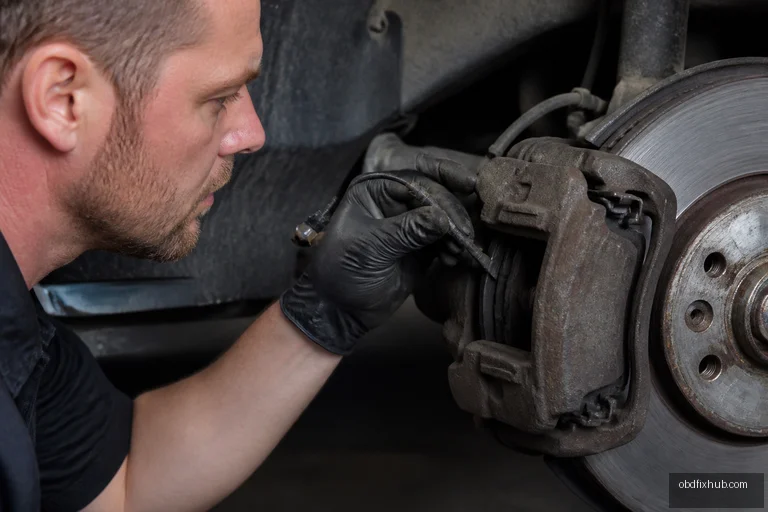
C004A Brake Lining Wear Sensor: Meaning, Causes & Fix
C004A usually indicates a fault in the brake lining wear sensor circuit, but it does not automatically prove that the brake pads are completely worn out. The code can be triggered by a worn sensor, damaged wiring, corrosion, an incorrect pad installation, or—in some vehicles—a problem in the ABS or brake control module. A proper diagnosis combines scan data with a physical brake inspection.
What Does the C004A Brake Lining Wear Sensor Code Mean?
C004A is a chassis diagnostic trouble code associated with the brake pad or brake lining wear monitoring system. The exact definition and sub-code can vary by manufacturer, so the vehicle’s service information matters. A suffix such as C004A-01, C004A-2B, or C004A-64 may identify a short circuit, an open circuit, an implausible signal, or an internal control-module fault.
Most wear-monitoring systems use a small electrical sensor installed in one or more brake pads. When the friction material reaches a specified limit, the sensor changes the circuit state or is physically cut by the rotor. Some systems monitor only one wheel position and use it as an indicator for the axle, while others monitor several pads individually.
Common Causes of C004A
- Brake pads are worn: The sensor has reached its warning limit or has contacted the brake rotor.
- Damaged sensor wire: The lead may be stretched, trapped behind the wheel, or rubbed through by the tire or suspension.
- Broken connector: Road salt, water intrusion, and impact damage can create high resistance or an intermittent connection.
- Sensor not transferred during pad replacement: Some pads use a separate sensor that must be replaced or correctly clipped into the new pad.
- Incorrect brake pad installation: A sensor-equipped pad fitted on the wrong side or in the wrong position can produce a fault immediately.
- Wheel-speed or brake control module issues: The wear signal may be processed through an ABS, electronic parking brake, or body control module.
- Recent suspension or brake work: A harness can be left unplugged after caliper, hub, strut, or wheel removal.
Symptoms You May Notice
The most obvious symptom is a brake warning, ABS warning, or service message on the instrument panel. Depending on the vehicle, the warning may appear together with a stored C004A code even when braking still feels normal. The driver may also see a message such as “Check Brake Pad Wear,” “Brake Pads Worn,” or “Brake System Service Required.”
Some vehicles show no immediate change in pedal feel because the wear sensor is only an electrical monitoring device. However, if the pads are genuinely thin, you may hear a metallic scraping sound, notice reduced braking performance, or feel vibration caused by uneven pad or rotor wear. A soft pedal, fluid leak, or vehicle pulling to one side should be treated as a separate and more urgent brake fault.
How to Diagnose C004A Correctly
Do not begin by replacing the ABS module. In real-world repairs, the cause is often a damaged harness near the wheel or a sensor left disconnected during a pad change.
- Record the complete code. Use a scan tool that can access the ABS or chassis module, not just the basic engine OBD system. Save any sub-code and freeze-frame information.
- Check the brake warning messages. Identify whether the system reports a front, rear, left, or right sensor. This information is more useful than the generic C004A description alone.
- Measure pad thickness. Inspect the inner and outer pads on both sides of the axle. The inner pad can wear faster when a caliper slide pin is seized, so checking only the visible outer pad is misleading.
- Inspect the sensor and harness. Look for cuts, crushed sections, loose clips, green corrosion, pulled terminals, and wiring that can touch the tire or rotor at full steering lock.
- Test the circuit using the manufacturer’s procedure. Depending on the design, the sensor may be a normally closed loop, a resistor-based sensor, or a digital device. Do not permanently bridge the connector unless the service manual specifically allows it for testing.
- Clear the code and perform a road test. If the fault returns immediately with good pads and wiring, check module inputs, software updates, and related ABS codes.
A useful diagnostic detail
If C004A appears immediately after brake pad replacement, compare the old and new parts by shape and connector position. A visually similar pad may lack the correct sensor channel, or the sensor may be installed on the wrong wheel. Also check whether the replacement pads require a new wear lead; many are designed as a one-time-use component.
How to Fix the C004A Fault
The correct repair depends on what the inspection finds:
- Replace the brake pads and wear sensor if the friction material is below the manufacturer’s minimum thickness.
- Replace a cut, melted, or corroded sensor lead rather than wrapping it with ordinary electrical tape.
- Repair connector terminals with the correct automotive repair parts and seal the connection against moisture.
- Secure the harness using the original clips so suspension movement and steering cannot pull on it.
- Service seized caliper slide pins or a sticking piston if one pad is wearing much faster than its mate.
- Carry out a module reset or pad-wear initialization when the manufacturer requires it after replacement.
After the repair, clear the code with a suitable scan tool and confirm that the warning does not return during a controlled road test. If the code returns with verified pads, a verified circuit, and no related wiring damage, diagnosis should continue at the brake control module rather than relying on repeated parts replacement.
Can You Drive With C004A?
Short-distance driving may be possible if the brake pedal is firm, braking is normal, and the pads have been physically confirmed to have adequate material. Nevertheless, the warning means the electronic wear-monitoring system cannot be trusted, so the vehicle should be inspected promptly.
Do not continue driving if the pads are at the backing plate, the rotor is severely scored, the pedal feels soft, the vehicle pulls during braking, or a red brake warning lamp is illuminated. Arrange professional brake service in those situations.
Summary
C004A points to a brake lining wear sensor or its electrical circuit, not necessarily to a failed ABS module. Start with the complete scan-code suffix, inspect every pad on the affected axle, and trace the sensor wiring from the pad to the control-module connector. Replacing the worn pad and sensor, repairing the harness, and completing any required reset usually resolves the fault when the diagnosis is accurate.
Before clearing C004A, verify the actual brake condition. A warning sensor is inexpensive compared with the consequences of ignoring a genuinely worn pad or a damaged braking system.
Frequently Asked Questions
Is C004A the same as an ABS fault?
Not necessarily. C004A is generally related to the brake lining wear monitoring circuit, although the ABS or chassis module may store and display the code. Related ABS codes or a manufacturer-specific suffix can change the diagnostic direction.
Can worn brake pads cause C004A?
Yes. If the pad-mounted sensor reaches its wear limit, the circuit changes state and the module stores C004A. However, damaged wiring or a disconnected sensor can create the same code with plenty of pad material remaining.
Do I need to replace the brake wear sensor every time?
Many contact-style sensors are intended to be replaced once they have touched the rotor or been removed from the pad. Some systems use reusable electronic sensors, so follow the vehicle manufacturer’s replacement procedure.
Will disconnecting the battery clear C004A?
It may erase some temporary data, but it will not repair the cause and may not clear a fault stored in the ABS or chassis module. Use a scan tool after completing the repair and verify that the code stays cleared.
Why did C004A appear after a brake job?
The sensor connector may be unplugged, the harness may be routed incorrectly, or the replacement pad may have the sensor in a different position. Recheck the pad location, connector lock, harness clips, and sensor compatibility before investigating expensive modules.




