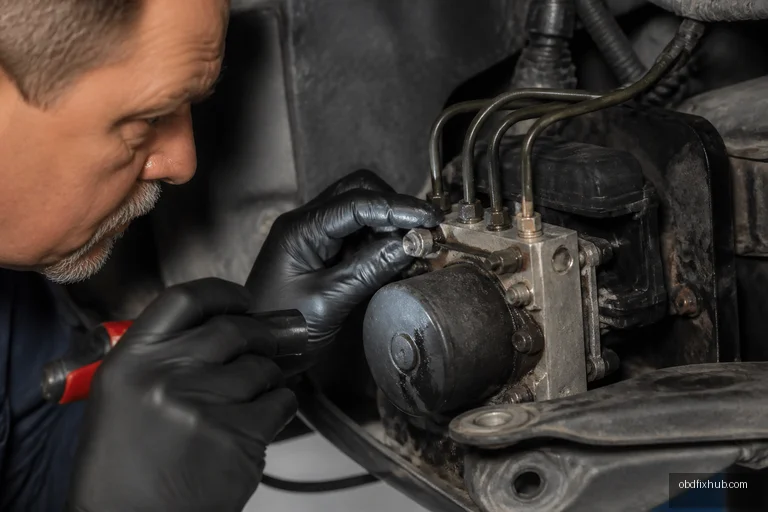
C055D Brake Hydraulic Circuit B Leak means the vehicle’s brake control system has detected that one hydraulic braking circuit is losing pressure or fluid. Do not treat it as an ordinary check-engine fault: a real brake fluid leak can leave only partial braking, create a dangerously low pedal, or cause a complete loss of stopping ability. Stop driving if the pedal is sinking, the brake warning light is on, or the reservoir level is falling.
What Does Code C055D Mean?
C055D is generally associated with a leak or pressure loss in brake hydraulic circuit B, often monitored by the electronic brake control module, ABS module, or an integrated electro-hydraulic brake unit. The exact definition and circuit layout are manufacturer-specific, so the vehicle’s service information should be checked before identifying circuit B as the front, rear, left, or right brakes.
On some vehicles, circuit B refers to one side of a split master-cylinder system. On others, it is a monitored pressure channel inside the ABS hydraulic modulator. That distinction matters: a visible fluid leak at a caliper is diagnosed differently from an internal pressure loss inside the hydraulic control unit.
What Happens When a Primary Hydraulic Brake Circuit Fails?
A vehicle with a dual-split master cylinder has two separate hydraulic circuits so that one failure does not normally eliminate every brake. If the primary circuit fails because of a ruptured brake line, the master-cylinder piston can still operate the remaining circuit. The driver usually retains some braking, but the pedal travels much farther, stopping distances increase, and the vehicle may pull or feel unstable under hard braking.
The result depends on the vehicle’s split design. A front/rear split may leave either both front or both rear brakes operating, while a diagonal split may retain one front brake and the opposite rear brake. Modern electronic brake systems may also disable ABS, traction control, stability control, or regenerative braking when a hydraulic fault is detected.
- A soft or unusually low brake pedal
- Longer stopping distances and a need to press much harder
- The vehicle pulling to one side during braking
- Red brake, ABS, or stability-control warning lights
- A pedal that slowly sinks while steady pressure is applied
Partial braking is not a safe condition for normal driving. If the pedal reaches the floor, the vehicle cannot stop normally, or brake fluid is visibly leaking, switch the engine off, secure the vehicle, and arrange a tow.
Common Causes of a C055D Brake Hydraulic Circuit B Leak
External fluid leaks
Rust-corroded steel brake pipes are common on older vehicles, especially where road salt collects along the chassis. A line may look intact until the brake pedal is pressed, when a pinhole opens and sprays or seeps fluid. Flexible brake hoses can also crack near their crimped fittings or swell internally.
Other leak points include caliper piston seals, bleeder screws, banjo washers, wheel cylinders, and the master-cylinder outlet fittings. A wet wheel, fluid behind a drum, or fluid running down the inside of a tire is strong evidence of an external hydraulic leak.
Master cylinder or brake booster leakage
A master-cylinder failure can be external, where fluid escapes at the cylinder or line fittings, or internal, where the piston seals allow pressure to bypass inside the cylinder. Internal bypass usually produces a sinking pedal without an obvious puddle. Brake fluid inside the vacuum booster, or on the firewall beneath the master cylinder, points to a rear master-cylinder seal leak.
ABS hydraulic unit or electronic brake control problem
The ABS modulator contains valves, passages, pressure sensors, and sometimes an electric pump. A defective pressure sensor, stuck valve, internal seal, or cracked hydraulic assembly can make the control module interpret circuit B as leaking. In this situation, the reservoir may remain full and no external fluid may be visible.
Low fluid caused by worn brake pads can occasionally trigger a warning, but it should not automatically be labeled a C055D leak. A falling level, wet component, or repeated need to top up the reservoir requires a proper leak inspection.
Symptoms of an Electronic Brake Control Module Failure
An electronic brake control module failure can resemble a hydraulic leak because both faults may illuminate the same warning lamps. The following symptoms suggest an electrical or module-related problem, although they do not prove it:
- ABS, red brake, traction-control, or stability-control warnings appearing together
- Communication codes showing that the scan tool cannot connect to the brake module
- False or implausible wheel-speed, pressure, or valve-related data
- ABS activation that is unavailable, intermittent, or triggered at low speed without wheel slip
- An ABS pump that runs continuously, fails to run, or operates after the ignition is switched off
- C055D returning immediately after a confirmed leak has been repaired and the system has been correctly bled
Before condemning an expensive electronic brake control module, verify battery voltage, module power and grounds, CAN wiring, wheel-speed sensor signals, connector condition, and actual hydraulic pressure. A low battery or corroded ground can create several misleading module codes at once.
How to Check for a Hydraulic Brake Leak
A basic inspection can identify many leaks, but it cannot safely replace a professional pressure test. Never crawl under a vehicle supported only by a jack, and never place fingers near a suspected high-pressure leak while someone is pressing the pedal.
- Check the reservoir first. With the vehicle on level ground and the engine off, compare the fluid level with the MIN and MAX marks. Do not use the fluid level alone as proof of a leak, because worn pads can lower it gradually.
- Inspect the wheels and calipers. Look for clear, amber, or dark oily fluid around caliper pistons, hose connections, bleeder screws, and the inner wheel surface. Brake fluid is usually thinner than grease and does not behave like normal suspension lubricant.
- Follow every brake line. Trace the pipes from the master cylinder to the ABS unit and along the chassis. Pay special attention to clips, bends, unions, and areas exposed to salt or road debris.
- Check the master cylinder and booster. Look around the mounting flange and beneath the booster. Fluid in this area can indicate a master-cylinder rear seal failure.
- Inspect inside drum brakes. On drum-equipped wheels, remove the drum or have a technician do it. A leaking wheel cylinder can fill the drum and contaminate the shoes without leaving a large external puddle.
- Observe the pedal. With the engine off, press firmly and hold. A pedal that slowly drops suggests internal bypass or an active leak. Do not repeat this test if the pedal is already near the floor.
Technicians can isolate the circuits, use approved pressure gauges, inspect ABS live data, and perform a scan-tool-assisted bleed. A pressure test is especially important when the reservoir level is stable but C055D returns.
How C055D Is Repaired
The repair depends on the failed component. A corroded line must be replaced with correctly routed, vehicle-compatible brake tubing; a damaged hose, caliper, wheel cylinder, or master cylinder must be renewed rather than patched. Any component exposed to brake fluid should be checked for contamination or damage.
After the mechanical repair, the system must be filled with the exact fluid specified on the reservoir cap or in the owner’s manual. The brakes then require a complete bleed, and some ABS systems need an electronic bleed procedure to cycle trapped air out of the hydraulic modulator. The module codes should be cleared only after the repair, followed by a controlled road test on a safe surface.
Simply adding fluid, clearing C055D, or replacing the ABS module without locating the pressure loss is not a repair. If fluid has reached the brake pads or shoes, those friction materials generally need replacement because contamination can severely reduce braking.
Can You Still Drive With a Brake Fluid Leak?
No. Even a small leak can become a complete hydraulic failure when the brakes heat up or the damaged line ruptures. Driving to a repair shop is appropriate only when a qualified technician has confirmed that there is no active leak and the braking system operates normally; otherwise, use a tow truck.
Key Takeaway
C055D identifies a pressure or leak problem in brake hydraulic circuit B, but the code alone does not identify the failed part. Check the fluid level, inspect the entire hydraulic system, verify electrical and module data, and have the system pressure-tested. Treat any low pedal, warning light, or visible fluid as a safety-critical fault rather than a code that can be postponed.
Frequently Asked Questions
What is the difference between C055D and C055E?
They commonly refer to leaks or pressure loss in different monitored brake circuits, with C055D usually identifying circuit B and C055E circuit A. The precise circuit assignment varies by manufacturer, so use the vehicle-specific service manual.
Can low brake fluid cause C055D without a visible leak?
Yes. A slow internal master-cylinder bypass or an ABS hydraulic-unit fault may reduce pressure without leaving fluid on the ground. However, an external leak must be ruled out before diagnosing an electronic fault.
Will bleeding the brakes clear C055D?
Bleeding can remove air and restore a firm pedal, but it will not repair a ruptured line, failed seal, or defective pressure sensor. Some vehicles require a scan-tool-assisted ABS bleeding procedure.
Is it safe to drive if only the ABS light is on?
If the brake pedal is firm and there is no red brake warning or fluid loss, the conventional brakes may still work, but ABS and stability functions may be disabled. Have the vehicle inspected promptly and avoid high-speed or emergency driving until the cause is known.




