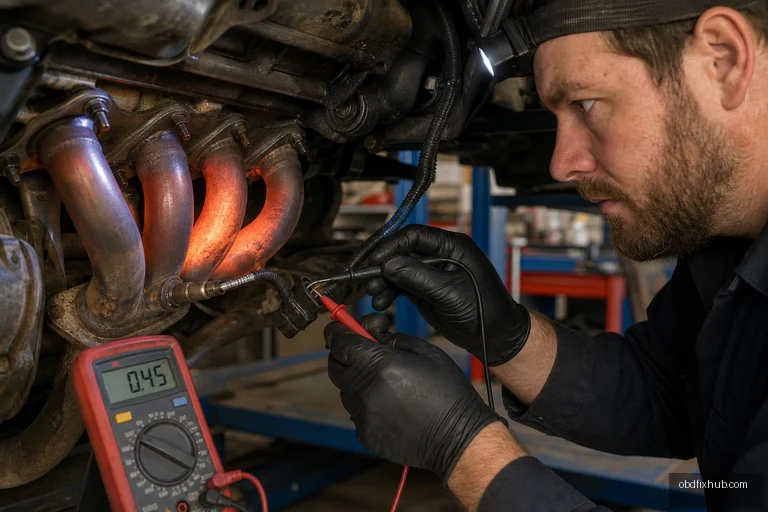
P0030 HO2S Heater Control Circuit Bank 1 Sensor 1 means the engine computer has detected a fault in the heater circuit of the upstream oxygen sensor on Bank 1. The most common repair is replacing a failed oxygen sensor or repairing damaged wiring, but testing the fuse, power supply, ground path, and PCM control circuit first prevents unnecessary parts replacement.
What Does P0030 Mean?
P0030 is an OBD-II powertrain code related to the heated oxygen sensor, also called an HO2S. “Bank 1” identifies the side of the engine containing cylinder number one, while “Sensor 1” refers to the sensor located before the catalytic converter. On an inline-four engine there is normally only one bank, but on a V6 or V8, identifying Bank 1 correctly is essential.
The oxygen sensor heater brings the sensor up to operating temperature quickly after a cold start. Without this heater, the sensor may remain inactive until exhaust heat warms it naturally. The PCM, or powertrain control module, monitors the heater circuit for an electrical problem such as an open circuit, short circuit, excessive resistance, or missing control current.
P0030 Symptoms
Some vehicles show very few noticeable symptoms because the engine can still run using calculated fuel values or a backup strategy. In other cases, the vehicle may run rich or lean during warm-up, particularly when the fault prevents closed-loop fuel control from beginning normally.
- Check Engine Light illuminated
- Longer time before the engine enters closed-loop operation
- Rough idle or hesitation shortly after a cold start
- Reduced fuel economy
- Increased emissions or a failed emissions inspection
- Occasional rich exhaust smell or dark exhaust smoke
- Additional oxygen-sensor or fuel-trim codes
A useful diagnostic clue is timing. If the vehicle starts and drives normally once warm, but the Check Engine Light returns after the next cold start, the heater circuit is more suspicious than the sensor’s signal circuit.
Common Causes of P0030
The code describes a heater control circuit fault, not automatically a bad oxygen sensor. In workshop diagnostics, the following causes are the most common:
- Failed heater element inside the Bank 1 Sensor 1 oxygen sensor
- Open, rubbed-through, melted, or corroded wiring near the exhaust
- Blown oxygen-sensor or engine-control fuse
- Loose, water-damaged, or contaminated sensor connector
- Missing ignition-switched power to the heater
- Faulty ground or low-side control circuit from the PCM
- Incorrect replacement sensor with a different connector or heater specification
- Rarely, a damaged PCM or a software-related control issue
Heat damage deserves special attention. The upstream sensor wiring often passes close to the exhaust manifold or catalytic converter. A harness can look acceptable from above while the insulation has softened against a heat shield, allowing the heater circuit to short only when the engine moves or reaches operating temperature.
How to Diagnose P0030 Correctly
Do not begin by replacing the sensor based only on the code. A quick electrical inspection often identifies the real fault and can prevent a repeat failure.
1. Confirm the code and check related faults
Use a scan tool to record the freeze-frame data, including coolant temperature, vehicle speed, and battery voltage when P0030 set. Low system voltage, multiple heater codes, or a recently discharged battery may point toward a power-supply problem rather than one isolated sensor.
2. Locate the correct sensor
Find cylinder number one using the vehicle’s service information, then identify the upstream oxygen sensor on that bank. Sensor 1 is before the catalytic converter; Sensor 2 is after it. Confusing these positions is a common reason for installing the wrong part and failing to resolve the code.
3. Inspect the connector and harness
With the ignition off, examine the connector for bent terminals, green corrosion, pushed-back pins, oil contamination, and water intrusion. Follow the harness toward the engine control module and fuse box. Look for contact with the exhaust, stretched wires, previous repairs made with twisted-and-taped connections, or wiring damaged by road debris.
4. Test the heater power supply
Many vehicles supply battery voltage to one heater wire through a fuse and control the other side with the PCM. With the connector unplugged and the ignition switched on, use a multimeter to check for the specified voltage. Do not assume the presence of voltage proves the circuit can carry current; a corroded connection may show normal voltage with no load but fail under operation.
5. Measure heater resistance
Turn the ignition off, disconnect the sensor, and measure resistance across the two heater terminals. The correct specification varies significantly by manufacturer and sensor design, so the factory service manual is the authority. Some sensors may measure only a few ohms, while others use a higher-resistance heater. Infinite resistance usually indicates an open heater, but a very low reading can indicate an internal short.
Never probe random terminals on a modern wideband sensor or apply battery voltage to signal wires. The heater terminals must be identified from the wiring diagram. Using the wrong terminals can damage an expensive sensor or create a misleading test result.
6. Verify the control side
If power and heater resistance are correct, test the ground-side control circuit according to the wiring diagram. A test light or oscilloscope may be needed to confirm that the PCM is switching the circuit. If the wiring is intact and the control signal is absent, check for PCM power, grounds, relevant technical service bulletins, and software updates before condemning the module.
How to Fix P0030
The correct repair depends on the failed part identified during testing:
- Replace the Bank 1 Sensor 1 oxygen sensor if its heater is open, shorted, or outside specification.
- Repair damaged wiring using sealed automotive-grade splices or replace the affected harness section.
- Clean or replace terminals and repair poor connector tension.
- Replace the correct fuse only after locating the reason it failed. A new fuse will blow again if the harness is shorted.
- Repair the power or ground circuit and verify voltage under load.
- Investigate PCM control failure only after all external circuit tests pass.
Use a quality sensor that matches the vehicle’s original design. Universal sensors with incorrectly joined wires can create resistance, polarity, or connector problems. Avoid applying ordinary grease to sensor terminals; if terminal protection is required, use the type and method specified by the manufacturer.
Can You Drive With a P0030 Code?
Usually, the vehicle can be driven a short distance if the Check Engine Light is steady and the engine is not misfiring. However, prolonged driving may increase fuel consumption and emissions, and an excessively rich mixture can eventually affect the catalytic converter. Stop driving and seek immediate diagnosis if the light flashes, the engine runs very poorly, or strong fuel odor is present.
Important Diagnostic Tips From Real-World Repairs
- Check battery voltage before testing heater operation; low voltage can set several heater codes at once.
- Compare the heater circuit with the opposite bank when the vehicle uses similar sensors and wiring.
- Inspect the harness while gently moving it. An intermittent open may appear only when the engine rocks in its mounts.
- Clear the code only after the repair, then perform a cold-start drive cycle. The PCM may not retest the heater until specific temperature and time conditions are met.
- If the fuse blows immediately after installing a new sensor, disconnect the sensor and retest the harness before installing another part.
Summary
P0030 identifies an electrical problem in the heater circuit for the upstream oxygen sensor on Bank 1. Start with the fuse, connector, wiring, heater resistance, and power supply before replacing the sensor. A proper circuit test is faster and more reliable than guessing, especially when exhaust heat has damaged the harness or a previous repair used the wrong sensor.
Frequently Asked Questions
Is P0030 caused by a bad oxygen sensor?
It can be, but not always. A blown fuse, melted wiring, poor connector, missing power supply, or PCM control problem can produce the same code. Test the heater circuit before replacing the sensor.
Which oxygen sensor is Bank 1 Sensor 1?
Bank 1 is the engine side containing cylinder number one. Sensor 1 is the upstream oxygen sensor installed before the catalytic converter. On inline engines, there is generally only one bank.
How much does it cost to fix P0030?
Cost depends on whether the fault is a fuse, wiring repair, sensor, or PCM issue. A sensor replacement is usually less expensive than harness or module work, but diagnosis should come first because parts prices and labor vary by vehicle.
Will clearing P0030 fix the problem?
No. Clearing the code only resets the warning temporarily. If the heater circuit remains faulty, the PCM will normally detect the problem again during a later cold-start or drive-cycle test.
Can a low battery trigger P0030?
Yes, low battery voltage or a weak charging system can interfere with heater operation and set related codes. If several electrical codes appeared after a difficult start, test the battery, alternator output, and main grounds before replacing sensors.




