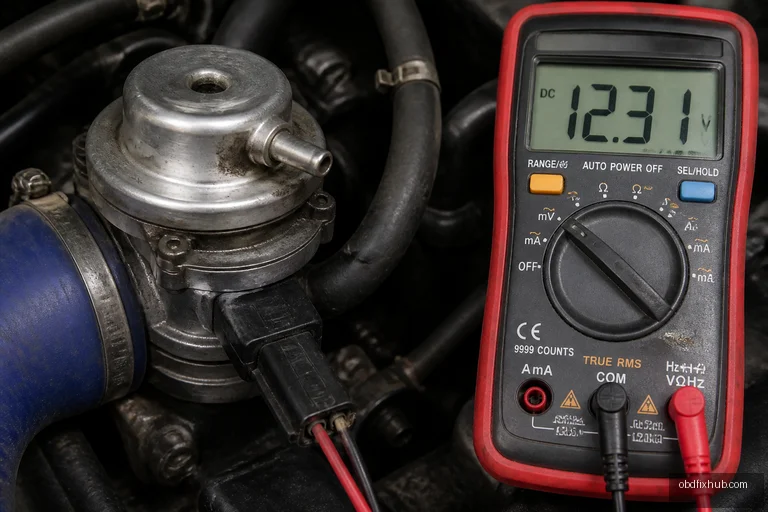
Search intent: Informational. Drivers searching for P0033 usually want to know whether the code is serious, what caused it, and how to test the system before replacing expensive turbocharger parts. P0033 Turbocharger/Supercharger Bypass Valve A Control Circuit means the engine control module has detected an electrical problem in the control circuit for bypass valve A. The fault may be caused by a failed solenoid, damaged wiring, poor power or ground, a connector problem, or an incorrect command from the control module—not necessarily a failed turbocharger.
What Does P0033 Mean?
P0033 is a generic OBD-II diagnostic trouble code related to forced-induction systems. It is set when the powertrain control module, or PCM, sees an abnormal voltage, resistance, or response in the circuit that operates a turbocharger or supercharger bypass valve.
The bypass valve manages compressed air when the throttle closes or the engine does not need full boost. On many turbocharged engines, it is called a diverter valve, compressor bypass valve, recirculation valve, or blow-off valve. The exact design varies by manufacturer, so the factory wiring diagram and service information matter more than the code description alone.
The letter A indicates that the vehicle may have more than one related valve or control circuit. P0033 does not identify a particular brand of solenoid, connector pin, or valve location. A Ford, Volkswagen, Subaru, Audi, or GM vehicle may use completely different hardware while storing the same basic code.
What a Turbocharger Bypass Valve Does
When the throttle plate closes while the turbo is still producing boost, pressure can surge back toward the compressor wheel. The bypass valve opens to release or recirculate that pressure, reducing compressor surge and improving drivability. In some systems, the valve is electrically controlled; in others, the PCM commands a vacuum solenoid that operates the valve.
This is different from a wastegate. The wastegate regulates exhaust flow to control turbine speed and maximum boost. The bypass valve manages intake-side pressure during throttle changes. Confusing these two components is a common reason technicians replace the wrong part after seeing a boost-related fault.
Common Symptoms of P0033
The symptoms depend on whether the bypass valve is stuck open, stuck closed, electrically disconnected, or receiving an incorrect command. Some vehicles drive almost normally at light throttle, while others enter reduced-power mode as soon as the code is stored.
- Check Engine Light or malfunction indicator lamp
- Reduced turbocharger or supercharger boost
- Hesitation during acceleration
- Surging, compressor flutter, or an unusual whooshing sound
- Rough transitions when lifting off the accelerator
- Low power under load or during uphill driving
- Reduced fuel economy
- Limp mode or a maximum engine-speed limitation
- Additional boost-control, fuel-trim, or air-leak codes
A valve stuck open can create an intake leak and prevent the engine from building boost. A valve stuck closed may produce pressure surges when the throttle shuts. If the fault is purely electrical, the engine may feel normal until the PCM commands the valve during a specific operating condition.
Most Common Causes of the P0033 Code
- Failed bypass valve solenoid: The internal coil can go open-circuit, short to ground, or develop excessive resistance when hot.
- Damaged wiring: Turbo-area wiring is exposed to heat, vibration, oil, and contact with brackets or the exhaust shield.
- Loose or corroded connector: Oil contamination, water intrusion, and spread terminals can interrupt the control signal.
- Blown fuse or missing power supply: A shared fuse may also supply other engine actuators, creating several codes at once.
- Vacuum or pressure-control problem: On vacuum-operated systems, split hoses, a failed vacuum solenoid, or a blocked passage can prevent valve movement.
- Sticking mechanical valve: Carbon deposits, oil residue, or a damaged diaphragm can keep the valve from reaching its commanded position.
- Air-intake or charge-pipe leak: A split hose can mimic a valve fault and may trigger related boost or fuel-trim codes.
- PCM or software issue: This is possible but should be considered only after power, ground, wiring, and actuator tests have passed.
How to Diagnose P0033 Correctly
Do not begin by ordering a turbocharger. A structured electrical test usually identifies the fault faster and avoids replacing a mechanically sound valve.
1. Scan for all stored codes
Record the freeze-frame data, including engine speed, load, coolant temperature, throttle position, and battery voltage. Look for companion codes such as boost-control, intake-leak, mass-airflow, or fuel-trim faults. A low system voltage or several actuator codes may point to a shared power supply rather than a single failed valve.
2. Inspect the valve and harness
With the engine cool, locate the bypass valve and follow its wiring back toward the main harness. Look for melted insulation near the turbo, a harness pulled tight across a bracket, green corrosion inside the connector, bent terminals, and oil-soaked wiring. Move the harness gently while watching the scan tool or checking continuity; an intermittent open may only appear when the harness is flexed.
3. Verify power and ground
Use a wiring diagram rather than assuming the wire colors. With the ignition on, confirm that the solenoid receives the specified supply voltage. Then check the ground side and the PCM control wire according to the manufacturer’s test procedure. A test light can show that voltage exists, but a loaded circuit test or voltage-drop test is better at exposing a high-resistance connection.
4. Measure solenoid resistance
Disconnect the valve before measuring resistance with a digital multimeter. Compare the reading with the vehicle’s service specification; there is no universal resistance value for every P0033 application. An infinite reading suggests an open coil, while a reading close to zero may indicate a shorted coil. Resistance that is correct cold can still fail when the solenoid heats up, so an intermittent fault may require testing immediately after a road test.
5. Test actuator operation
If the scan tool supports bi-directional controls, command the bypass valve on and off while listening and watching the data stream. A healthy actuator should respond consistently, not click once and then become silent. For a vacuum-operated system, use a hand vacuum pump and verify that the valve holds vacuum and moves through its full range.
6. Check for mechanical and boost leaks
Inspect the valve diaphragm, piston, seal, charge pipes, intercooler connections, and intake couplers. A smoke test or regulated pressure test can reveal leaks that are invisible during a visual inspection. Never pressurize an intake system beyond the manufacturer’s safe test pressure, and keep fingers, clothing, and tools away from moving belts and fans.
How to Fix P0033
The correct repair depends on the failed part identified during testing. Typical repairs include replacing the bypass valve or its solenoid, repairing a broken control wire, replacing a corroded connector, restoring a missing fuse or power feed, replacing cracked vacuum tubing, or cleaning and securing the valve’s mounting and sealing surfaces.
If the valve is integrated into the turbocharger or supercharger assembly, replacement may be more involved. However, the presence of P0033 alone does not justify replacing the complete forced-induction unit. Confirm that the actuator receives the correct command and that the mechanical valve itself is defective before approving a high-cost repair.
Can You Drive With a P0033 Code?
Short, gentle driving may be possible if the engine has no severe hesitation, abnormal noises, or flashing Check Engine Light. Avoid hard acceleration, towing, high boost, and long uphill pulls until the problem is diagnosed. Continued operation with uncontrolled boost or compressor surge can increase stress on the turbocharger, intake system, and engine.
Stop driving and have the vehicle inspected promptly if it enters limp mode, produces loud turbo noises, smokes, loses power suddenly, or shows additional oil-pressure, misfire, or overboost faults. A flashing warning light generally indicates a condition that can damage the catalytic converter or engine.
After the Repair: Clear and Verify
After repairing the circuit, clear the code and perform a complete drive cycle under the conditions shown in the freeze-frame data. Confirm that the bypass valve responds in a scan-tool output test and monitor requested versus actual boost. The repair is not fully verified until the code stays cleared and the vehicle completes its readiness checks without abnormal boost behavior.
Key Takeaway
P0033 identifies a fault in the electrical control circuit for turbocharger or supercharger bypass valve A. Start with the fuse, power supply, ground, connector, wiring, and actuator resistance before condemning the turbocharger. A careful circuit diagnosis is usually less expensive—and far more reliable—than replacing parts based only on the Check Engine Light.
Frequently Asked Questions
Is P0033 a serious code?
It can be serious if the valve causes uncontrolled boost, compressor surge, or severe power loss. If the vehicle runs normally, schedule diagnosis soon and avoid heavy load until the cause is confirmed.
Does P0033 mean the turbocharger is bad?
No. P0033 refers to the bypass valve control circuit, not automatically to the turbocharger itself. Wiring, a fuse, connector corrosion, a vacuum hose, or the valve solenoid can all cause the code.
Can a vacuum leak cause P0033?
Yes, especially on systems that use a vacuum-operated bypass valve or vacuum control solenoid. A smoke test and hand-vacuum test can distinguish a leaking hose from an electrical actuator problem.
How much does it cost to fix P0033?
Cost varies widely by vehicle. A connector or hose may be inexpensive, while an integrated bypass valve or actuator can require substantial labor. Testing first is the best way to avoid unnecessary turbocharger replacement.
Can I clear P0033 without repairing it?
You can erase the stored code with a scan tool, but it will usually return when the PCM repeats its actuator test. Clearing the code does not restore valve operation or correct an electrical fault.




