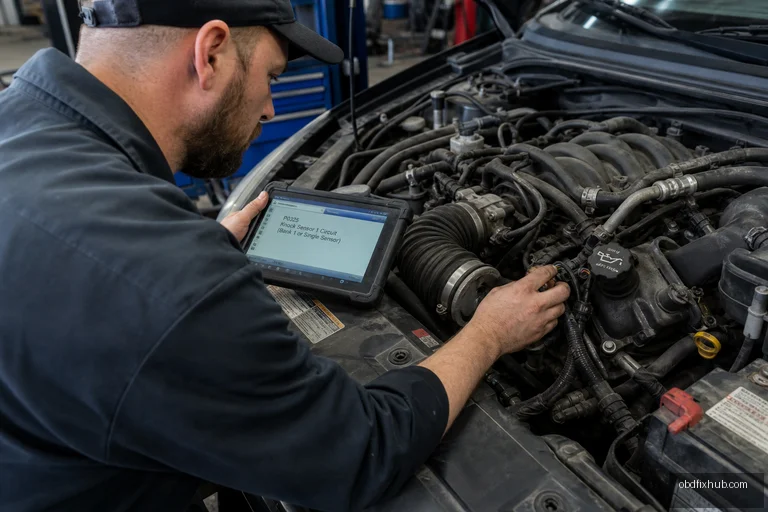
Search intent: informational. Drivers searching for the P0324 code usually want to know whether the fault is serious, what caused it, and whether replacing the knock sensor will solve the problem. P0324 means the engine computer has detected a fault in the knock or combustion vibration control system. The sensor itself may be defective, but wiring, connector damage, incorrect engine noise, poor fuel, timing problems, or a control-module issue can trigger the same code.
What Does the P0324 Code Mean?
P0324 is a generic OBD-II diagnostic trouble code defined as Knock/Combustion Vibration Control System Error. The powertrain control module (PCM) monitors the knock-control circuit and uses the knock sensor signal to identify abnormal combustion, commonly called detonation or engine knock.
When the PCM sees an implausible signal, an electrical fault, or a system response that does not match operating conditions, it stores P0324 and turns on the Check Engine Light. On some vehicles, the code describes a complete system fault rather than proving that the knock sensor has failed.
The exact diagnostic procedure varies by manufacturer. A General Motors vehicle, for example, may use different sensor wiring and test values from a Toyota, Ford, Hyundai, or Volkswagen. Always check the service information for the specific engine before testing resistance or applying voltage to the circuit.
P0324 Code Symptoms
Some vehicles drive almost normally with P0324, while others reduce ignition timing or enter a protective strategy. The most common symptoms include:
- Illuminated Check Engine Light
- Reduced engine power or sluggish acceleration
- Poor fuel economy
- Hesitation under load or during uphill acceleration
- Engine pinging or metallic rattling during acceleration
- Rough running, hard starting, or occasional stalling
- Failing an emissions inspection because the trouble code remains active
A stored P0324 does not always cause noticeable symptoms. In many cases, the PCM detects the fault during a self-test or under a specific combination of engine speed, load, and temperature that the driver rarely notices.
Common Causes of P0324
1. Failed or contaminated knock sensor
A knock sensor is usually a piezoelectric device mounted directly to the engine block. Oil contamination, corrosion, physical damage, excessive heat, or incorrect installation torque can make its signal unreliable. A sensor that has been overtightened may produce a distorted signal even if its housing looks perfect.
2. Damaged wiring or a poor connector
Knock-sensor wiring often runs close to the exhaust manifold, cylinder head, or other high-temperature components. Look for melted insulation, rubbed-through wires, oil-soaked connectors, loose terminals, and corrosion inside the plug. A wire may pass a quick visual inspection but fail when the engine moves under acceleration.
3. Unwanted engine vibration
The PCM can interpret abnormal mechanical noise as combustion vibration. Loose heat shields, broken engine mounts, a failing accessory bearing, piston slap, valvetrain noise, or an exhaust component touching the body can create misleading knock-sensor activity. Replacing the sensor will not cure a genuine mechanical noise source.
4. Real detonation or pre-ignition
Low-quality fuel, excessive carbon deposits, an overheating engine, incorrect ignition timing, a lean air-fuel mixture, or excessive boost can cause actual detonation. If the engine is audibly pinging, treat the combustion problem as urgent rather than simply clearing the code.
5. PCM software or internal fault
Some manufacturers have released software updates or technical service bulletins for false knock-control codes. A failed PCM driver or calibration issue is less common than a wiring problem, so the module should be considered only after the circuit, power supply, ground, and mechanical causes have been tested.
How to Diagnose and Fix Code P0324
The most reliable repair begins with diagnosis, not a parts cannon. A professional technician will normally follow these steps:
- Scan all stored and pending codes. Codes such as P0325, P0326, P0327, P0328, misfire codes, lean-condition codes, or overheating codes may reveal the underlying problem. Record freeze-frame data before clearing anything.
- Confirm the complaint. Note engine temperature, RPM, load, fuel level, and road conditions when the code sets. A fault that appears only during heavy acceleration requires a different test strategy from one that appears immediately after starting.
- Inspect the sensor and harness. Check routing, connector tension, heat damage, oil contamination, and signs of rodent damage. Make sure the sensor is mounted on the correct engine surface and tightened to the manufacturer’s torque specification.
- Test the circuit with the factory wiring diagram. Verify reference voltage, ground, continuity, resistance where specified, and short-to-ground or short-to-power conditions. Do not assume every knock sensor should show the same resistance; some systems require a specific signal waveform test instead.
- Check for mechanical and combustion noise. Inspect engine mounts, heat shields, exhaust contact points, accessory components, coolant temperature, fuel trims, and ignition timing. Listen for genuine pinging during a controlled road test.
- Check technical service bulletins and software updates. If the circuit passes and no mechanical cause is found, a PCM calibration update may be the correct repair.
- Repair, clear, and verify. After the repair, clear the code and complete the manufacturer’s drive cycle. A proper verification confirms that the monitor runs and the code does not return under the original conditions.
Do not replace a knock sensor solely because the scan tool displays P0324. On engines where the sensor is beneath the intake manifold, unnecessary replacement can add several hours of labor and still leave the real wiring or mechanical problem unresolved.
How Much Does It Cost to Fix a P0324 Code?
The cost depends heavily on vehicle design and the actual failed component. Typical U.S. repair ranges are:
- Diagnostic testing: approximately $75–$150
- Wiring or connector repair: approximately $100–$400
- Accessible knock-sensor replacement: approximately $150–$400
- Knock-sensor replacement beneath an intake manifold: approximately $400–$900 or more
- PCM programming or replacement: approximately $150–$1,500+, depending on the vehicle
Independent shops may charge less than dealerships, but the cheapest quote is not always the best value. Ask whether the price includes circuit testing, freeze-frame analysis, the required torque procedure, and a post-repair drive cycle. Parts prices and labor rates also vary significantly by engine.
Can You Drive With a P0324 Code?
Short, gentle driving is often possible when the Check Engine Light is steady, the engine is not overheating, and there is no severe loss of power or loud knocking. However, it is not wise to continue driving normally for weeks without diagnosis. If the vehicle is experiencing real detonation, the condition can damage pistons, spark plugs, bearings, or the catalytic converter.
Stop driving and arrange professional assistance if the Check Engine Light flashes, the engine knocks loudly, the vehicle misfires, coolant temperature rises, or power drops sharply. Avoid towing, hard acceleration, high RPM, and steep uphill loads until the fault is understood.
Is It Okay to Drive With a Knock Sensor Code?
It can be safe for a limited trip, but the answer depends on how the engine is running. A failed knock sensor may cause the PCM to retard ignition timing, resulting in reduced performance and higher fuel consumption. In another vehicle, the system may fail to protect the engine from detonation effectively.
Using premium fuel may temporarily reduce audible pinging in some engines, but it does not repair the sensor circuit or eliminate a mechanical fault. Do not use fuel additives as a substitute for testing, especially if the code returns immediately after clearing.
What You Should Do Next
Start by scanning for additional codes and preserving the freeze-frame data. Then inspect the knock-sensor connector and harness before buying parts. If the code returns after a repair, request a circuit test and a check for abnormal engine vibration rather than another automatic sensor replacement.
Frequently Asked Questions
Can a bad knock sensor cause P0324?
Yes, a failed knock sensor can cause P0324, but the code can also result from damaged wiring, connector corrosion, abnormal engine noise, combustion problems, or a PCM issue. Testing is needed to identify the true cause.
Will changing the knock sensor fix P0324?
It will fix the code only if the sensor is the failed component and the wiring, mounting, and engine condition are correct. On some vehicles, the sensor is difficult to access, so diagnosis should come before replacement.
Can bad gasoline trigger a P0324 code?
Poor-quality or incorrect fuel can cause detonation and may contribute to a knock-control fault, particularly under heavy load. If the code persists after refueling with the manufacturer-recommended fuel, inspect the electrical and mechanical systems.
How do I fix code P0324?
Scan all codes, review freeze-frame data, inspect the sensor and harness, test the circuit according to the factory wiring diagram, and check for real engine knock or mechanical vibration. Repair the confirmed cause, then clear the code and verify it through a complete drive cycle.
Bottom line: P0324 is a warning about the knock-control system, not an automatic instruction to replace the knock sensor. Diagnose the circuit and the engine noise source carefully, because an accurate repair protects the engine and avoids paying for parts that were never faulty.




