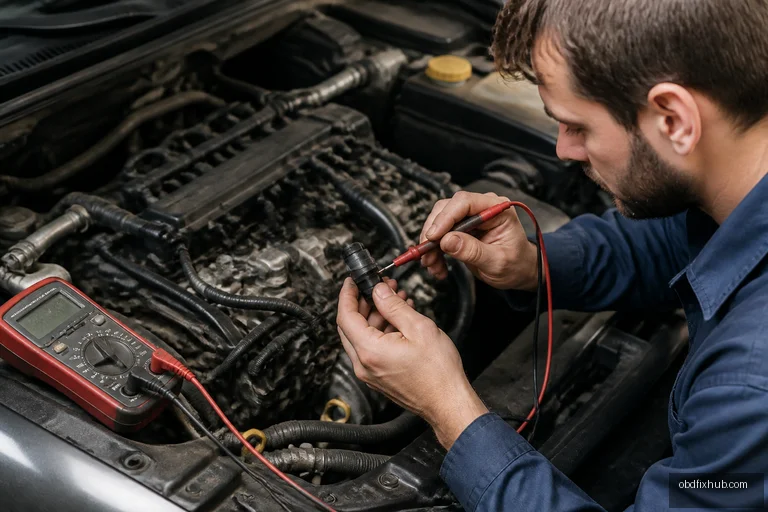
P0340 Camshaft Position Sensor A Circuit means the engine computer has detected a problem with the electrical circuit or signal from camshaft position sensor A. The fault may be caused by a failed sensor, damaged wiring, a poor connector, low voltage, or an engine timing problem. Replacing the sensor without testing the circuit is a common mistake and does not always fix the code.
What Does the P0340 Code Mean?
The camshaft position sensor tells the powertrain control module (PCM) where the camshaft is positioned during the engine cycle. The PCM uses this information to control fuel injection, ignition timing, variable valve timing, and sometimes the engine start-up sequence.
When P0340 is stored, the PCM is not receiving a reliable signal from the sensor designated “A.” On many engines, this refers to the intake camshaft or the camshaft on Bank 1, but the exact designation varies by manufacturer. A vehicle-specific service manual is the final authority, especially on V6 and V8 engines with multiple camshaft sensors.
P0340 Symptoms You May Notice
The symptoms depend on whether the signal is completely missing or only intermittently dropping out. A vehicle may continue to run with reduced performance, or it may crank without starting if the PCM cannot determine camshaft position during engine operation.
- Check Engine Light illuminated
- Hard starting or extended cranking
- Crank-no-start condition
- Rough idle or engine hesitation
- Misfires, poor acceleration, or reduced fuel economy
- Stalling when hot or during deceleration
- Reduced power or limp-home mode
- Unusual automatic transmission shifting on some vehicles
An intermittent P0340 is particularly easy to misdiagnose. For example, an engine may start normally in the morning but stall after the sensor connector becomes hot. Heat-related failures, oil contamination, and wiring that opens when it vibrates are frequent real-world causes.
Common Causes of P0340
1. Failed camshaft position sensor
Internal electronic failure is common, particularly on high-mileage engines exposed to heat and oil vapors. A sensor can pass a basic resistance test and still produce a weak or distorted signal while the engine is running, so resistance alone cannot confirm that the sensor is healthy.
2. Damaged wiring or terminals
Look for rubbed-through insulation, broken wires near the connector, corrosion, loose terminals, and wiring trapped under a bracket. The harness often flexes near the cylinder head, where vibration and engine heat can cause an intermittent open circuit.
3. Oil or moisture in the connector
Oil leaking from a valve cover or camshaft seal can migrate into the sensor connector. Water intrusion after engine washing can also disturb the 5-volt reference, ground, or signal circuit. A connector that looks dirty should be inspected for pushed-back terminals, not merely sprayed and reconnected.
4. Power supply or ground problem
A weak battery, poor engine ground, blown fuse, or shared sensor supply fault can create P0340 even when the camshaft sensor itself is functional. If other sensors show related codes, investigate the common power or ground circuit before replacing parts.
5. Incorrect mechanical timing
A stretched timing chain, jumped belt, damaged reluctor wheel, or incorrectly installed timing components can place the camshaft signal out of position. In this situation, the circuit may be electrically perfect, but the PCM sees a camshaft pattern that does not agree with the crankshaft signal.
6. PCM or aftermarket equipment issues
PCM failure is possible but uncommon. Poor-quality replacement sensors, remote-start systems, alarm wiring, and previous repairs that splice into sensor circuits can introduce signal interference or incorrect voltage readings.
How to Diagnose P0340 Correctly
Professional diagnosis begins with identifying the vehicle’s exact wiring diagram and sensor type. Some sensors use a three-wire Hall-effect design with power, ground, and digital signal circuits; others use a two-wire magnetic pickup that generates its own alternating-current signal.
- Confirm all stored codes. Record freeze-frame data and check for related codes such as crankshaft sensor, correlation, low-voltage, or variable valve timing faults.
- Inspect the sensor and harness. Follow the wiring from the sensor to the PCM. Check for oil, corrosion, melted insulation, stretched wires, and terminals that do not grip firmly.
- Verify power and ground. With the ignition on, measure the reference voltage according to the wiring diagram. Do not assume every sensor uses exactly 5 volts. Test the ground with a voltage-drop measurement rather than relying only on continuity.
- Check the signal while cranking. A digital multimeter may show a changing voltage, but an oscilloscope is better. A clean, repeatable waveform is more useful than a static resistance reading.
- Perform a wiggle test. Monitor the scan tool or scope while gently moving the harness. If the signal drops out, the wiring or connector is likely at fault.
- Compare camshaft and crankshaft data. If the sensor waveform is present but synchronization is incorrect, inspect timing-chain or timing-belt alignment and mechanical timing components.
One practical diagnostic clue is the engine’s behavior during cranking. If the scan tool shows no engine RPM, begin with the crankshaft position system and its power supply. If RPM is present but camshaft synchronization remains absent, focus on the camshaft circuit, sensor signal, and mechanical timing.
How to Fix P0340
The correct repair depends on the test results. If the sensor has no output and power, ground, and wiring are confirmed, replace it with a high-quality part that matches the vehicle application. Cheap sensors can create a repeat P0340 because their signal amplitude or timing does not meet the PCM’s requirements.
- Repair damaged wires using sealed automotive-grade splices.
- Replace loose, corroded, or oil-soaked terminals and connectors.
- Clean the sensor mounting surface and ensure the sensor is fully seated.
- Repair valve cover or seal leaks that contaminate the connector.
- Replace a damaged camshaft reluctor or timing component as required.
- Correct timing-chain or timing-belt alignment problems before installing another sensor.
After the repair, clear the code and complete a road test under the conditions shown in the freeze-frame data. A successful repair should be confirmed by checking that the monitor runs and that the code does not return during cold start, hot restart, acceleration, and idle operation.
Can You Drive With a P0340 Code?
Short trips may be possible if the engine runs smoothly, but driving should not be treated as harmless. A failing camshaft signal can cause stalling, hard starting, misfires, or reduced power in traffic. If the Check Engine Light is flashing, the engine is misfiring, or the vehicle stalls, stop driving and arrange a diagnosis.
P0340 Repair Cost
Costs vary substantially by vehicle and access to the sensor. A basic sensor replacement may cost approximately $100–$300, including parts and labor. Wiring repairs can be less expensive or more costly depending on accessibility, while timing-chain or timing-belt repairs can exceed $1,000. These are general estimates, not a substitute for a vehicle-specific quote.
Before approving a repair, ask whether the shop tested the signal, power, ground, and mechanical timing. A diagnosis that consists only of reading the code and installing a sensor is incomplete.
Key Takeaway
P0340 does not automatically mean “replace the camshaft sensor.” It identifies a problem with the camshaft sensor A circuit or its signal, and the root cause may be wiring, power, grounding, connector damage, mechanical timing, or the sensor itself. Start with a wiring inspection and electrical tests, then verify the camshaft signal against the crankshaft before spending money on parts.
Frequently Asked Questions
Is P0340 always caused by a bad camshaft position sensor?
No. A failed sensor is only one possibility. Damaged wiring, connector corrosion, poor grounds, low system voltage, timing-chain problems, and reluctor damage can all set P0340.
Can a bad crankshaft sensor cause P0340?
It can contribute to related symptoms and synchronization faults, but P0340 specifically points to the camshaft sensor A circuit. Scan data and waveform testing are needed to determine which signal is missing or incorrect.
Will replacing the sensor clear P0340?
Only if the sensor was the actual cause. The code must be cleared with a scan tool, followed by a drive cycle. If the underlying wiring or timing problem remains, P0340 will return.
How serious is the P0340 code?
It can be serious when it causes stalling, a no-start condition, or misfires. If the vehicle still runs normally, arrange a prompt diagnosis rather than continuing to drive indefinitely.




